Thursday, 13 August 2020

After a really nice spell of sunny, warm and dry weather we left Seward heading east for Prince William Sound. It wasn't far, but, we were in a hurry to get there to beat a coming SE gale. We made it in time, but, the rain started and it became really cold and wet. Even though it was still early August, we were hoping this wasn't a sign of things to come over the next couple of weeks we'd be cruising in the area. 

The pouring rain didn't deter these two sea otters from giving us a warm welcome.

We felt right at home when we entered the Sound through Port Bainbridge. The first night we anchored in Hogg Bay, Bainbridge Island. Next morning we passed by Bainbridge Glacier...

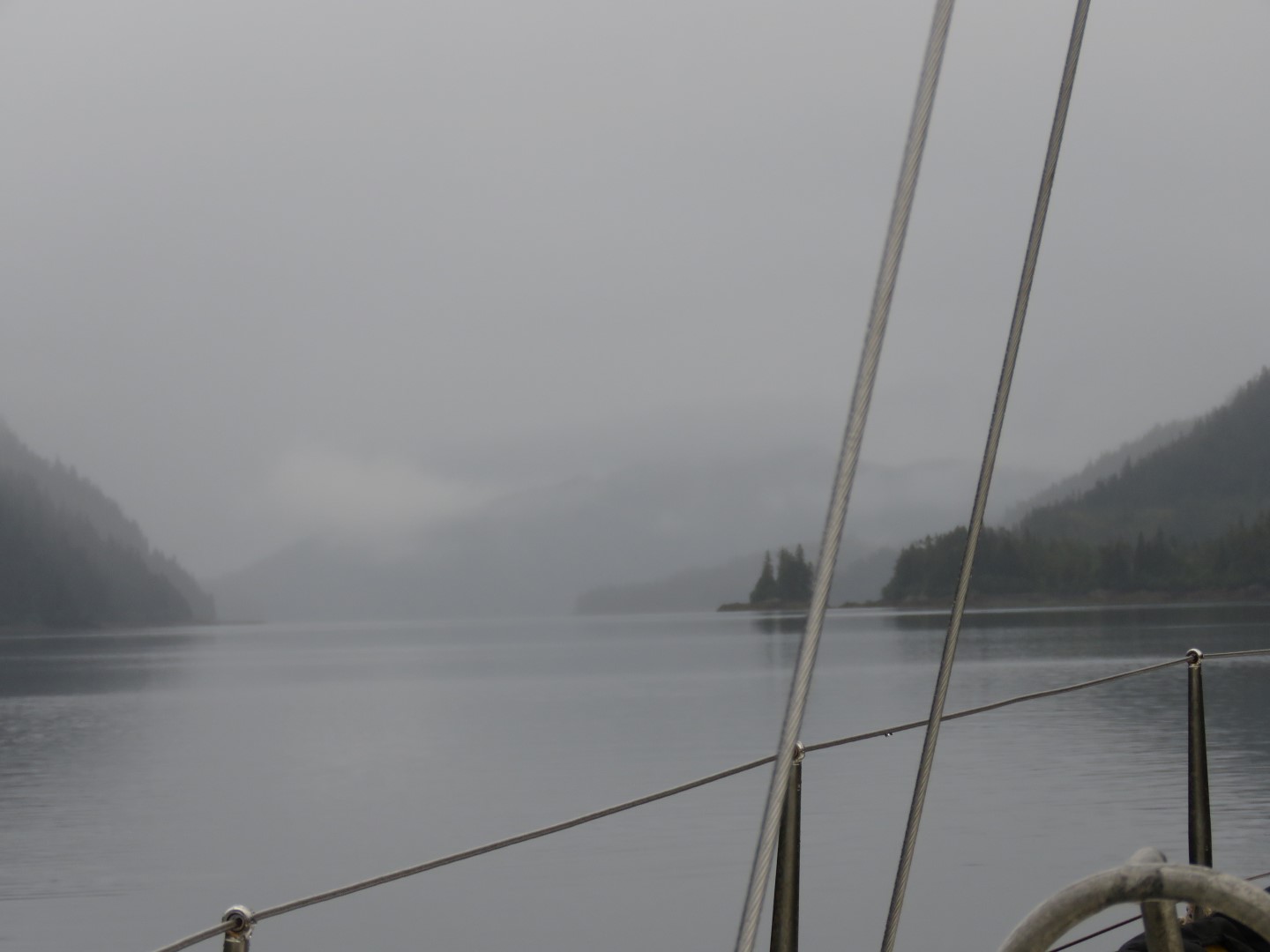
and then through a very scenic Bainbridge Pass! (what we could see of it in the misty, foggy conditions).
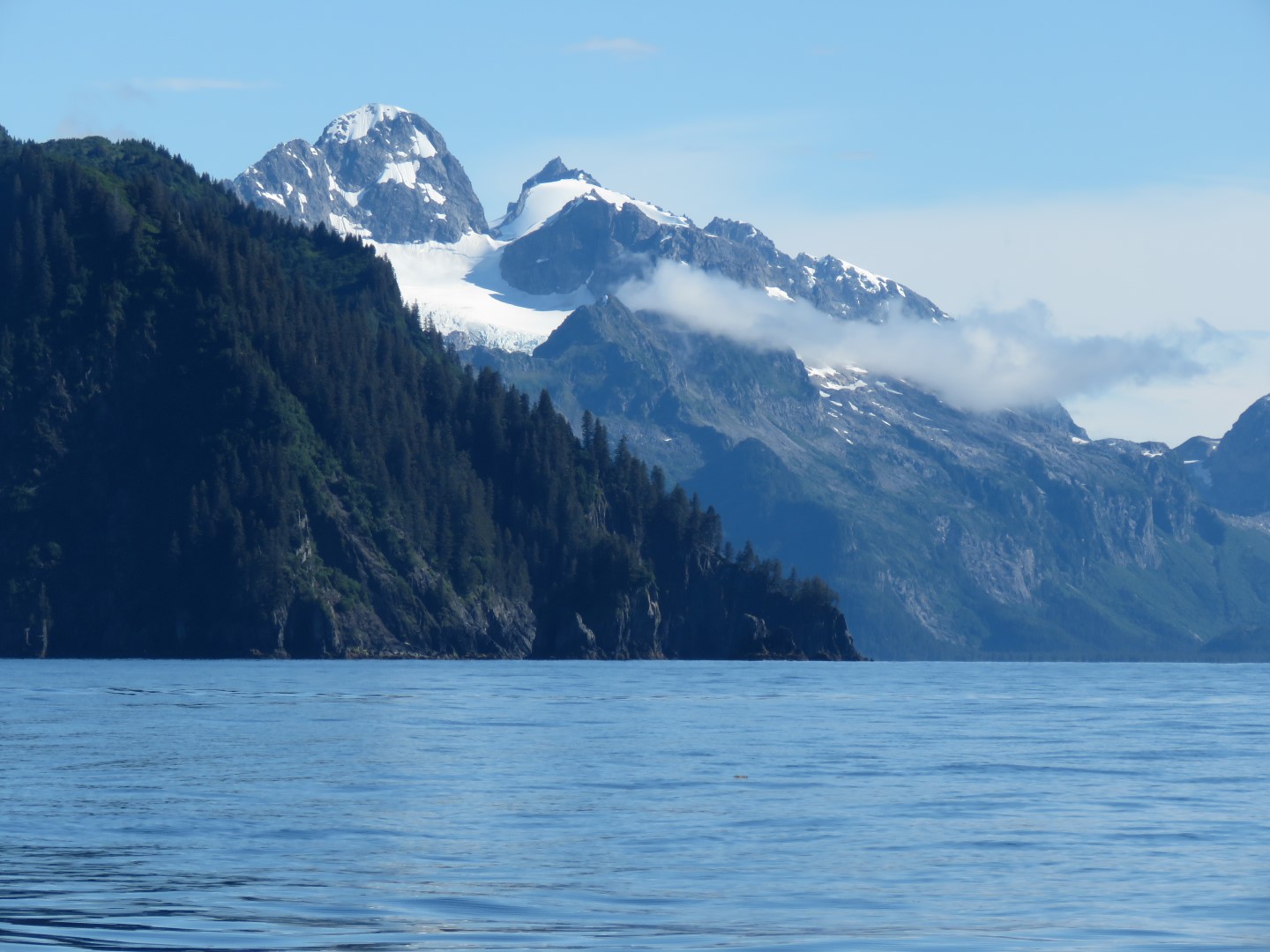
The weather soon turned for the better and the scenery became stunning.

The anchorages were easier and more secure than most in the Kenai Fjords. There were so many good ones it was hard to choose. One of our favourites was Nellie Juan Anchorage, right next to the Nellie Juan Glacier. It was a tiny, perfect cove, suitable for one boat. We tucked ourselves into it on a sunny afternoon. There was a rushing stream at the back of the anchorage, smooth rock walls and glorious views.


The next day dawned into another beauty and we took the opportunity to visit the glacial moraine and stretch our legs. We found a rushing salmon stream, full of struggling fish (and no bears, luckily, as we were on foot).

They were all heading upstream to this waterfall.

Nearby, the glacier was releasing lots of ice into another rushing river coming off the glacier face, the current was too strong to get up the river so we enjoyed a stroll among the beached 'bergy bits' (which is actually the scientific term for these smaller bits of ice) instead.

G, ever the pun master, came up with a new term, 'birdie bits', for bergy bits with birds on top!

We enjoyed many more great anchorages, but, we saved the best for last. We headed north to College Fjord, at 61N, the furthest north we'd be on this cruise. This is a major tourist destination with many tour boats, flightseeing trips etc. that access the fjord from Whittier. This year, we had the entire fjord to ourselves, only seeing one other boat, a tour boat that 'flew' past us at an unbelievable 32 knots, don't know what kind of engine was in there, but, wow!

We headed up to the end of the fjord, the ice was increasing in the approaches, but, we managed to dodge it easily. The air got noticeably colder as we got closer to the head of the fjord where there were two arms with a substantial glacier at the head of each. Harvard is one of the few advancing glaciers left, Yale is a retreating glacier, but, still has a solid face calving directly into the water. There was less ice in the Yale Arm so we headed up that way and anchored right at the head, directly across from the Yale Glacier. We were in a shallow area behind an island, so, most of the ice stayed away from us and we enjoyed the aquamarine, glacial-silted water with just seals and tiny seabirds for company. This was the view from the stern of the boat at around 10 p.m. Through the night we heard a number of thunderous booms from calving ice.

In the morning, we were sorry to leave this idyllic spot, but, we were starting to feel some time pressure as it was now nearing the middle of August. We want to be across the Gulf of Alaska by the beginning of September before the weather changes for the worse. So, we quickly moved on to the far eastern side of the Sound and the town of Cordova, which is only accessible by boat, or, airplane. It was greener on this side and we spent our last night at anchor in green and gorgeous St. Matthews Bay.


We'll only be in town for a few days to reprovision and get ready for our passage across the Gulf of Alaska, heading directly for Dixon Entrance and Canada! We should only be at sea for about a week.

Alaska has been a really wonderful cruising ground. What a summer we've had here, we enjoyed it very much. We only travelled about 700 miles, between Kodiak and Cordova, in three months. It was a motor cruise as there was no wind for sailing. Every night we anchored in a beautiful place and usually had it all to ourselves. 

We feel very lucky to have been able to cruise at all this summer with so many sailors stuck in ports around the world, either with their boats, or, without. To have been in such an isolated place was an added bonus for us, self-isolation and physical distancing weren't difficult to achieve at all, just a regular part of daily life. Now, as we head further south for the winter season, that may change, but, living on a boat is still a good place to be during these trying times.


 photo arrow.pngCONTINUE READING

Tuesday, 21 July 2020

As mentioned in the previous post, one of the things we loved about the Kenai Fjords was the abundant wildlife we found there. Even though it was late June, there was still lots of young about, including this oystercatcher chick.


We almost missed seeing these young seal pups, they blended in so well with the rocks they were sprawled on.


We saw mature seals on the ice near the Northwestern glacier.


Seeing puffins is always a delight. Here there were tufted puffins, new to us.


In the water there were many of these incredibly beautiful jellyfish to be seen.


The bears in this area were now black bears, no longer the extra-large Kodiak brown bears we saw west of Cook Inlet.


We saw this bear swimming across a large bay.


There was evidence of bears everywhere...


Sea otters have to be the most endearing creatures. They look so relaxed just laying there on their backs. We learned that when they wrap themselves in a piece of kelp like this, it's to anchor themselves to the bottom, so they don't float away while they are eating/sleeping.


We really wanted to see an otter 'raft' where large numbers of otters somehow attach themselves to each other and float, with their young on their stomachs, in a large group. We did see a raft with maybe 25 otters, in Otter Cove, but, didn't want to get too close and disturb them, so, no pictures.

And finally, another eagle shot. This was taken in Kodiak, but,  I couldn't resist publishing it here, that glare is just chilling.


 photo arrow.pngCONTINUE READING

Monday, 20 July 2020

We spent three weeks in Kodiak, recovering from our less than ideal passage from Hawaii to Alaska and getting ready for the next leg of our adventure, cruising the Northern Gulf of Alaska along the Kenai Peninsula. We knew we wanted to revisit Shelikof Strait, which we'd last visited in 2015 after arriving in Alaska from our North West Passage transit and also see Prince William Sound. What we weren't sure about was whether we wanted to visit the Kenai Fjords. After talking to other cruisers and reviewing a cruising guide to the area (Exploring Alaska's Kenai Fjords, David Wm. Miller) we decided to go. Are we glad we did! The Kenai Fjords and its national park, has to be one of, if not the best, cruising ground we've ever visited. It had all the elements we look for and love, spectacular scenery of mountains, glaciers and waterfalls, uncrowded (mostly empty) anchorages within easy reach of each other, abundant wildlife, mostly benign weather and not too many tour boats.


But, I'm getting ahead of myself, first, the boat needed some work. We had to fix the autopilot which was a fairly simple job once we had located the right parts for the drive coupling. G worked very hard to relocate the hydraulic pump so that it is now more accessible for the next time it needs rebuilding.

Also, after relearning what being wet and cold in the cockpit (hand-steering 800 miles without an autopilot on our last passage) feels like, after the last few years in the tropics, we also took the opportunity to turn on the heat ready for the wet and cool Pacific northwest climate we're anticipating this fall and winter. We refurbished the marine diesel heater that was already on the boat, but, had been disconnected. It now works really well, almost too well. We've been really enjoying it on the few dismal, rainy days we've had. We also installed a hydronic heater, a Dickinson Radex2 that cycles the Yanmar engine's coolant through pipes into the cabin where fans distribute the heat. What a treat to come down from the cockpit to a warm, dry and cozy boat, at least when motoring which we expect to do a lot of here.

We set off from Kodiak, through Whale Passage and had a rough crossing of Shelikof. We were aiming for Hallo Bay on the mainland side where we'd hoped to find Kodiak bears. This time of year the bears are eating vegetation and clams and this was supposed to be where we'd see them. Later in the year, when they're feasting on salmon, they move to other areas. We spent two nights there, adjacent to the Hallo Glacier which was so immense it looked surreal. The anchorage was open and fine during the day, but, at night the wind piped up and we found ourselves on anchor watch with 35 knot winds. We thought it was just a fluke and decided to stay a second night so that we'd have an opportunity to go to shore in the dinghy. It turned out to be too rough for the dinghy and we had a second night of 35 knot winds at anchor, which must be regular, katabatic winds at this location. We left the next day and cruised as close to the shoreline as we could get and we did see bears, there were a few huge specimens hanging around on the beach, too far away to get good photos, but, still exciting to see them.


We crossed back over Shelikof and passed by the sometimes problematic entrance to Cook Inlet (Anchorage) without incident, it was mostly calm and relatively windless. We started into the fjords area. The landscape started off green and tranquil.


Then, snow-capped mountains appeared...


...followed by the raw elements of ice, snow and rock. We particularly liked the Northwestern Glacier area. It truly was, as the cruising guide said, "...a spell-binding glacial enclave...filled with valley glaciers, towering cirques, hanging valleys and three tidewater glaciers.".


From the Northwestern Glacier, we moved to the Aaliak Glacial Basin, in the next fjord. It didn't have quite the appeal of the Northwestern, but, had its own charms. We anchored for a couple of nights in Abra Cove, right under a 1,000 foot vertical granite wall. For scale, look very closely at this photo, you can just make out Gjoa at the bottom of the cliff, towards the right.


There were numerous waterfalls cascading down the wall into a small, deep lagoon at its base. We took the dinghy for a little tour along the lagoon.


In front of us, we had an incredible view of the Aaliak Glacier face. Although we were probably 2-3 miles away from the face, we could hear loud, thundering booms in the night, huge ice chunks calving off. The sunset, at 11 p.m., over the glacier was amazing.


We spent a couple of quiet weeks in the fjords and thoroughly enjoyed them. The weather was mostly superb: dry, sunny and warm, but, not too warm. There wasn't much wind, but, it didn't matter, the distances between anchorages were short and we just enjoyed puttering along under motor, enjoying the view.

It was sometimes tricky to get the anchor to set as most anchorages were very deep. Often the anchor would be clinging to a narrow ledge along the shoreline. The conditions were very benign and we always chose a very sheltered anchorage, so, had no issues thankfully. Mostly we had the anchorages all to ourselves, but, we did have to share a few times. There were 3-4 other boats following the same general route that we leapfrogged with. This Swiss boat also made the passage from Hawaii to Alaska a few weeks after us and much more quickly than we did!


Next, we headed towards the town of Seward. On the way there, the seascape was very different, dotted with many islands, rock spires and arches, just as entrancing as the glaciers.


In the next post, I will show you some examples of the wonderful wildlife we encountered during our cruise through this amazing area.
 photo arrow.pngCONTINUE READING

Sunday, 14 June 2020

Arrival: Monday, June 9
Kodiak, Alaska
57 47.2N / 152 24.6W

Sailed: 3035 miles (from Honolulu) VMG: 2300

As mentioned in our week 2 post, we knew we were in for a seriously long passage due to the many lengthy calms we were experiencing. In the end, we were at sea 33 days, but, here we are now, in Kodiak Alaska! The nights are very short this far north and the eagles are abundant. These pictures were taken at 9 p.m. The weather is cool, but, sunny and we are enjoying the change from a too-hot (for us) Hawaii.


The winds cooperated in week 4 and we started off making good progress. The next day an autopilot failure soon  put an end to that. All of a sudden, the pump started making some strangled noises and then all went quiet. Before we left, we had purchased a new autopilot motor from England as a spare and had extra brushes custom-made for the old motor. Along with our other spares and the two fully redundant electronic course computers, fluxgate compasses and rudder reference units, we felt we were well-equipped to deal with a failure. We did some diagnostics, replaced a few parts and came to the conclusion that it must be the pump's solenoid valve, a single point of failure that we didn't have a spare for. The motor seemed to be running fine, it just didn't engage the rudder, so, we decided that replacing the motor with its spare was probably wasted effort. At this point, we just wanted to get on with it, so, decided to hand-steer the last 800 miles into Kodiak. This wasn't a trivial effort, but, we knew we'd get there eventually. When we bought this boat, it was, surprisingly, lacking a proper steering compass, so, were very glad that we had installed one.


We did one hour on, one hour off shifts staring at this compass card, trying to keep to our course. It was very cold in the cockpit at night. After some experimentation, we found that actually, if you balance the sails and rudder properly this boat will self-steer very well. Not all the time, mind you, but, at least you can take your hands off the wheel momentarily. We did have a couple of really long runs of self-steering. On one occasion, motor-sailing, it went overnight without us having to touch the wheel once. Such intense concentration is very tiring and we did stop a couple of times to take a rest and warm up. Our course was a little wobbly, the autopilot can steer much more accurately than we can, but, our forward progress was good.

After we got to Kodiak and pulled the pump apart, it was very obvious that the drive coupling was the problem, not the solenoid. It was just worn out. The 'lovejoy' had no teeth left, the motor was running, but, it wasn't engaging the pump. If we'd just taken a few hours to swap out the motor while at sea we wouldn't have had this hand-steering ordeal. But, looking on the bright side, we now know how to balance and sail this boat much more efficiently.

Another event occurred that slowed us down even further. Our Yankee (type of headsail) furler line snapped. We were able to quickly pull the sail down and lash it to the deck, adroitly avoiding dumping it into the water, but, this meant that we couldn't easily use one of the three sails we usually fly for optimum speed. It began to feel like we'd never get there! It was a moot point anyway as the wind soon went very light and we motored the last 130 miles into Kodiak. There was a low approaching and we didn't want to spend even one more night at sea.

Kodiak is a very busy fishing port, a working town. It does the fourth largest catch in the country, mostly salmon, which is now in season. We are in St. Paul Boat Harbor, one of two marinas which hold about 700 fishing boats. We are the only visiting sailboat. Boats are coming and going at all times of the day and night to the many canneries here in town. It's a bustling place. We'll be here for a couple of weeks at least, waiting for some boat parts to arrive. After that we'll either be on a mini-Alaskan cruise (hopefully), or, headed straight for Dixon Entrance and Canada. It all depends on whether we can extend our US visas and/or the Canada/US border opens again on June 21.


 photo arrow.pngCONTINUE READING

Wednesday, 27 May 2020

noon local - Wednesday, May 27, 2020
41 32.5N / 150 05.1W

Week 3 of our passage from Hawaii to Alaska was another disappointing mileage week. We sailed 687 miles which maybe isn't too bad but made only 330 miles good to our destination as the winds just weren't from the right direction. This grand total even included 100 miles of motoring when the wind went to zero for a few days in the middle of the week. At least we are now past the 1/2 way point, but, with 946 miles still to go we are another week to ten days away from arrival.

We started the week hove-to just taking that glancing blow from the low pressure system I wrote about last week and ended it hove-to again, for two days, to deal with a second low which came in right behind it. This time it wasn't just a glancing blow though as, unfortunately, we had F8 (gale) to F9 (strong gale) conditions, gusting up to 50 knots, with 5 metre seas. We hove-to to avoid getting further north nearer the centre of the low which had 60 knot winds. Luckily, we didn't see those.


It looked like it might be ok for a departure this morning, it had dropped to 25-30 knots and the seas were down quite a bit. So, at first light (0400 in these parts) we set off. We're now hard on the wind sailing close-hauled at around 6 knots, almost on course. There's a fair amount of spray over the decks as we are banging into the still high seas. At least the sun is shining and we're moving, mostly in the right direction. It sure beats the past two days spent laying in our sea berths, watching the wind anemometer, wondering how bad will it get, should we have deployed the drogue, should we have done, or, not done this/that etc...

Between the two low pressure systems, we had no wind to speak of. The sea was a flat, oily, mirror calm. We motored for a while and happened upon another small sailboat, just twelve miles away from us. We spoke on the VHF and Richard informed us he was 35 days out from Hawaii. At that point, we were only on day 17, so, that made us feel better. He actually has further to go than us too as he was heading just north of Dixon Entrance, another 300 miles or so further than our due north landfall. We wish him fair winds.

The winds are looking good for the next week, both in direction and velocity. There is one more low pressure system that we may encounter about a week from now, but, that forecast could easily change. Right now it doesn't look as strong as the one we just got through, so, fingers crossed we miss it and/or it won't be anything to worry about.

----------
Sent via SailMail, http://www.sailmail.com
 photo arrow.pngCONTINUE READING

Wednesday, 20 May 2020

noon local - Wednesday, May 20, 2020
36 20.1N / 156 49.6W

Week 2 of our passage from Hawaii to Alaska was another disappointing mileage week. We only sailed 582 miles making just 408 good to our destination. This total even included a day of motoring when the wind went to zero. We had one good wind day. The rest of the time the wind averaged around five knots. We'd hoped to be 2/3 of the way by today, but, unfortunately we aren't even half-way yet, still 171 miles short. It always feels better once you're past that 1/2 way mark. As it is, unless we can make better time in the days ahead, this will end up a seriously long passage and cut into our cruising time in Alaska.


The "North Pacific High" is known to settle over this area as a huge, slow-moving high with calms and light winds, but, it's not here yet. It probably won't start to move in for another month. There are still lots of low pressure systems, with significant wind, all around us, somehow we've ended up sailing in a high pressure trough between them. Normally, that's a good thing, but, you still need wind to sail and more than five knots would be good!


As mentioned in last week's post we took a glancing blow from one low pressure system, it was only about twelve hours and easy to deal with, just a little uncomfortable. Unfortunately, there's another one heading our way which we'll be in the middle of come Saturday/Sunday. We'll probably be altering course a bit to try and avoid the worst of it, thus, delaying our progress even further. Oh well, we'll get there eventually, we have lots of food/water and fuel. We have about a 1,500 mile range with our fuel capacity of 1,200 litres. As we're only about 1,270 miles from our destination, we could theoretically motor the whole way if we had to, but, where's the fun in that.

The weather has started to get a little cooler now, around 16C and we're enjoying the change. Fleece tops and long pants have made an appearance. Our down duvets, freshly laundered in Hawaii after a long hiatus spent squashed into a cupboard, are on standby.

We've seen no wildlife whatsoever, no whales and only a couple of dolphins way off in the distance. We're seeing quite a bit of plastic pollution in the water, maybe 2-3 pieces a day, doesn't sound like much, but, we're used to not seeing any in other places/oceans. Surprisingly, given our remoteness, there are a lot of ships around. They seem to be on a route between the US west coast and China/Japan. One of them called us up around 4 a.m. (this is very unusual, first time ever actually) to ask us if we were ok as our erratic course and speed of 1.9 knots didn't seem right. Well, yes, we answered this is the best we can do with the light winds. They're usually steaming along at around 16 knots. Nice of them to inquire though! Also good to know they are picking up our AIS signal from a long distance away.

Speaking of remoteness, we have to be in one of the most isolated sea areas of the planet. We are 1270 miles to Alaska, 930 miles to Hawaii, 1618 miles to San Francisco and 3005 miles to Tokyo.

----------
Sent via SailMail, http://www.sailmail.com
 photo arrow.pngCONTINUE READING

Wednesday, 13 May 2020

noon local - Wednesday, May 13, 2020
30 22.6N / 162 52.1W

It's not that often that you get this close to a pelagic seabird. Usually, they're off in the distance doing flight cartwheels. They're a joy to watch and actually, out here in the big blue desert, they're often the only thing moving. It always lifts your spirits to see them. On day six of our passage from Hawaii to Alaska, it was windless with a totally flat sea to match. Without much wind for flying, the birds were bobbing around the boat instead. Beautiful to see them so close up. We don't have a bird book aboard, so, don't know which kind they were. In flight the wingspan looked to be around two metres!


The first four days of the passage were typical tradewind conditions, around 20 knots from the NE blowing constantly at the same velocity and direction. We didn't touch the sails for four days. We've only had conditions like this once or twice before, so, it was a joy to start the passage this way. The wind soon died. Days 5-6 were spent moving at about 1-2 knots, but, we weren't complaining, at least we weren't stopped dead with the sails slatting. Overnight on day six we decided to stop for a while. There was a large, deep and nasty low-pressure system hovering over us. We had been watching it come towards us since day 1 and knew we would intersect at some point. We didn't want to get in the middle of it. It looks like we'll get the worst of it overnight tonight, but, it should only be a glancing blow along its bottom edge. After that, it's looking good again for getting more northing in.

Due to the calms, it wasn't a great week mileage-wise, but, not too bad, we've had worse. We sailed 680 miles, 516 miles were good to our destination (Kodiak), which started off 2,200 nautical miles away, only 1,684 to go. We'll be leaving the tradewind belt soon and move into an area where westerly winds prevail. In that area we will be able to travel more on the rhumb line, so, will hopefully make up some time.

Due to the light conditions, week 1 was relatively drama-free. There's always something though and this week was no exception. We use our generator a lot on passage and on day 4 (late in the evening of course) it just wouldn't start. It reported a 'fuel supply problem'. We spent three hours changing filters everywhere we could think of, bleeding injectors, manually priming the fuel lines, inspecting fuel pumps and starter motors etc...etc. Nothing worked. Then, G decided to use his 'magic wrench'. This is a tool that everybody should get. It's maybe not as good as a 'sonic screwdriver' (Dr. Who's favourite tool), but, this is the fourth time it has saved the day for us. You operate it by taking a medium-sized wrench and whacking the offending object as hard as you can with a short, sharp blow. One whack to the fuel pump and away it went. It has been running flawlessly ever since. In the past it has worked on our autopilot pump twice and our Yanmar starter once!

----------
Sent via SailMail, http://www.sailmail.com
 photo arrow.pngCONTINUE READING

Saturday, 11 April 2020

I hadn't planned such a long hiatus from writing in this travel journal, but, here we are, a full three months since my last post. Our stay here has to be divided into 'before virus' and 'after virus' parts. 'Before virus' we had very mixed feelings about being here, more on that a bit later, but, 'after virus', we are very happy to be here and very grateful. Things could be a lot worse and are for many cruisers still out there trapped in various places around the globe. We have the good fortune to be sitting this pandemic out on the most remote landmass in the world, thousands of miles from anywhere and well away from the mass devastation, both economic and health-wise, being wrought elsewhere.

Before arriving in Hawaii it seemed very difficult to get any reliable, up-to-date information on marina availability and cruising conditions here. We later learned, from a local, about Noodle's Notes, a fantastic free resource where you can obtain a .pdf copy of the cruising guide we wished we'd had before we got here. Bill "Noodle" Leary, the author, has this to say about sailing in Hawaii:
"Hawaii can be a challenging place to sail. The channels between the islands are wide and rough, small boat harbors are scarce, crowded, dilapidated and good anchorages are over-regulated, seasonally protected, and scarce."
He was correct on all counts, particularly about the small boat harbors. We ended up at the Ala Wai Boat Harbor, in Honolulu, the largest of the state-owned marinas. You can see the masts in the centre of this photo taken from Diamond Head (one of the few hikes we were able to do before the lockdown started).


The location just can't be beat for convenience. We are at the western terminus of Waikiki beach, adjacent to the Hilton Hawaiian Village complex. Every Friday night (before virus) at 1945 we were treated to a spectacular fireworks show viewed right from our cockpit.


We are just a short walk from the Ala Moana Beach Park (where police with loudspeaker-equipped drones are now enforcing stay-at-home rules) and adjacent to that, the Ala Moana Shopping Centre (closed now), the largest mall in the State. We are also within walking distance of all that Waikiki has to offer, from high-end, designer, shopping (not a draw for us) and great restaurants (now offering only take-out), of which we've taken good advantage, to a boardwalk stroll along the beach for evening walks. Many of the hotels have lush, torch-lit gardens.


The Japanese are the biggest tourism visitors here and their influence is everywhere, from Japanese food courts, to bilingual signage. We've been experimenting with Japanese food and very much enjoyed a visit to an Udon noodle house where they make the noodles, from scratch, in full view. Delicious and very reasonably-priced.


The bus service was excellent (much reduced now and only for essential workers) and we settled in to our boat job list. The weather was cool and rainy during January which was a very welcome respite from the oppressive heat we had endured in French Polynesia.

The location was the best part. The marina was the worst part. The rules and regulations were the most onerous we've encountered anywhere and not cruiser-friendly. Before we could get a permit to stay they made us do a 'buoy run' to prove that we were seaworthy (it didn't matter that we'd only just sailed over two thousand miles to get there), we had to have a boat inspection not only by the marina, but, also by the Coast Guard who followed us in from our buoy run. We also were informed that as of a month ago, the rates in the marina had tripled from what we'd been expecting. We were going to be paying more for a berth here than anywhere else we'd ever been. There was nowhere to anchor other than in an industrial area near the airport, so, we just accepted the conditions. It would have been a bit more palatable if the facilities had also been as world-class as the rates, but, they were far from it. The washrooms/showers are filthy, so well-used and broken-down they are beyond cleaning. There are rats and cockroaches scurrying everywhere. The docks are dangerously dilapidated and have no security. The water is full of floating garbage. A boat near us was boarded one night by a very disturbed man who insisted he had to 'leave this island, right now, before 'they' got him'. Five police officers had to come to subdue and remove him, very scary for the people aboard. The numbers of homeless, or 'residentially-challenged'  (as they are called here) people is shocking. There are tent encampments everywhere, in the parks and even right on the sidewalks. Many of the occupants are obviously mentally ill. We've seen open drug-taking and deal-making. When you're here for more than a one-week vacation and venture away from the tourist areas, the glaring social problems make it obvious that Hawaii isn't a paradise for all.

Bad, yes, but, we only planned to be here for four months and just got used to it. The flowers started to bloom and the sun shone most days. Then, the virus arrived. Hawaii was slow to implement restrictions. It seemed obvious to us though that their tourism industry put the islands at a very high risk. There are ten million visitors here every year and 30,000 fly in every day from all over the world. It seemed obvious that the huge visitor influx needed to be stopped. Many locals agreed and just before the lockdown began there were convoys of honking vehicles with signs like 'tourist go home'  and 'if you love us, leave' plastered all over them. They drove up and down the two main tourism streets and it wasn't a good feeling. Anyway, the government soon acted and we have been under a 'stay-at-home' order and curfew for a few weeks now. We only go out once a week to grocery shop. The marina is so quiet it has become much more pleasant. We can even hear birdsong instead of amplified lounge singer music from the hotels. Oahu only has a permanent population of about one million. As of this writing, April 11, there are less than 500 confirmed cases and seven deaths. So, fairly low risk for the moment and we are thankful. We are disappointed that we won't be able to do any touring, but, compared to what others are suffering, we're not complaining.

We did get a few outings in before the lockdown. This is the view from the Makapu'u Lighthouse Trail.


A little out of town, we visited Sandy Beach (before lockdown).


Some of the birds here are very intriguing. This one, which looks a smaller version of a northern cardinal, actually isn't. It isn't a native bird, having been introduced from South America.


 photo arrow.pngCONTINUE READING

Saturday, 4 January 2020

Monday, Dec 30
21 17.2N / 157 50.4

Week 3 of our passage from Rangiroa, French Polynesia to Oahu, Hawaii was not a 'fun' week and we were very relieved, after 23 days at sea, to have this iconic view of Diamond Head and Waikiki Beach in front of us. Another passage complete, we had sailed 2465 miles to make 2252 good.


In our last post I mentioned that we had 'left' the doldrums. I now take it back, we hadn't left the doldrums at all, they do move and were just a bit further north. Once we hit 6N we got the full treatment. It started with a lot of yellow blobs (squalls) showing up all over the radar screen. We continued on, dodging where possible and dealing with the gusts when not possible to dodge. The blobs started to reform and eventually merged into one huge blob completely surrounding us. We reduced sail as it was gusting into the 30's. It got quite rough and we eventually hove-to in order to clean up the mess in the galley. At some point, a dish had wedged itself against the usually very sturdy latch on the inside of our china cupboard and opened it, sending most of our china flying across the galley to hit the opposite wall and shatter into pieces. We lost about 1/2 of it. We sat there for about four hours to let the worst of it cross over us. We got underway and it actually got worse the next night (it always happens at night), Christmas Eve, with gusts now into the 40's and steady F8 winds. We have dealt many times with gale-force winds and with squalls, but, we've never really had the combination of the two which was a different animal. It was hard to know what to expect, we'd see a squall coming and maybe there were going to be big gusts and maybe there weren't, the anticipation became very wearing.

We got to about 11N on Christmas Day and got a present as the squalls abated and blue skies returned. The next few days were excellent with great speed and long daily runs. Then, the wind died to nothing after a few hours of going between 13-30 knots every ten minutes. We motored for a while until the wind picked up again. We were on the final stretch into Honolulu and counting down the hours. The wind was supposed to drop away at midnight and we were anticipating a motor in for the final leg and an early morning arrival. Then, when we were about 50 miles out an isolated squall popped up with no notice, lots of rain and winds 35 again, we hove-to and thought we might have to spend a further night at sea, what a disappointment, but, after a few hours, winds dropped into the mid-20's and on we went arriving at 1500 into the Ali Wai Yacht Harbour, just in time for New Year's Eve celebrations the next day. We'll be here until mid-May when we'll head off for Alaska. We'll, of course, be doing boat jobs, but, hope to fit in a few tourist activities as well.
 photo arrow.pngCONTINUE READING