Showing posts with label Miscellaneous. Show all posts

Friday, 28 December 2018

The New Year is always a time for reflection, a look forward and a look back. Last year we started keeping a collection of the witty and/or interesting signs that we came across in our travels during the year. Signs can often be a blight on the landscape, but, they can be entertaining as well. Sometimes, the best ones are seen on-the-go and you can't capture them, but, maybe, you'll still find something in this collection from 2018 that will raise a smile. Happy New Year!

This one was seen in Wales.


It took us a long time to figure out what a 'sticky beak' is. In Australia, it's like a 'nosy parker', or, someone who sticks their nose in where it's not wanted


A few more Australian specimens. The water looked very inviting at this spot, but, this scary sign makes it clear you wouldn't want to go in.


An historical reproduction sign.


Also in Australia, in traffic, we saw a rather politically incorrect bumper sticker: 'this car is made with spanners, not chopsticks'. Hmmm.....

In the UK, signs had a lighter touch. This one has a polite 'sorry' preface. In any other country, it would probably read 'NO CAMPING!'


Only in the UK would you find 'thatcher' as a profession.


Brits also have a unique sense of humour, we laughed at this boat name.


We couldn't figure this one out. What's a 'car trap'? Guess it means 'no entry' for cars.


 photo arrow.pngCONTINUE READING

Saturday, 6 January 2018

Since we purchased our current boat, in May 2017, the steep learning curve and maintenance issues have kept us so busy that there wasn't a lot of time for blog updating. Thus, the page on the site entitled 'THE BOAT' (on the horizontal menu bar across the top) was severely out-of-date. I've now updated it and changed the name to 'THE BOATS' as it contains information on all five of the boats we've owned. You may want to take a look? Here's a pic of our very first boat, "Cygnet", an Alberg22 purchased in 2005.


Also, I was never happy with the 'FIND GJOA' page either. What I'd really like to be able to show readers is a map that continually updates our real time position and keeps a historical track based on AIS data (which is generated from our AIS transponder and doesn't require any manual intervention). I know I can do something similar using maybe a SPOT device, or email, to report position with a subscription to various services etc., but, these all cost money and/or manual intervention and I haven't found one yet that offers a simple, cost-effective (i.e. free), hands-off solution that I like (any suggestions are welcome).

In the past I've manually moved our historical tracks from our chartplotter and loaded them to Google Earth and that is what I have been showing. Unfortunately, this requires a lot of manual effort and was never suitable for uploading when at sea. Recently, I realized I could embed a map from www.marinetraffic.com which would show our current position, from real time AIS data, when we are close to a shore-based station and when offshore in remote areas, possibly by satellite collection as well. I've now added this map to the FIND GJOA page. It's not great either, but, may be interesting to look at when we're underway again...
 photo arrow.pngCONTINUE READING

Sunday, 31 December 2017

The end of another year is upon us and I'm planning to start a new annual, end of year tradition with this post. Last year (2016), I published a post entitled Signs-Part I with photos of signs that we came across in our travels that had either made us laugh, think, or, just generally intrigued us. Often, the best ones go by in a flash if we're in transit, so we can't get a photograph, but, here are a few we came across in 2017 that may amuse you.

Don't remember where we came across these three...


The next four were in New Zealand...


One from the USA...


and a few from Canada...


This one isn't a 'sign', but, it definitely brought a smile on a woodland walk...

This one, seen on a park bench in Revelstoke BC, was a little unusual in that it didn't commemorate the dead as is usually the case with plaques on sponsored benches, but, expressed thanks to a place and community that obviously meant much to them. A few simple words, but, so evocative it really tugged at the heartstrings.


 photo arrow.pngCONTINUE READING

Saturday, 19 August 2017

I first started programming computers, in high school, in 1968. We started with Fortran, on an IBM 1130, in math class and moved on to COBOL (common, business-oriented, programming language, I can't believe I remember that mnemonic, it's amazing the stupid things that stick in your memory) from there. It's been a love/hate relationship with machines ever since. To be honest, it was mostly a hate relationship, but, a long business career in IT (information technology) paid the bills along the way, led to an early retirement and this cruising life.

Photo By Martin Skøtt - Flickr: IBM 1130, CC BY-SA 2.0, https://commons.wikimedia.org/w/index.php?curid=16327576

Working mostly for very large, global corporations, on enterprise-wide systems meant that there certainly wasn't ever much 'fun' in the software we worked on and definitely not much personal utility either. All the early promise and hype about personal computing seemed rather hollow. Now, however, I'm starting to see some of that early promise being realized with apps that are not only 'fun', but, really useful as well. Although I'm very late to the party and still resist some aspects of social media (I'm not on Facebook or Twitter) I have taken baby steps into the iPad app market. Here are a few of the apps I'm using. They are all either free, or, are very reasonably priced. Maybe you'll find some of them useful as well. Most of them require that you have a GPS-enabled iPad.

1. Navionics Boating App - this app, along with downloaded Navionics charts and the iPad's GPS allow you to use your iPad as a mini chartplotter. It works really well and provides a great backup to your main chartplotter system. The charts are very reasonably priced compared to charts meant for purpose-built plotters. It's also fun to use on ferries and/or cruise ships to follow along the route you're travelling.

2. SkyGuide - this app shows you a map of the night sky at your current location (or a location you choose). You can line it up with what you're looking at in the sky over your head and it will identify the stars and constellations etc.

3. maps.me - this app has proved invaluable on many occasions. Before leaving on a trip, just download the maps for areas and towns/cities you'll be visiting. Then, without needing internet access, you can use them when you arrive to find your way around. It also identifies local points of interest and shops/restaurants etc.  In all the places we've used it, even remote ones, it has been incredibly accurate and useful. Using the GPS in your iPad, you can even set it up to act like a voice navigation system, for walking, or, vehicle use. We have a primary TomTom satnav system for vehicle use, but, have found that maps.me often seems to have better low-level details on street names etc. and we find ourselves switching to use it quite often.

4. MarineTraffic - this app shows the locations of all AIS (automatic identification system)-equipped vessels worldwide. This includes large cargo ships and even sailboats like us. It will show where the boat last transmitted from and a past track. You can see the same thing on www.marinetraffic.com. Sometimes it's a little out of date, but, still fascinating. Try entering 'GJOA' and you will see our current location. It's already picked us up in Malaysia. I am still ambivalent about whether I like being tracked, but, there's no option. A lot of countries now are requiring AIS use, like Thailand, Singapore and Indonesia, with more probably to follow and I suppose it may be useful in a search and rescue scenario. On the other side, some countries have been known to levy fines on yachts, using their AIS track as evidence, when they might happen to wander back and forth across a border accidentally. People around the world are snapping and uploading photos of boats and these also get displayed. We were really surprised to see a picture of Black Sheep II, our first cruising boat, taken by somebody without our knowledge, in Gotland, Sweden, on the web site.

5. SWBC Sked - this app displays a schedule for Shortwave Broadcasts. It also shows which channels are broadcasting right now, so, you can tune in your shortwave receiver. Have just started using this and still need to figure out the channel numbering, but, it will be really useful.

6. Google Translate - this is a free download. We're heading for rural Indonesia and I don't think many people will speak English there. We downloaded the Indonesian dictionary so we could use it offline. It even has voice activation, you speak into it and it translates. This led to quite a few laughs with some of the results. Haven't tried it yet, but, you're also supposed to be able to point your iPad camera at a street sign, it will recognize it and translate it for you. Amazing....

7. Rankers Camping NZ  - This app was invaluable during our recent three month campervan tour of New Zealand. It shows all the camping options, including free ones, around your current location.

8. Camps Australia - This app wasn't quite as user-friendly as Rankers Camping NZ, but, served the same purpose and also proved invaluable for a campervan tour.

9. WikiCamps - This is also a camping app for Australia. It sometimes had different options than shown on Camps Australia, so, best to have both really.

 photo arrow.pngCONTINUE READING

Friday, 12 May 2017

Here she is, our new (to us) boat!


We are very pleased to be able to announce that we have purchased another boat! After being without a boat for fourteen months (we sold old Gjoa in January 2016) we were beginning to despair of  finding anything suitable ever again. Please welcome a new Gjoa (the boat formerly known as Momo-Sailing and most recently, Momo-Saruwa). Strangely, it is another German designed and built boat, just like old Gjoa.


We knew we wanted an aluminium hull, preferably unpainted and were not willing to compromise on that. We had toyed with the idea of buying a catamaran and even went so far as to put an offer on one. Aluminium catamarans are few and far between (or horrifically expensive) and we had some reservations about their handling and ocean-crossing capabilities, so, we started looking at monohulls again. As they say, sometimes the 'devil you know' is the best choice. We had our eye on a couple, but, frankly, they were old, needed work and were rather ordinary. We were heads down into our campervan conversion when something interesting came up and caught our attention. We read the listing avidly until we came to the part about its bilge keels (two small keels) and we were no longer interested. The only bilge-keeled boats we'd ever seen were in the UK, usually sitting forlornly askew in the middle of a tidal mud flat. They had a reputation as rather 'slow pigs' and we didn't want anything to do with one. We decided to keep looking.


A couple of weeks later, I was browsing again and had a closer look at the listing. As we studied it we realized that, other than two keels, this boat had just about everything else on our list of desired attributes. We decided to do a bit of research into twin keels, could they really be so bad? A couple of papers we read convinced us that maybe twin keels weren't so bad after all and actually were even possibly better than single keel boats in a number of ways. For the interested, here is a link to one convincing piece on the 'advantages of twin keels'.

http://www.brayyachtdesign.bc.ca/article_twinkeels.html

Higher sailing speeds were an attractive advantage and this seems to be borne out by a survey done on Momo-Saruwa which indicated sailing speeds of  7-8 knots in 18 knots of wind. We'll believe it when we see it, but, if true, it will be a nice plus. It's interesting that maybe we've ended up with something that's not a catamaran, but, not a traditional monohull either, something almost between the two. We should have higher sailing speeds, a shoal draft (only 1.55 m)  and the ability to take the ground like a catamaran, but, with the solid construction, good tracking capability and righting ability of a monohull.


As mentioned in our last post, we had to travel to Langkawi, Malysia in order to view the boat and meet the Swiss owners who were leaving in a few days to return home. The boat lived up to its pictures. The forecabin was built just like on old Gjoa, with sleeping accommodation for two people and storage for an army.


The aft cabin (centre cockpit) was reached by a passage that had limited headroom, but, opened up nicely. 


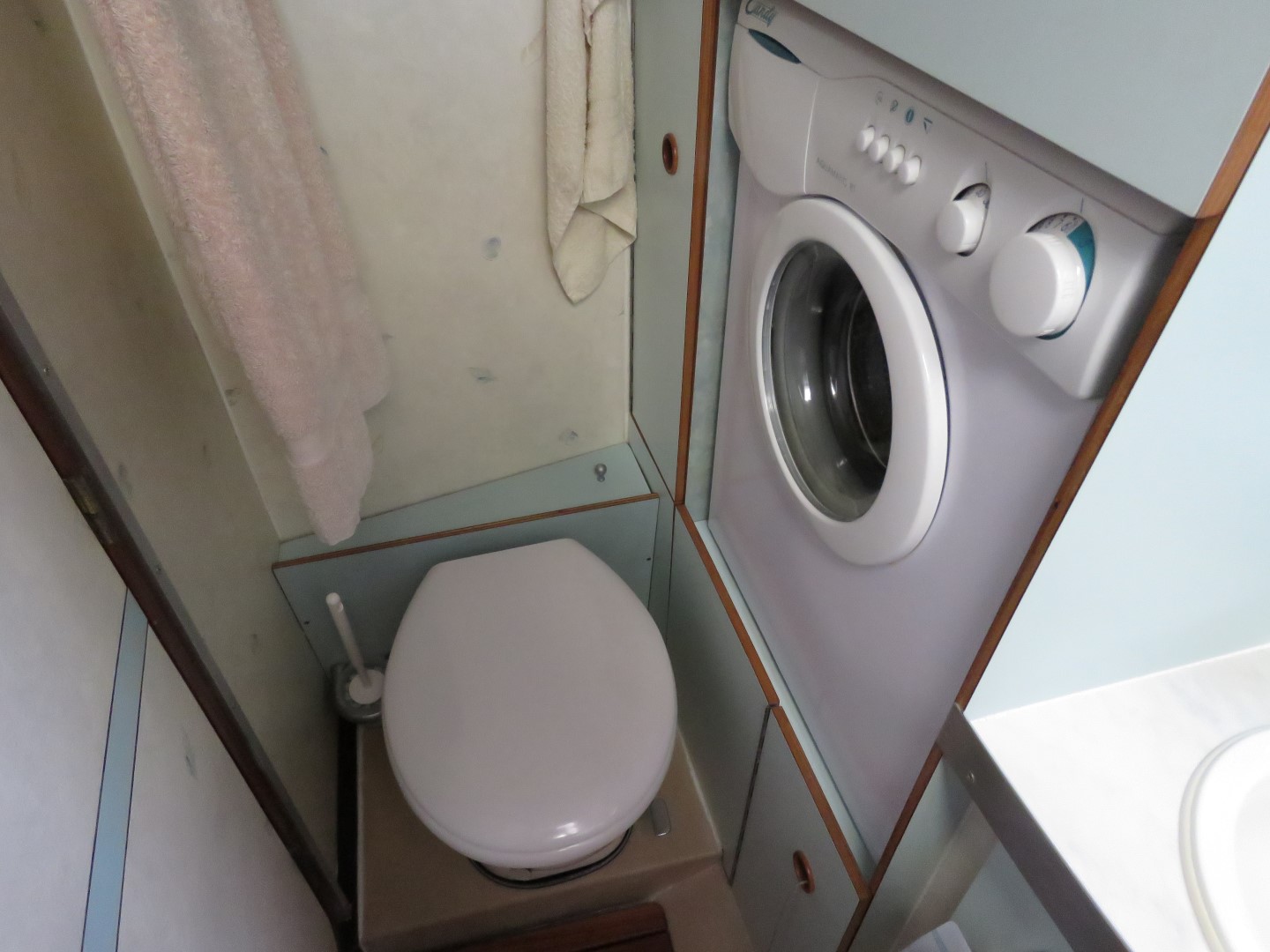
We paid top dollar for the boat, but, were able to rationalize this based on all the new equipment onboard. Hopefully, our maintenance bills should be fairly low for the first few years anyway. There is a brand-new engine and gearbox, Yanmar 75hp 4JH4G-TBE (only ten hours on it!), new 600ah house bank batteries, a new Panda Fischer 8kva generator installed in 2015, new electronics 2015, full insulation (so important, but, impossible to retrofit well in a boat), diesel heater and a full array of creature comforts which we've never had before. With added comforts, though, comes increased complexity and maintenance. Over time, we may try to simplify the boat, but, for right now, we're willing to put the work into learning and maintaining a boat with 12v, 24v and 240v electrical systems along with the aforementioned huge generator that powers an electric cooktop/oven/microwave, 70 lph watermaker, washing machine, hot water, pressurized water, a shower, freezer, fridge, twin autopilots, bow thruster and many other things. The learning curve will be very steep. There is solar and wind power, but, their input is minimal. Tankage is great, 1110 litres diesel. Some of the equipment choices are not what we would have chosen and we'll either get used to them or replace over time.


The boat is a 2001 Reinke 13m Special, designed by German naval architect Kurt Reinke and professionally-built at Rehberger yachts in Bremen, Germany with interior finishing done at Friendship, Switzerland. She is hull number 15, hopefully all the design kinks were worked out in numbers 1-14!


She was built in 2001, twelve years newer than our old Gjoa, and we will be the third owners. Both previous owners were Swiss and even though the first owners were thirteen year liveaboards, the boat is in absolutely immaculate condition, still mostly just like new. The Special designation is because she is slightly longer than the original 13m design (13.95m) and slightly wider (3.98m beam) to accommodate the very thick insulation. Different than any other Reinke we've ever seen, this one has a raised saloon table and nav station that provides seated 360 degree visibility, something we also hoped to get with a catamaran and have gotten it in a monohull instead.


The galley is also 'down', our preferred location and has lots of really bright headroom.


There is a 'proper' engine room with easy interior access. A hatch in the cockpit sole lifts up and provides standing headroom access to the engine and generator.


A very solid aluminum hard dodger, integral to the boat, with windshield (and wiper!) covers the helm position for inclement weather. A bimini for the tropics shades the comfortable cockpit and rounds out the design.


Her hull is 10mm, topsides 8mm, 5mm deck and she weighs 15,000 kg. The hull and decks are unpainted (hooray!) with a non-skid paint partially covering the decks. A fully-battened main, twin headsail rig, running backstays, dedicated trysail track, trysail and storm jib complete a large sail inventory. A sugarscoop and swim ladder provide great access to the dinghy and water. There are many ingenious examples of German design onboard, including interior locking mechanisms for the tank fills, interior sliding bars that lock the anchor locker, cockpit locker and hatches and a locking liferaft compartment on the sugarscoop. The deck on top of the aft cabin is a great place to stage a drogue deployment.

I'm sure that the non-sailors out there have their eyes glazed over about now and you're saying 'enough already'! I could go on and on, maybe the pictures will give you some idea. The pros outweighed the cons on this boat and we decided to go for it. I don't think we'll regret it.

Our plans for 2017 will now include less time on the campervan and a trip to get the boat from Malaysia to Australia. We're not sure yet what our timeframes will be. All will be revealed in due course.
 photo arrow.pngCONTINUE READING

Sunday, 7 February 2016

It is with somewhat heavy hearts that we are announcing today that Gjoa has been sold!

Gjoa in her element, Cambridge Bay, Nunavut, September 2014.
 It may seem like a sudden decision, but, after completing the North West Passage this past fall we were in a quandary about what to do next. We'd been so focused on a year of planning, including acquiring Gjoa and two years execution of our North West Passage expedition that, all of a sudden, we were faced with new decisions. Where to go and what to do next?

Our full-time cruising life started in June 2010. Since then we haven't sailed south of 50 degrees North latitude and have spent two winters aboard north of the Arctic Circle. Patagonia definitely and strongly beckoned. It seemed a logical next step, but, to be honest, after almost six years north of 50, we've seen enough cold, snow, rain, fog, ice, mountains, fjords, glaciers and low pressure systems to last a lifetime. We'd now like to experience some of those azure blue seas and white sand beaches that exist in the lower latitudes.

Gjoa is a great high latitude boat, but, lacked desired attributes for more tropical climes, so, although we weren't actively looking for a buyer, when one appeared it seemed to make sense and Gjoa is now in new hands. We met her new owner, Randall Reeves, in Nuuk, Greenland in 2014 and at various places in the NWP thereafter. He indicated an interest in acquiring her at that time, but, we weren't ready then.

Randall is planning an ambitious expedition voyage of his own. You can read all about it and follow along with him at  http://figure8voyage.com/. We wish him every success.

We are now 'boatless' and probably will be for some time to come. This blog will no longer be a sailing blog, but, more of a general travel blog. We are busy planning the year ahead and have lots of ideas. We are planning a three month road trip north to enjoy another Canadian summer followed by a 'busman's holiday' aboard a cruise ship in September. We will be aboard for 43 days and travel from Vancouver to San Diego, then Hawaii, visit a number of the South Pacific islands and Australia before ending up in New Zealand. A once-in-a-lifetime voyage. Upon arrival 'downunder', we'll have a look at what tropical boats are on offer, so, stay tuned! Could there be a multihull in our future?
 photo arrow.pngCONTINUE READING

Thursday, 26 February 2015


I guess if you're reading this you will have noticed that our blog has had a major makeover. Hope you like it!

P.S. All the pre-Gjoa posts (prior to 2013) have now been populated as well, so, you may be interested in reading through some of those...
 photo arrow.pngCONTINUE READING

Saturday, 29 March 2014

Hi All! Although we won’t be posting regularly until we get underway in mid-May, we wanted to announce the location of our new blog. We hope you enjoy the map above showing where we’ve been since we set off on this voyage in June 2010. We’ll be able to update our progress on the map once we are moving again.

As most of you know, after the initial intense 1-1/2 years of cruising, we stopped in the UK to top up our cruising kitty, recover and reflect on our choice of the cruising life. We decided we wanted to continue, but, needed to make a few changes. We’ve cast off our land ties almost entirely now and made another big change, a ‘new’ (to us) boat, Gjøa. The original ‘Gjøa’ was the boat that Norwegian Roald Amundsen used to make the first successful transit of the NorthWest Passage in 1903-1906. The boat was named for the wife of the original owner/builder. As a Canadian-registered boat, we weren’t able to register the proper Norwegian spelling,so it is Gjoa.

I’ve written in the past about the fantastic year we spent living on our previous boat in Norway and the part that the Norwegians played in early Arctic explorations of Canada. We’ve long had the Arctic ‘bug’ and the Norwegian visit inspired us to finally plan our own Arctic explorations and transit of the NorthWest Passage this summer. It is hoped that our new boat’s name, along with its illustrious sailing history will bring us good luck on our passage.

Gjoa was first named ‘Asma’ and was built in Germany,  in 1989, specifically for a circumnavigation of the Americas by Clark Stede, a journalist and photographer. Published in 1994, Rund Amerika: Die erste Umseglung des amerikanischen Kontinents’ (only in German) documents his successful voyage along with Michelle Poncini. If we are successful in our transit of the Passage this summer, it, will be the boat’s second time through!

After ‘Asma’ she became ‘Taonui’. As ‘Taonui’, she provided sixteen years and 100,000 miles of adventures for her owners Tony and Coryn Gooch, including visits to Antarctica, South Georgia and a single-handed, solo, non-stop circumnavigation in 2002/3.

We feel privileged to own a boat with such an amazing history and hope some of her sailing success will continue with us. We plan to travel to many places she’s already been and many new ones as well. Pictures and postings to follow…..stay tuned.
----------
Cowes 29/3/2014 20:51 50°45.07'N 001°17.32'W
 photo arrow.pngCONTINUE READING

Thursday, 31 January 2013

Quite a dramatic headline to this post, but, we’re not giving up cruising. We’re changing boats! We’d been toying with the idea of changing Black Sheep for some time. Although she has served us well for the last five years (almost three years living aboard now), we found ourselves being increasingly drawn to cold, wild places and felt that in order to do more of that, comfortably, we’d need a boat that was designed to cruise in those areas. Our three primary goals in making the change were: an ice-resistant (steel or aluminum), insulated hull; heat, both while motoring and while sailing and a warm, dry place to spend watches. Ok and maybe we’d like a few more creature comforts as well. How about hot water and a shower, maybe a bit more storage space? Maybe a few more technical items like an alternate battery charging source, a drogue and a good downwind sail plan setup? At the same time, we also didn’t want a boat with overly complex, expensive, systems.

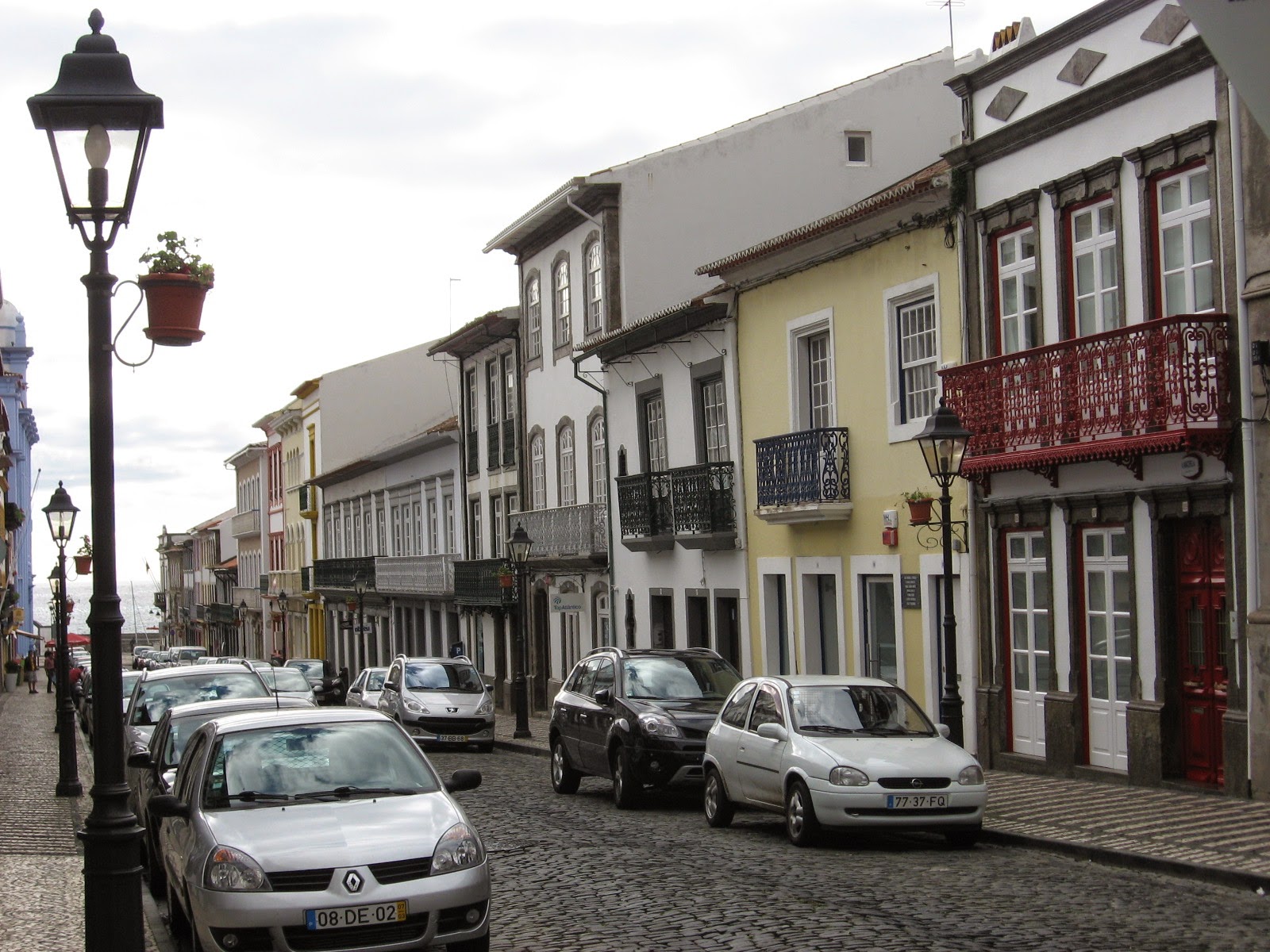
We’d looked at a few boats and even went so far as to put an offer on one in the U.K. It was a compromise, at best, and with hindsight we are very happy we were outbid. Through another cruiser here at St. Kat’s we were put in touch with a very experienced sailor who was toying with the idea of selling his boat after sixteen years of ownership. So, in our usual fashion, in early November, we immediately flew off to the Azores for a week, where the boat was on the hard for the winter, to have a look.
Terceira, Azores

Terceira, Azores

It wasn’t love at first sight, our hoped-for creature comforts weren’t there, but, after weighing up all the pluses and minuses we decided to go for it. A deal was soon arranged, a deposit paid and here we are. We haven’t actually closed the deal yet, so, will leave more of the details about the boat until that happens. She should be arriving in Lymington, on the south coast of the U.K., after the owner has had his last ocean sail with her. Expected arrival is in early June, which seems to be coming up awfully fast. We have been making plans and getting very excited. It will mean another tumultuous year for us, but, what else is new, it seems to be our normal state of being.

An unexpected and expensive hassle soon materialized when we went to put Black Sheep on the market. We’d read about the need to deal with the boat’s VAT tax status, which we had already done anyway, so, that was ok. We’d also read about the need for a CE mark (European standards certification) on all boats imported into the EU. There seemed to be numerous ways around this restriction, but, unfortunately, for one reason or another, Black Sheep didn’t qualify for any of them. The biggest sticking point was that our thirty year old engine wouldn’t meet current emission standards and would have to be replaced. It didn’t matter that the engine was built in the UK originally, or, that there must be hundreds, if not thousands, of boats currently in the UK with the same type of engine (Perkins 4.108), or, that we could take the engine out and put it into another boat already in the UK and that would be ok also. We also found out that boat brokers won’t even list a boat for sale unless it has the mark. So, were stuck, the engine would have to be replaced.

Once the decision was made, we sprung into action. We had heard good things about a rigging shop at Suffolk Yacht Harbour at Levington, Suffolk (near Ipswich). We needed to repair our mast (the detached interior conduit that I wrote about earlier), so, knew we’d have to make a stop there. Then, we found there was an engine shop there as well and hired them for the job. We took their advice and went for the Yanmar 3JH5E engine, 39HP, which is a comparable replacement to the old one. Other Baba35 owners had also re-engined with this model. We were warned that not only would the engine need to be replaced, but, the motor mounts would need to be adjusted and it would probably require a new shaft and exhaust system as well. This all proved true and added to the substantial cost.

We wanted to get the job done as soon as possible, so, despite it being Christmas week, we decided to move the boat to be ready for them to start right after the holidays. We left London on Christmas Eve, even though there was a gale forecast. Otherwise, we’d have been unable to get out for a couple of days as the marina office was closed. We were only going down the Thames to the Medway (Queenborough) the first day, so, would be in sheltered waters. We made it ok, picked up a mooring, and sat there for a couple of days over Christmas to wait out the gales. It was quite enjoyable, with our new diesel heater keeping us cozy and with a proper Christmas dinner cooked aboard. The only negative was our fridge conked out, but, not a hardship as it was cold enough to keep food outside.

To make a long story short, we were hauled out and the mast and old engine were craned out soon thereafter. It took two weeks to replace the engine with them working on it every day. It was tough living aboard, on the hard, at the same time, but, it all got done. On the way back, we motored the whole way to exercise the new engine. We were amazed to see about a 30% increase in speed, a 50% reduction in fuel usage and quieter operation too! Wishing now that we were going to be enjoying this new engine instead of handing it over to a new owner.

There’s still more paperwork to be got through, a surveyor visit, a stability test and the application for the CE mark submitted, but, I think we’re getting to the home stretch now.

Our visit to Suffolk was a nice break, it was like being on a mini-holiday and it felt great to be back at sea again (even though we were very rusty and made some stupid mistakes). Suffolk itself was a nice surprise. It was good to be back in the countryside where you can see the sky and the landscape. There were great walks right from the marina, through protected bird marshes and deer were spotted among the hedgerows as well. A bus ride took us into the town of Ipswich, a mid-sized town that has everything you need in a compact area. After a brief snow delay, we’re now back in London hoping to get the boat on the market and sold, soon!

 photo arrow.pngCONTINUE READING

Friday, 2 July 2010

In January 2010, we finished up in the U.K. and temporarily relocated to Savannah, so, we could start making the necessary changes and do the maintenance required for a boat to be capable of making a long, offshore voyage and support a liveaboard lifestyle. G had finished up work in the U.K. at the end of November so was able to devote full-time to the project doing just about all the hands-on work. A was still working, but, was able to pitch in on weekends and also managed the project management, gear research, ordering and financials etc. We rented an apartment for four months to have somewhere for A to work, stage the new gear and store the old gear while we had the boat in pieces for maintenance.

The boat wasn't in too bad shape mechanically, although there were a lot of very complex systems for such a small boat (more on that later). However, the cosmetics were another matter. The brightwork (wooden accents) had been let go and was in varying states of finish, mostly peeling, or, absent varnish.  The exposed wood had weathered. The gelcoat was faded and chalky. The teak decks were grooved. The dodger was coming apart, the interior upholstery was very old and ugly. There was mildewed wallpaper inside. The previous owner's custom changes weren't to our taste etc. The boat has an all-teak interior, but, even the galley counters were teak, so, it also needed to be lightened up
and modernized. All in all, the boat looked very tired and needed a thorough going-over.
'Before'
Here's a summary of the maintenance items we did:

1. painted the hull black. In hindsight, if we'd know how much work this was going to be, we probably wouldn't have started it. The  gelcoat wasn't that bad and could probably have been brought back. However, we've always been partial to dark-hulled boats and we started, so,  had to finish. G had to hand-sand the hull five times. Once initially, then between each of two coats of epoxy primer undercoat and then between two coats of topsides paint. We applied the paint together, using the 'roll-and-tip' method. It worked ok and we are reasonably pleased with the results. A professional could probably have done better, but, then it would have cost way more too. As long as nobody looks too closely, it's fine!
1. reupholstered interior, added lee cloths
2. painted interior lockers, stripped wallpaper and painted salon walls
3. Corian overlay on galley counters, new faucet
4. sanded teak decks, rebunged where necessary
5. stripped and applied eight coats varnish to all brightwork. This was an incredible amount of work taking G almost a month  to just strip the wood. Used Interlux Schooner Gold varnish.
6. removed and painted bowsprit, replaced dolphin striker bolts
6. replaced chainplates
7. replaced running rigging, fenders and docklines
8. replace some standing rigging including bolts, clevis pins etc.
9. cleaned and repaired sails, added a third reef and new boltrope to main, replaced suncovers
10. replaced dodger skin, replaced all boat canvas
11. cleaned and polished all fibreglass and stainless
12. rebuilt chain locker partition, removed and replaced some rode and marked and sorted out the rest
13. replaced water filters and watermaker membrane
14. unstepped mast, cleaned/waxed, replaced VHF cable, installed wind system
15. removed davits and bimini frame
16. removed old aerials and cables from radar arch, ran new ones
17. new valve/fuel pump for our diesel heater
18. sand bottom and two coats bottom paint
19. new hand-painted lettering and bootstripe
20. new gaskets, glass and screens in all twelve bronze portlights
21. built plywood covers for offshore use on butterfly hatch
22. new interior bookshelves, storage cabinet
23. rebuilt teak boom gallows
24. removed and rebedded most deck hardware including headsail tracks, stanchions
25. replaced keel bolt for grounding system
26. refrigeration serviced
27. rebuilt the head (toilet), checked seacocks, seawater manifold etc.
28. installed a hydronic heater to be used for free engine heat when motoring
29. new lifelines
39 fibreglass repair to leading edge of keel
40. rebuilt generator, installed new alternator on it, installed separate water pump switch
41. repaired exhaust manifold on main engine,

Here's list of new gear we added to the boat:
1. Nasa Clipper Wind System
2. Nasa LPG Gas Detection System
3. Standard Horizon Matrix GX2100 VHF with built-in AIS
4. Icom, model IC-M34 Handheld VHF Marine Transceiver with battery pack
5. Standard Horizon CP300 GPS Chartplotter
6. Aqua Signal, Series 32 LED nav lights
7. Bitstorm Bad Boy Extreme Wi-Fi device
8. McMurdo G5 Smartfind EPIRB
9. Iridium 9555 Satellite Phone
11. OGM LED tricolor and anchor light
12. Aqua Signal steaming/deck light
13. Nasa Target HF3 SSB receiver
14. Astra III-B Sextant
15. Viking four-person liferaft
16. Monitor windvane
17. ATN storm jib (Gale-sail)
18. Fiorentino para-anchor
19. ATN top climber (mast climber)
20. second depth sounder
21. all new flares to SOLAS requirements
22. offshore medical kit and fire blanket
23. two immersion suits
24. lifesling
25. replaced prop line cutters

Here's a list of existing gear we kept:
1. Sitex, model T-180 Radar
2. Autohelm Boat Speed (2)
3. Autohelm Depth (2)
4. Autohelm, model ST6000 Autopilot
5. Magellan GPS
8. PUR Survivor 06 hand-held watermaker
9. PUR 35 watermaker
'After'

Launch Day!
Most of the cost of the refit was hiring a mechanic to help us with our 45 HP Perkins 4-108 diesel engine and Kubota generator. Our surveyor pointed out that the end fitting on the exhaust manifold looked like a problem. It was. The mechanic found a dangerous exhaust leak that led to an expensive, custom made part repair. Of course, one thing led to another and a few more jobs got done. Although expensive, it was well worth it as we are now confident our Perkins should last a few more years and the Kubota one-cylinder generator is functional again  after it was rebuilt and reinstalled. In the process though, we 'fried' our battery monitor and as it was obsolete had to install a basic one so we at least had something to look at. It also didn't inspire much confidence when our mechanic stated that '...the charging system on this boat is the most complex that he's ever seen in thirty years in the business...'. The former owner of the boat that installed the system must have been an engineer with too much time on his hands. We tried to avoid problems and not change the existing system design (i.e. kept the generator and didn't install wind/solar options), but, I'm sure we are going to pay the price of an overly complex system in future.

We've read and heard that most people planning to live aboard often spend years preparing the boat. We did our refit in four months flat. It required a high degree of organization, an incredible amount of hard, dirty work and more money spent that, if we'd known how much, we probably wouldn't have
started! However, it's all behind us now, we're proud of the boat and are enjoying all the positive comments on it that we've been receiving wherever we go.

 photo arrow.pngCONTINUE READING

Thursday, 1 July 2010

In January 2008, we purchased our boat, a Baba35, in Savannah GA. Many people have asked how we came to choose a Baba. It actually was a very easy decision.  From our research and reading we knew we wanted a blue-water capable boat, at least 35 feet for comfort, but, no longer than 35 feet (so it can be easily handled by only two and be more economical to use and maintain), a very traditional design with a full keel/ cutter rig, a quality build and built in the early 1980's (before they started underbuilding production boats). It also had to have 'character'. With these characteristics, the list of suitable boats was actually was very short. We liked Bob Perry's designs and started looking at Hans Christians and Tayana 37s. This eventually led us to the Babas. The Babas were built in Taiwan in the early 80's by TaShing, who were considered the best yard there at the time. We planned to buy in the U.S. as that's where most of the boats ended up, the prices were better and the exchange rate was good at the time. So, we lined up five candidates to view on a boat-buying trip and luckily we found one that was in good condition and proved suitable. We were based in the U.K. at the time and toyed with the idea of shipping the boat over to use in the U.K. as we didn't have time then to sail it over. We quickly decided that the cost of shipping plus the cost of marinas in the U.K. was prohibitive and it would be cheaper to fly over 4-5 times to visit rather than ship. So, a number of visits ensued, none of which allowed us to do more than day-sail the boat and think about what we wanted to do with it (while we watched it deteriorate in the hot Savannah sun).

When we purchased the boat, we hadn't yet finalized our cruising plans and Europe was a far-away 'maybe'. However, over the two years, with a lot of sailing experience gained in the U.K. and a very capable offshore boat, we thought 'why not? We can do this...' and starting planning a transAtlantic
voyage. This decision dictated a lot of what we did next.
 photo arrow.pngCONTINUE READING