Thursday, 30 June 2011

Most sailors in the northern latitudes are out sailing by the beginning of June. We were still in Tromsø studying ice reports and contemplating our planned voyage north to the Svalbard archipelago, about 600 miles north from the Norwegian mainland. To make it worse, there had been one or two really lovely spring days in town and we were getting antsy to leave. Svalbard weather reports didn’t look that promising, some of the fjords were still blocked with ice and the temperature was hovering around 0-2C with snow showers. After a long, dark winter we were relishing some summer weather, not more winter. We started to second-guess our decision to head north. After all, when we’d arrived in Tromsø last fall, we hadn’t intended to travel any further north. We’d heard about Svalbard, but, thought it would be far beyond the capabilities of both us and our fibreglass boat. In addition, there seemed to be a high degree of regulation and bureaucracy involved as well.

This is an ice report from May 23. Most of the fjords are ‘fast ice’ with ‘drift ice’ all along the western coastline. Note the ‘?’ just north of the island at the bottom, this really instilled a lot of confidence!
After doing some more study and talking to others about it, it seemed that it would be ok to go in a fibreglass boat, as long as we stayed on the west coast of Spitsbergen, the main island, paid attention to the ice charts and didn’t put ourselves in any places where there was a good likelihood of being trapped by ice. The other caveat was to keep a good watch to avoid hitting any floating ice which would be quite likely to punch a good-sized hole in our hull. After reflecting on our crossing of the North Atlantic and North Sea last year, we thought sea conditions and the actual sailing couldn’t be much worse than we’d already experienced, so, we decided to head north. However, this decision came with a string attached, we promised ourselves we could go as long as it didn’t impede our decision to be somewhere warmer for next winter. This put a time constraint on our visit as we wanted to be entering Sweden and the Baltic around the beginning of August. To get north and back again required leaving Tromsø around mid-June.

The days dragged along and a week of grey skies came back to Tromsø adding to our dismal mood. Should we go, or, shouldn’t we, it was constantly on our minds. Finally, a weather window opened up, a whole week of sunshine and fair winds was forecast and we were off. A busy final few days ensued, closing up our affairs, doing last-minute provisioning and saying sad farewells to the good friends we had met over the winter. I had heard that constantly having to say goodbye is one of the hardest parts of cruising and that has proven to be the case for us as well. We departed on Thursday, June 9, to do a three day mini shakedown cruise prior to leaving the security of the mainland for the voyage north.

Leaving Tromsø gave us a fine view of the oil rig that had been towed in for repairs.
The warm, sunny weather arrived on schedule and we had a delightful three days cruising east to Skjervøy, the small town where Nansen’s ship Fram returned in 1896 after her polar circuit. The town has a stunning setting with a well-sheltered natural harbour surrounded by tall, snow-covered peaks. We thoroughly enjoyed sitting outside in the sunny cockpit for the first time this year, watching the fishing boats come and go. G casually waved at a fisherman in a nice-looking boat. Later, the fisherman came over to chat and brought us a gift of about two kilos of freshly caught shrimp! Fresh shrimp (‘ferske reker’) are sold off the back of fishing boats all over Norway and are usually consumed with a mayonnaise-like dressing for dipping. To be honest, I’m sounding ungrateful, but, as much as we appreciated the gift, we didn’t appreciate all the head, leg and tail peeling prior to eating. Also, the shrimp are cooked on the boat already and we found them way too salty, they must have been cooked in salt water. Anyway, it was a lovely gesture and much-appreciated, in spite of our squeamishness.

After visiting Skjervøy, we made a short side-trip to the Jokelfjord glacier, the only remaining glacier in mainland Europe to calve into the sea. We experienced our first taste of sailing with ice in the water here, it was exciting at the time but proved rather tame with what was to come later.

Jokelfjord glacier
We made our final preparations for sea and left the mainland on Sunday, June 12 to head north out into the Norwegian Sea. Almost immediately, all the bad memories of our North Atlantic crossing came back with a vengeance. First, our choice of exit point could have been better. We exited through an area of the coastline known to have potential for severe wind over current turbulence. The last remaining vestiges of the North American Gulf Stream run along the north coast of Norway, known as the Norwegian Current in this location. There had been a near gale the night before and although the wind was now only about twenty knots, the sea was still very confused. We were getting thrown around in what can only be described as what it must feel like to be in a washing machine. We know it’s bad when the crockery starts breaking and we lost a souvenir coffee mug we’d only just purchased. We tried sailing until the wind eventually died, we tried motoring, that was worse. In the end, we basically just hung on as we pounded into the head seas. Then, things started to fail. We went to put the Monitor windvane air paddle on and the handle broke off and fell into the sea. The Windex monitor at the top of the mast broke in half and fell off. G noticed the new bilge pump seemed to be on all the time. He didn’t want it to burn out, so, he turned it off. Within ten minutes the bilge was full and there was water over the cabin sole (and over our newly installed propane gas monitor sensor). We madly started hand-bailing into the galley sinks and pumping it overboard from there. Once we’d cleared the water, it didn’t come back. We can’t figure this out. We thought originally it was being caused by excessive wave action over the bow and maybe coming in through the hawse pipes and/or chain locker somehow, but, there is just nowhere for it to get in. A clue from this recurrence was that it seems to stop when we slow the boat down and lessen the amount of heel. So, now we think it might be some kind of back-siphon via a through-hull, but, we’re not sure where or how. This is a mystery that may never get solved. At least having experienced it once before, this time didn’t induce quite the same level of panic as the first time!

Next was the near collision with a freighter. At ten minutes to CPA (closest point of approach), I called the other boat to find out their intentions for passing. The first words I spoke on the VHF blew a fuse and the radio went dead! After a mad scrabble through the ditch bag, I pulled out the handheld VHF and made contact to ask whether he was planning to pass us ahead or astern. He said ‘ahead’ and then added ‘I think’, very confidence-inspiring. It was ahead, but, so close we could almost see the whites of his eyes on the bridge. We have never passed so close to a boat before. Normally, we try and stay out of their way and would have taken evading action much earlier, but, in the severe waves we were in, we were afraid of a broach, or, a knockdown and as we were the stand-on boat, thought it better to maintain our course and speed and let him make the minor adjustment required to pass astern of us. At this point, we had one of those moments where you question ‘why am I doing this’ and almost turned back.

By the next day, the waves had reduced in size by ½ and were generally now all coming from the same direction. We were far enough offshore to be away from the confused seas and all the local shipping. What a relief. It was grey, cloudy and cool, but, we had winds from just the right direction and we sailed for almost three days, on the rhumb line, between 5-6 knots without having to touch the sails, or, the windvane, the entire time. We made the best day’s mileage ever and it was great. More of the same please! The skies cleared off just enough for us to spot Bjørnøya (Bear Island) on the way. This is a bird sanctuary island located conveniently ½ way to Spitsbergen. We had originally planned to stop here, but, due to the uncertainty surrounding the location of the pack ice to the east, we thought it was better to stay well west and we passed it about thirty-five miles off. We were unable to see Sørkapp (South Cape) on Spitsbergen due to poor visibility. When land finally hove into view, it was a most peculiar sight with a low, horizontal band of cloud cutting off the tops of the mountains from the mid-way point, but, with the light underneath the clouds somehow still glowing and reflecting off the bands of snow cover.

first view of Spitsbergen

At this point, our favourable wind started to fail and we were into the ‘normal’ wind pattern for Svalbard at this time of year, light and variable. We fiddled about with the sails a bit, then, decided to start the motor and get into Longyearbyen, the main town and administrative centre for Svalbard.

Svalbard is located at the junction of three seas: the Greenland Sea, Norwegian Sea and Barents Sea. It is an island archipelago and is the nearest it is possible to sail to the North Pole, just 600M further north from its north coast. 60% of it is glacier and only 6-7% can support any plant life due to permafrost. In 1920, sovereignty over Svalbard was granted to Norway and Norwegian law is followed. However, Svalbard has its own Governor (Sysselman) and is a duty-free area. The year-round population is approximately 3,000 with about ½ being Norwegian, the other ½ are Russian/Ukrainian. Russia still has mining interests and the town (one of only three) of Barentsburg is almost totally Russian in population.

The town of Longyearbyen, the main settlement, is quite industrial-looking and has the character of a frontier town. All the buildings are on stilts, due to the permafrost. The people are a varied mix: tourists, scientists, students, mine workers and a few frontiersman, who were easily identifiable with their weatherbeaten faces and heavy outdoor clothing. A number of people were walking around with rifles over their shoulders. It’s not required in Longyearbyen, but, everywhere else it is a requirement to carry a rifle, due to the polar bear risk. This includes yachtsmen and we thought we’d have to rent a rifle for our visit. We were reluctant to do this and as we were only staying a week, the easiest solution was to just not go ashore and hope that bears don’t climb onto sailboats.

As it was, we didn’t see any polar bears although many other boats did see a number of mothers and cubs. Those boats, though, were either larger and/or made of steel/aluminium and therefore able to go to areas where there was still ice where most of the bears live. A couple of other boats had close encounters with whales. We saw quite a few spouting off in the distance, but, didn’t have any close encounters, maybe a good thing. It was still a thrill to hear them breathing and sense their massive presence nearby.

photo courtesy of Rudi Caeyers . We didn’t see any bears, but, G’s friend Rudi shot this photo just a couple of weeks ago. For more of his great photos, see www.rudicaeyers.com

The wildlife highlight for us was seeing walrus in their natural habitat. The walrus colony at Poolepynten can easily be seen from a boat. We approached the shore carefully and there they were. Huge mountains of flesh piled up together in a large, brown heap. Many were on their backs with their tusks in the air. We got close enough to smell them, very fishy and they barely seemed aware of our presence. A couple of them were in the water feeding. We watched one giant lumber down to the beachfront via his jiggling flesh, what an effort. Once in the water though, he was very graceful despite his size and shape.

the walrus colony at Poolepynten

the walrus colony at Poolepynten
On arrival in Longyearbyen, the weather had been grey and cool. As we started our week’s cruise north to Magdalenfjord, the weather changed to an unbelievable stretch of sunny, warm, cloudless weather. The air temperature was only 4-7C, but, the warm sun made up for it. We were able to just wear light jackets and forego the long underwear for a while. All our worries about having no heat on the boat while sailing, or, at anchor went away. We have a heater while motoring and as the high pressure that brought sunny skies also brought a lack of wind, we motored a lot and were quite toasty.

Cruising to Magdalenfjord took us as far north as latitude 79 degrees and 34 minutes. It was hard to imagine we were just 626 miles from the North Pole at this point. We were also less than fifty miles from the permanent ice cap where the sailing stops rather abruptly. The last sunny day, of our run of five, was when we sailed into Magdalenfjord. It was about 11 p.m. and we were just heading into the anchorage. The sea was absolutely flat with that oily motion it gets in a calm. The sun was still high in the sky. There was a very light mist in the air reflecting a brilliant white light from the sun. The sea was like molten gold on which we were floating with a gentle motion. I now know where the term ‘white night’ comes from and it is an image not soon forgotten.

Here’s proof, just 626 miles from the North Pole!
In the morning we had a surprise to see that another boat had come into the anchorage during the night. It was more of a surprise that we knew the boat and its captain. It was ‘Ulla Rinman’ from Tromsø, a converted lifeboat that now takes charter guests on Arctic adventures. G had met Geir, the captain, in Tromsø over the winter and had helped him move the boat across town. We chatted with him on VHF prior to departure.
‘Ulla Rinman’ at Magdalenfjord
The scenery throughout the cruise was spectacular. The Arctic mountain landscape doesn’t have the verdant green forests and turquoise-tinged glacial lakes of mountain ranges to the south. However, it is still beautiful in its own way. The basic elements are water, rock, ice, snow and sky and the beauty comes with the interplay of light and shade on the various surfaces. The terrain is almost totally vertical. Each valley seemed to have a glacier in it, many calving directly into the sea.

Our first anchorage at Trygghamna, near Longyearbyen
 An exception to the rule of a barren landscape were these beautiful Arctic flowers seen an Ny Ålesund.
Sea cave near Blomstrandhamna, we saw people go right into this cave in a dinghy.
 It was easy to get blasé about glaciers because there were so many, but, they were fascinating. At a number of anchorages, we were able to get quite close. Our favourite was at Dahlbebrukta. This anchorage looked marginal on the chart and we were nervous going in as there was quite a bit of large ice in the water. It was late, around 1:30 a.m. and we just wanted to get stopped, anchored and into our bunks. As we expected, there were a few bumps on the hull in the night from ice hitting us. We awoke to what sounded like pouring rain, but, the brilliant sunshine coming through the portlights showed that was impossible. What on earth could it be? Emerging into the cockpit we soon saw that a large berg must have calved in the night and the bay was now filled with splinters of it all around us. I’d heard that glacial ice makes a popping noise in the water, but, this was incredible. It sounded like the sea was alive with the snap, crackle and pop of the air coming out of the ice. It was very weird and exciting at the same time. There was a lot of glacial ‘blue ice’ (the very dense older ice) in the water as well, very scenic.

Dahlbrebukta glacier. This photo was taken at midnight!

One of the beautiful bergs at Dahlbrebukta

Waggonbreem glacier at Magdalenfjord
Another interesting stop was to the smallest of the three settlements on Spitsbergen, Ny Ålesund. It’s a research station with about 25 year-round residents. In the summer, about 200 scientists and students come to do research from all over the world. China, Korea, France, Germany, India and of course, Norway, all have research stations here. The Poles also have a large presence on Spitsbergen, but, their research station is based in the south of the island. Ny Ålesund is the place where Amundsen launched his airship, ‘Norge’, on its historic crossing of the Arctic in the 1920’s. The tower used to tether Norge still stands.
World’s most northerly post office at Ny Ålesund.
mini-train used at Ny Ålesund for coal transport
After completing our cruise, we are now back in Longyearbyen for a couple of days. We are getting caught up with showers, laundry, diesel, water etc. and will be provisioning for our voyage south. We expect to leave by July 1, be at sea for about three weeks, travel about 1200 miles and hope to make landfall in South Norway, somewhere south of Bergen.
Black Sheep II at the dock in Ny Ålesund

CRUISING NOTES
For the sailors reading this, our trip to Svalbard was a great success and highly recommended, if travel in the northern latitudes appeals to you. Any well-found boat with an experienced crew should be able to make the trip to the west coast of Spitsbergen, with the right weather and ice conditions. High pressure, when it arrives, tends to remain stationary and the weather settled, more so than in latitudes further south. The winds tend to be light and variable, so, expect to motor and purchase a lot of diesel. Northbound progress up Spitsbergen may be slow as the prevailing winds are usually from the north.

Navigation aids are few and far between. The only real navigational challenge is the ice potential and one tricky bit of navigation in the strait between Spitsbergen and Prins Karls Forland (island), Forlandsrevet, where there is a 0.5m narrows with 3meter depth. We never did identify the transit for getting through here (lining up a point with a rock buttress) as there was cloud hanging over the mountain tops both when we were northbound and southbound. Our CMAP electronic charts seemed to be accurate and our chartplotter got us through easily with no problems.

A permit is required from the Governor’s office to visit Svalbard, SAR insurance is required, landing fees must be paid and a rifle rented, if you are going ashore. Although it sounds onerous, the whole process was basically effortless, just filling out the application form with proof of insurance and sending it in. Our insurance broker was able to provide the SAR insurance for only an additional $100 on our premium. When we were out cruising, we twice met RIBs with Sysselman officials aboard and they knew our names and that we were on the approved ‘list’, so, make sure your paperwork is in order before arriving.

Postscript: We had an email from Mark and Jane, who stayed in Svalbard for a few weeks after we left at the end of June. Apparently, there was an ‘ice event’ in July where ice was swept into Longyearbyen harbour and filled it overnight. Even cruise ships were unable to enter the harbour. The dock we were tied up to, along with the boats attached to it, was broken away and pushed down the shoreline with damage to the boats. I’m really glad we missed that!

 photo arrow.pngCONTINUE READING

Tuesday, 31 May 2011

In Norway, May 17 is Grunnlovsdag (National Day). It is a highly anticipated and widely enjoyed holiday event, a day to wave the flag and celebrate Norway’s national heritage.

Across Norway, it’s a day of parades and music. In the Tromsø official parade, it seemed like every school in town participated in the march as well as various bands and other town groups.

Banner of one of the school groups in the parade.
Lots of colour and flags on display.
There aren’t any ‘floats’ as such, but, the highlight is that almost all of the marchers are wearing Norwegian traditional dress. Actually, just about everybody, whether in a parade or not, had it on. It’s the one day when all age groups, men, women and children dress up in their traditional finery. The outfits are beautifully made, consisting of long skirts for the women with some combination of an apron, petticoat, cape and/or bonnet. The men are in fitted waistcoats, jodhpurs, leggings and hats. Both men and women wear plain black shoes with large, square, silver buckles. I’m not sure of the origin or meaning of the designs, but, they seemed to hint at eighteenth century origin although I could be wrong. The fabrics range from very fine wool to silk. The women’s clothes are beautifully embroidered, often with a matching purse. The colour range is limited with blue, green and brown/black being the most common.
A couple in Norwegian traditional dress.
Girls in Norwegian traditional dress.
It really was a lovely sight and it seems to mean a lot to the Norwegians. The traditional dress is sometimes also worn to church and often at weddings as well.
Sami (aboriginal people) traditional dress.
Unofficial parades continued throughout the day and everybody gathered in the pedestrian mall downtown to chat and listen to the music from the outdoor stage. It was a very cold day with a brisk wind, but, that didn’t seem to impede the crowd’s enjoyment of the events.

One of the guest parade groups in town was the Russian Navy band and we saw them, in their sailor suits and brass button finery, around town for a few days before the event. They were a very pasty-looking bunch, with bad skin, as if they’d been confined to a submarine for a few months, maybe they had been!

Another parade participant was a large group of teenagers all wearing red bib overalls. The overall’s bib was a Norwegian flag, strategically draped down over their lap. Down the side of one leg, in large white letters, was the label ‘Russ 2011’. They were running through the parade, holding hands, blowing whistles and just generally acting like teenagers. We’d actually been seeing these overalls around town for a few weeks prior to the event and wondered at their significance. It turned out that the teens wearing them are this year’s graduating ‘high school’ class. Instead of signing yearbooks for each other, they write messages on the pants and I guess they are then kept as a souvenir, kind of a nice tradition.

A pair of ‘high school’ graduation overalls.
Contributing to everyone’s high spirits in May has been the arrival of the ‘midnight sun’. It is now daylight all the time! To be honest, we haven’t really noticed it that much as we are both good sleepers and haven’t needed to black out our portholes or anything to get to sleep. It is interesting though, to wake at 2-3 a.m. and see a blue sky. Conversely, it seems weird to be going to bed with the sun shining. It will be like this now for two months. We are really looking forward to not having any night sailing for our upcoming voyages. Speaking of which, if all goes according to plan, this will probably be our last post from Tromsø. Our preparations are well under way and we hope to leave here the week of June 6 for a local cruise and then, if the ice permits, we will leave for Svalbard hopefully the week of June 13, or, 20th.

We’ve been getting first-hand Svalbard ice reports from G’s Belgian photographer friend, Rudy, who’s there on a polar research vessel right now. A number of the fjords are still completely blocked with pack ice and they were unable to get to shore at one of the weather stations due to the ice. So, it’s still way too early for us to consider heading north. Svalbard is about six hundred miles north from where we are now and the temperatures are also lagging behind. It’s averaging between 3-12 degrees C here and we did have snow showers yesterday (27th). In Svalbard, it’s still hovering around zero and just below, with snow showers quite often. We’ve been thinking ahead to our reward of warmer temperatures in the Mediterranean where we hope to be at the end of this year. We were planning for Barcelona, but, there’s been a bit of a glitch with the marina we were hoping to get into, so, now we are thinking about maybe just staying in the south of France instead. More on this later, but, right now, we’re still heading for the Med in that general area.

Boat preparations have been going reasonably well. At the beginning of May, A made a quick trip to Miami to pick up our new mainsail, Strong Track track system and a set of lazyjacks. You might be wondering why I would go in person rather than just ship it when there are such good international courier services. Well, there are a lot of reasons, but, the biggest is that we didn’t want the shipment to get stuck in Oslo customs for weeks while we stressed about our departure date. It felt better to be in control of the situation and hand-carry the goods. ‘Hand-carry’ is a bit of a misnomer though, as the sail weighed 60 lbs. and came in a very long, very big box. The sail track and full battens for the sail were coiled up inside another very large, octagonal-shaped box. I also had a small backpack with my personal luggage. It was lots of ‘fun’ getting from rental car, rental car shuttle bus, to a Miami departure gate, deplane at Heathrow (with the boxes), take a bus (and the boxes) to Gatwick, check-in the boxes for Oslo, then, get the boxes off at Oslo, check them in again for the plane to Tromsø and then by taxi to the boat. Actually, it wasn’t as bad as it sounded although it was a relief to get back. It was in the 90’s in Miami which was great for about ten minutes, then, I was wishing for cooler temperatures again. The overweight/oversize fees charged by Delta were exorbitant. I really hate flying now, sailing is a much better way to go!

The good news is that everything fitted and the track and sail went on without a hitch. The lazyjacks (a system of ropes used to catch the mainsail when lowering it) are a different story. We’re now on day three of fiddling with them to get the right layout and have made Swiss cheese of our mast and boom in the process. G has to go up the mast again tomorrow to hopefully do the final fitting for them.

G up the mast fixing our roller furling and installing ‘lazyjacks’.
One of the tasks on our list was to do a capacity test on our batteries. We had problems with them last year as they didn’t seem to be holding a charge very well and we found that even running a few instruments while sailing was a problem. We installed our new Xantrex LinkLite battery monitor first, to replace its dead predecessor, and then ran some tests. Unfortunately, our worst fears were realized and we definitely need new batteries. The boat budget has already been well and truly blown for this year, so, we are going to try and mollycoddle them along although it will probably mean we will have to charge at least twice a day while sailing. As long as our generator continues to work, this won’t be too bad as it is very miserly on diesel usage. Also, due to the twenty-four daylight, we won’t need to have any running lights showing at night which will help. However, a close eye will constantly need to be kept on them to prevent unwanted problems.

It hasn’t been all boat work and no play though. This month, we had our very first boat guest, Selka the dog, for four days and we enjoyed her company very much.
Selka, our first boat guest.
Selka’s owners wanted to go to Oslo to visit family for the long holiday weekend. Celia, my friend, is the usual dogsitter but couldn’t take her as she was going to Amsterdam. We were happy to step in. She is a very placid dog and took to the boat unbelievably well. By the third day she was going up and down the companionway by herself with just a little support. Think of a dog climbing a ladder as that is essentially what she was doing. She also got on/off the boat by herself as well. An added bonus is that she came with a car. The weather cooperated and we took her off with us on two short road trips. One, to Kvaløya (Whale Island). The island has an incredibly varied terrain, from the beautiful little harbour of Sommarøy, where the clear blue water and white sand reminded us a bit of Bermuda, to mountains on the interior where we saw lots of Norwegians out ‘top-touring’, in the brilliant sunshine, on the remaining snow on the peaks. We were also thrilled to see our first wild reindeer.

Reindeer on Kvaløya.
The next day we headed out to the Lyngenfjord area. This area is often called the ‘Lyngen Alps’ as the jagged peaks are reminiscent of the Swiss Alps. It was also a lovely day out with lots of views of mountains and cascading spring waterfalls. It was a real treat to have the use of the car.

For next month’s entry, I hope to be posting from Svalbard. I’m not sure if we’ll be able to access the internet from there and depending on our departure date, I may not be able to post on the first of the month as usual, although I’ll try to do it as close to that date as I possibly can.

 photo arrow.pngCONTINUE READING

Saturday, 30 April 2011

After the ski snafus reported in last month’s post, I’m delighted to report that this month brought ski success on both the Alpine and cross-country fronts.

Celia and I got in a fantastic last day of Alpine skiing at Snowman Resort. It was pouring rain when we left Tromsø and I had my doubts. On arrival, the rain miraculously stopped, the weather was warm and the snow was excellent. I had fully mastered the bobble and T-bar lifts by now and managed to stay upright on both the ascents as well as the descents.

G and I were determined to do a cross-country hut-to-hut ski trip especially after last month’s aborted attempt. We watched the weather carefully every day. Two weeks passed, I found a used pair of skis to buy, G still had his borrowed skis and we were able to borrow two backpacks. Mark/Jane and Marissa from Tevakenui decided to come as well, this was to be their fourth trip. The weather forecast wasn’t great, but seemed reasonable. As it turned out, it was probably the last and best week of the winter for a ski trip. Since then, it has hovered just above zero with rain, sleet and grey skies just about every day. For our four days in the mountains however, the weather was wonderful, mostly sunny and with little wind, what luck.

We set off on a Tuesday morning. The trail that was invisible on the first trip attempt was now very apparent, there were tracks to follow and the ‘cut’ through the trees was clear, now that we knew where to look. On our first trip we had gone too far up the mountain too fast and missed it entirely. We crossed our decision point from last time and realized that we had made the right decision to turn back. It was still quite a way to Trollvasbu, the first cabin, and it was mostly uphill. Today, in better conditions, it was an easy few hours of skiing and we arrived in good time.

 
Trollvasbu, most of the huts look something like this although Trollvasbu is exceptionally large with five bedrooms and a large great room.

The view from Trollvasbu.
Mark and Jane from yacht Tevakenui (New Zealand).
 
Marissa, aged 15, towing a ‘pulk’.
Trollvasbu is a large, easily accessible cabin and thus sees a lot of use. The night before there had been a school group of twenty-two teens that had spent the night. Luckily, we didn’t have to share with them! We shared with a rather dour, older Norwegian man who was there to do work on the cabin. He didn’t speak any English and communication was difficult. The Norwegians like their heat and he stoked up the fire so high that we were all roasting. We’d open a window or a door, then, he would close it and put more wood on the fire. It got to be quite humorous with all the opening/closing going on. An early night was in order, but, after just forty-five minutes in bed, Mark called the alarm. Northern Lights! We sprang out of bed and outside. It was amazing, an undulating, green curtain of light with tinges of pink and yellow. It stretched from horizon to horizon right over the top of the cabin and our heads. How fortunate on the first night out to see such a quality display.
Northern Lights above Trollvasbu, out-of-focus and doesn’t really do it justice but maybe you can get some idea.
Next day dawned bright and sunny and we pushed on to Nonsbu. It was only about a three hour ski away and we arrived in time for lunch. This hut was kind of semi-detached with two self-contained units joined together.
 
G in the galley at Nonsbu. Note our water supply, the bucket of snow melting on the stove.]
Mark, Jane and Marissa took one side and we took the other. We had a few people drop in for lunch and then a very interesting overnight visitor. Into this hut in the middle of nowhere, a single woman shows up who lives in Copenhagen. Her family owns a seven generation winery at a French chateau in Burgundy. How unlikely is that. She was lightly packed, but had made sure to bring along her custom-made pair of traditional reindeer boots worn by the Sami (Lapland aboriginal people).
These are the traditional Sami reindeer boots our overnight visitor wore.
Each day we had been climbing higher into the mountains. After leaving Nonsbu, we were heading for Skarvassbu, the hut with the highest elevation and the longest ski distance. The weather was lovely, bright and sunny. There was lot of up, but, also a lot of down. Then, we arrived at ‘Killer’, the hill that went on forever. It actually only took about an hour to ‘ski’ up, but, it was up all the way and very steep. Reaching the plateau and the cabin at the top, the elevation was obvious with the very deep blanket of snow surrounding the cabin. From the approach, it looked almost buried in the snow.

G arriving at Skarvassbu, being greeted by Mark/Jane. Note the snow banked up and over the cabin. The windows were completely snow-covered and the trip to the similarly buried adjacent loo was an adventure in itself.

 
View from the top.
View from the top. This photo was taken by Mark/Marissa after they had skied to the summit of a nearby peak on an afternoon outing.
There were only five bunks in Skarvassbu, so, we had it all to ourselves. We had settled in for a quiet evening, the wind had picked up and it had started to snow. It was snug and warm in the tiny cabin. Around 8 p.m. there was a lot of noise and commotion outside. We were startled to see about a dozen snowmobiles roar up to our door. Snowmobiles in Norway are highly regulated and are only allowed in certain areas (Canada take note) and they are rarely seen around Tromsø. It was the Norwegian Red Cross mountain rescue team, out on practice manoeuvres. They all piled into our cabin and we made coffee and learned what they were up to. They were practicing towing stretchers and up to five skiers on a rope behind snowmobiles. This is so, in case of an avalanche emergency, they can get rescuers to the scene quickly and in great numbers. It was a lot of fun meeting such an enthusiastic, active bunch and they quickly roared off to get back to town before dark.
The rescue team suiting up for departure.
 
The rescue team in action.
The fourth day was again bright and sunny. The forecast had been for 60mm of rain, so, we felt really blessed to see a blue sky. It was mostly downhill all the way into Tromsdalen to where we could get on a bus back to the boat. As we descended into the valley and back into the trees, the air warmed up and the snow got softer. Jackets, hats and mittens came off and the last part of the run was an absolutely delightful, effortless coast through the forest. We stopped partway along for a picnic lunch atop a convenient sun-warmed rock.

The weather, scenery and company had been superb, what a great trip and a grand finale to our winter here in Norway. If we were to do it again, however, I don’t think we’d go without the proper ski gear. We knew the gear we had wasn’t really adequate for the conditions we’d encounter as we only had very light, narrow skis and shoe-like boots which are intended for fully groomed tracks with moderate inclines. Back country touring in mountains requires more robust boots and wider skis. On downhill skis, the edges provide a lot of control, on the flimsy skis we had, it felt like there was no control on the sometimes steep downhills we encountered. We actually walked down the last, very steep downhill as we didn’t want to risk a broken limb. On the uphill climbs, I was lucky to have been able to borrow a pair of ‘skins’. I hadn’t heard of these before, they are like a temporary strip of Velcro that you stick onto the bottom of your skis. I couldn’t believe how well these worked, I could just ski/walk right up the hill with no sliding backwards. Unfortunately, we only had one pair, so, G used the old-fashioned method of doing a ‘herringbone’ up hills. A lot more effort is required to counteract the inevitable backsliding.

Norwegians also do a lot of what they call ‘top-touring’ where they climb up a mountain and then ski down. For this activity, they use downhill boots and skis with a specialized binding which adjusts to fit your foot to the incline on the way up, very ingenious. A lot of Norwegians still do traditional Telemark skiing as well. If you haven’t seen it before, it’s amazing and incredibly graceful to watch. There are a lot of deep knee bends involved. I think this is one of those sports you need to learn as a child, not as a 60 year old! It also requires specialized boots and bindings.
G/A loaded up and on the trail.
Now that we have done all the winter activities that we had planned and feel that winter is behind us, we are eager to get on with spring and our departure from Norway. As mentioned earlier, the weather has not been cooperating. It really has been dismal and quite depressing with all the rain, cool temperatures and grey skies recently. We keep hoping we will get at least one sunny day to work outside on the boat, but, it just doesn’t seem to happen. We’ve pressed on with our inside jobs and have made amazing progress. So far, we’ve gotten through the following major jobs:

  • Removed toilet and Lectra-San system.

  • Installed new toilet and all new hose, tested holding tank etc.

  • Installed VHF splitter and AIS transceiver. This turned out to be quite a simple install. We also spent time mapping and tidying up the electronics wiring and cleaning out obsolete equipment etc.

  • Installed external Iridium satellite phone antenna. This has improved things immensely and the phone is now a useful tool that can be used inside the boat. Have also figured out how to use it for internet access, although this will be used very sparingly due to cost, but, could prove useful for a quick weather forecast at sea.

  • Installed external WIFI aerial.

  • Replaced dead battery monitor.

  • Installed propane gas monitor.

We’ve also done many other small jobs that have been niggling at us for a while. As a bonus, we’ve been getting a much better understanding of the boat systems although we’re not totally there yet.

There are still a number of jobs that need to get done before departure, but, we’re confident we have the time to get most of them done. Some of the jobs, like touching up the brightwork and the ice-damaged hull paint will just have to wait until we get to a warmer climate. We are so disappointed with all the brightwork (varnished wood) we did last year. It was an incredible amount of work and did look really nice. We followed all the rules and hoped to have it last for a few years at least with only minor annual touchups. If we had been able to cover up the entire boat for the winter, it may have survived. As it is, anywhere that snow sat on it, the water has gotten under the varnish which is fatal to it. It will need to be scraped/sanded back and hopefully we will be able to patch it rather than start over again.

In May, we will be finishing our boat preparation. Sometime in June will see us on our way and out sailing again. A is going to Miami for a few days next week to pick up the new mainsail and track system. There will be some work required to install it as we have to create a new mast gate slightly higher than the old one to accommodate the new track. Hopefully, it will all fit ok and not take too long to install.

One aid to outside work is the rapidly lengthening days. It’s now light at 4 a.m. through 10:30 p.m. The remaining hours are really just twilight. By May 14, we should have 24 hour daylight. G has been getting up at first light, 4 a.m. Don’t know what he’ll do when the sun never goes down…

 photo arrow.pngCONTINUE READING

Thursday, 31 March 2011

This winter we thought we’d have lots of time to rediscover the joys of skiing, both downhill and cross-country. What with one thing and another, events have conspired against us and we’ve hardly done any skiing at all. January was dark and most of February was spent in Canada. March seemed to be our last chance to get serious if we were going to do it. There certainly wasn’t a shortage of snow as it snowed almost every day all month.

I have previously mentioned the downhill ski trips to Snowman Resort (Målselv Fjellandsby) with Celia. We had bought a three-day lift ticket so were eager to get our third visit in. We set out in early March in a car Celia had borrowed from a friend. We were enjoying the drive to the resort in the clear morning and it promised a great day. We were almost there when all the dashboard lights lit up. Not sure what was happening we pulled over and tried a few things. The car started again and the lights had gone away, so, we continued on our journey rather nervously. I kept looking at how narrow the road was. There weren’t any shoulders due to the amount of snow that had been banked steeply on either side. After about 10km, I started to relax, we were almost there. Then, the car started to cough and splutter and we lost power. We were on a curve and there was just no way to get off the road. We rounded the corner and just coasted into the only bus stop lay-by for miles. Relief!

Luckily, Celia speaks Norwegian so we were able to call a tow truck. While waiting for the tow truck driver to call us back we both really needed to find a washroom. We were in the middle of nowhere. It was impossible to leave the road due to the deep snow. We thought if we opened the car door into the snowbank it would provide enough privacy and that’s what we did. As we’re both crouched down, each behind a door, the phone rings. I answer and hand it to Celia. As she’s multi-tasking talking to the driver while continuing to crouch, we notice over our shoulders that a car is pulling out of the driveway right beside us. So much for our privacy. The driver pulls up and now Celia has three tasks in process: talking to the driveway car driver to determine where we are, relaying our location to the tow truck driver, all while she is two inches off the ground with her knickers down. I start to laugh and all three of us (the car driver was a middle-aged lady luckily) end up in gales of laughter. The tow truck driver on the phone couldn’t figure out what was so funny. That was the last bit of fun for that day. We were towed into the nearest town where we had to leave the car for repairs. We got the bus back to Tromsø and although we were only a couple of miles from the resort, there was no skiing to be had that day.

 
Celia and our disabled car.
We haven’t done much cross-country skiing over the last few years, but, used to enjoy it although it can be really hard work. When we found out that there was a cross-country ski trail running the full length of Tromsøya (the island on which Tromsø is located) and also ski trails through the surrounding mountains we thought we’d like to take it up again. We had noticed used skis in the Salvation Army store earlier. We should have bought them while we had the chance. Now, in March, there just weren’t any to be had. G was able to borrow a set from a friend. I found a store that rented them. We decided to try the hut-to-hut network in the mountains above Tromsø. It was to be a three night outing, staying at a mountain hut each night.

The mountain huts belong to the Norwegian Trekking Association (www.turistforeningen.no/english). This is an amazing organization that has been in existence for 160 years. They manage a network of 20,000km! of marked hiking trails,  7,000km of cross-country ski trails and 460 cabins which criss-cross the entire country. They also have guided tours. The cabins range from fully staffed lodges that provide meals to very basic huts that provide emergency shelter only. The cabins above Tromsø are self-service. This means they are fully equipped with beds, kitchens/cookware, wood stoves and firewood. You only need to bring sleeping bags and food. Cabin prices are very reasonable, only about $40 if you are a member and not much more if you aren’t. With wonderful facilities such as this, it’s no wonder the Norwegians love the outdoor life so much.

So, with our borrowed and rented equipment, including a borrowed backpack and one pack of our own, we set off. The weather forecast indicated light snow and winds with grey skies and temperatures around 0 for the next nine days. We were hoping for a few clear patches in this dismal forecast. We left late as we’d been told the first hut was only a few hours of easy skiing away. We took the bus to the start point and set off. Our map reading and compass skills were rusty and we ended up skiing quite a bit out of our way, first up above the treeline and then down to the river. We had a GPS, but, of course this only indicates a straight line to the destination, it doesn’t show you the best way through. The hut is next to the river so we thought we could use it as a ‘handrail’ to guide us there, so, downhill we went. We ended up bushwhacking through dense brush and it wasn’t fun. We decided to retrace our steps back up the hill. By now it was getting on for 17:00 with only about an hour’s daylight left. Our pack had also started to disintegrate at the shoulder straps. We had nothing to repair it with and if it broke we’d be in big trouble. Things were getting a little serious as we didn’t want to be out there after dark.

About half-way back up the hill, over to the right, I saw a rather unnatural looking squared-off ridge where it looked like the snow had been cut off. We didn’t see this on the way down. Looking to the left, it became immediately obvious that there was a cut through the trees! So, we had a decision to make, left to the hut which must be just a mile or so through the cut, or, back to the road to try again another day. Due to the equipment problems, we decided for the known path back to the road and arrived just after dark. It was lucky we made this choice for we found out that the weather forecast had been changed at the last minute and we were now in for a big snowstorm and high winds the next day. We also found out that there is a groomer which drives from Tromsø once a week across the ski trail! All you have to do is follow its path. There was so much fresh snow and no tracks, so, we didn’t see the path and weren’t looking for it as we weren’t aware it existed. Anyway, we felt a bit like fools, but, better safe than sorry. We are planning to try again in April. People tell us that skiing in the mountains is possible even in May/June. We’ll probably be too busy with the boat then, but, we would like to see and experience the huts. Will keep you posted…

When we do get up to the huts it will probably look a lot like the following photos. These were taken from the cable car running up the side of the mountain which overlooks the boat. The forecast for this day was heavy snow. As you can see, it was a glorious day without a flake in sight and we took full advantage of it. Being able to just ‘seize the day’ is one of the joys of being retired and more in control of your own time.


On the sailing front, we have ordered our new mainsail from Mack Sails in Florida. It will be a fully-battened main, with a ‘Strong Track’ track slide system and a set of lazyjacks. We have measured up for our new toilet and will be ordering it this week. We’re just going with a basic, manual Jabsco as you can get these anywhere and will therefore be easy to replace/repair in future. Now all we need is some better weather to get started on our boat jobs. There is still tons of snow on the boat and it’s a little too cold to be working outside. We’ve been told that a hot summer’s day in Tromsø is about 15C, so, maybe the wait for warmer weather will be a too long one. We need to get started soon as we’d like to be underway sometime in June.

After much studying of various charts, books and pilots, we have refined our sailing plans and have decided that our goal for this year’s cruise is Barcelona, Spain. We’d like to be there by November and stay over for the winter. There could be a lot of reasons why we might not make it all the way, but, we need to have a goal to aim for. It will be about 4,000 miles of sailing. The Baltic cruise will be cut a little bit short as we’re now planning to traverse the French canals from Calais, through Paris and out into the Med near Marseilles with a final sprint across to Barcelona. The mast will need to come down for the canal trip. We also need to stick with the main canals. At 1.8 metres water draught and 3.2 metres air draught, Black Sheep II is at the maximum dimensions. We expect we might touch bottom in a few places, but, as long as there isn’t a drought this summer we should be able to squeeze through. It is surely a better choice than going around the outside and across the Bay of Biscay in October when the conditions can get really bad.


 photo arrow.pngCONTINUE READING

Monday, 28 February 2011

As I briefly mentioned at the end of January’s post, we had to make an unplanned trip back to Canada for three weeks to visit A’s mother who was ill in hospital. We made it just in time to say a very quick farewell as she passed away within twenty-four hours of our arrival, on January 31, 2011. The death was not unexpected as she was eighty-four and had been ill for many years. In a way, we felt relief that it was finally over for her as the last year had seen her lose her independence and mobility, a very difficult burden to live with for a fiercely independent person. We were also grateful that it happened at a time when we were not out sailing and were therefore able to quickly pick up and travel.

My mother left England in 1957 and lived for over fifty years in Canada where two of my brothers were born. Her ‘Englishness’, however, remained intact through all those years and England is where she chose to be for her final resting place. On the way back to Norway, we had a two day layover in England. This enabled us to take her ashes to Mortlake Cemetery, in London. The cemetery is adjacent to the Chiswick Bridge and fronts right onto the River Thames. It was a typically, grey, dank, cold English day, but, the crocus and daffodils were almost ready to bloom and it was green with the promise of spring. We met other family members there and put Mum to rest in the Rose Garden. She has now come full circle back to England.
 
Gates to Mortlake cemetery.
After the family meeting at the cemetery, we had lunch at an adjacent pub, the Ship Inn. Even though the weather was cold, there were rowers out on the river in front of the pub.
On the first of our two-day layover in England, waiting for our connecting flight from Gatwick to Tromsø, we went up to London in search of a chandlery. We were hoping to pick up some cruising guides to help in planning our 2011 sailing season. We were fighting to stay awake having been up all night, but, forced ourselves to walk around Westminster for three hours looking at old haunts. It had been many, many years since we’d been by Buckingham Palace and Big Ben etc. Although we didn’t get the guides we wanted, the walking tour was a lot of fun. Here are a few photos from our quick tour:
 
Big Ben, of course. Nice to see it all freshly restored and without scaffolding.
The Household Cavalry barracks adjacent to the Palace.
 
Westminster Cathedral]
 
 
Westminster Abbey
Although the primary purpose of our trip was sad, there was also a side benefit in that we found ourselves with some time, after the first week, for other pursuits.

Muskoka, in February, can be very pleasant when it’s cold, sunny and with those brittle, blue skies against white snow that you only see in the North. We found the brilliant sunshine blinding at first as we two moles hadn’t seen any direct sun for two months, but, soon got used to it and enjoyed the sun’s warmth. We were hoping to be able to get out cross-country skiing, but, ran out of time. We were able to get out for a skate on Lake Muskoka though and although out of practice and wobbly it was fun.
A skating on Lake Muskoka, I do have skates on my feet here although they’ve been chopped out of the picture.

G skating on Lake Muskoka
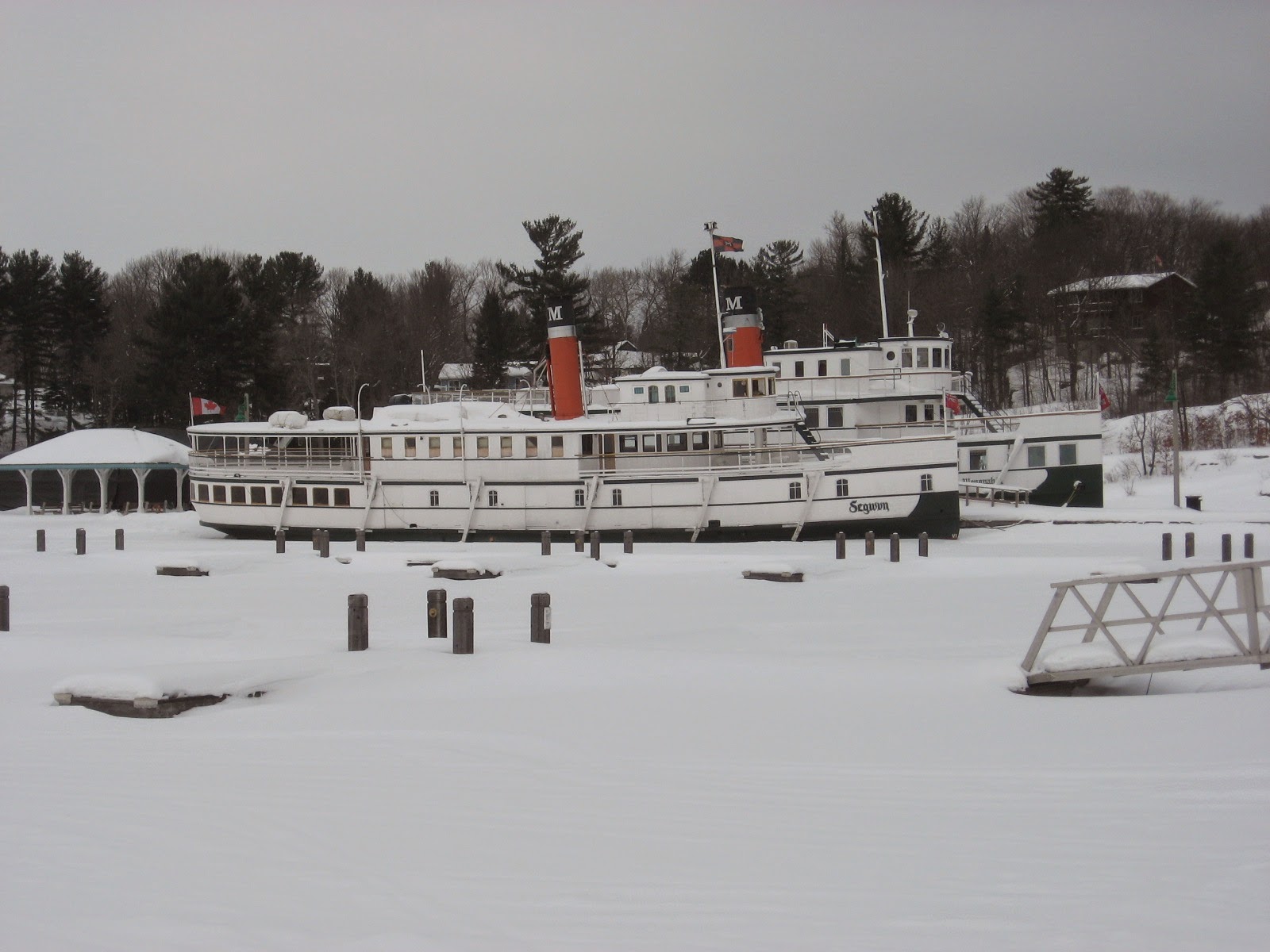
Gravenhurst, on Lake Muskoka, is home to a couple of steamships. One, the RMS (Royal Mail Ship) Segwun (frozen into the ice in the foreground in the picture below), is a true wooden antique and is coal-fired. It is truly amazing to see it in operation, with the coal fires being stoked below (a very hot job in the summer), black smoke belching out of the chimney above and all the brass workings of the ship polished to perfection and in operation.
 
The antique Segwun (foreground) and the replica Wenonah (background).

Historic plaque about steamboating in Muskoka.
We also really enjoyed being warm and able to have a hot shower every day in our apartment. We were able to visit friends and also get through all the usual personal maintenance items, like dental visits, haircuts, visits to accountants/lawyers and property managers etc. G was able to renew his driver’s license which had been a bit of a worry.

The extra time also allowed us to get started on the purchase of some of the boat maintenance items we need before starting our 2011 sailing season. A lot of the items we needed are only available in the U.S. At Christmas, we’d tried importing a couple of replacement manual galley foot pumps into Norway from the U.K. This proved to be so difficult and expensive that we just didn’t know how we were going to be able to obtain the other items. Being in Canada enabled us to quickly get onto West Marine and our other suppliers and order the following  items:

1)      AIS transceiver – I mentioned in a previous post how useful our AIS receiver had been and how we wished we had a transceiver (a unit that both transmits and receives boat info like course/speed, boat name, MMSI number and even calculates the CPA (closest point of approach) and TCPA (time to closest point of approach)).  With this new transceiver, our boat information should now show up on the big ships’ AIS screens. This, of course, assumes that someone is looking at the screen, it is turned on etc., but, we feel that anything that lessens the risk of getting run down is worth it. This year we will again be in areas with very heavy shipping. The transceivers had been quite expensive which is why we didn’t get one before, but, West Marine now has a unit available for only USD$500 which made it affordable. Unfortunately, you have to lay out another USD$200 for a VHF AIS Antenna Splitter so you can share the same coax cable that the VHF radio uses, but, even with the cost of both units, the price is still less than the name brand transceivers by themselves.

2)      Iridium external antenna – Our satellite phone has proved useful at times and is another essential safety item. However, we were very disappointed with its performance. Calls seemed to get continually dropped, even while at sea. Also, it can only be used outside with a clear view of the horizon. So, when it’s dark, the weather is freezing and the wind is howling through the rigging, it isn’t very conducive to going out on deck to make a phone call. In order to make calls from inside the boat we needed an external antenna. We also want to start using the phone to download data (weather grib files etc.), so, we needed an external antenna to do this as well. As usual, the price was out of sight, $600 for a piece of cone-shaped plastic and a bunch of cables. Added to the cost of the phone and the minutes it almost makes me wish we’d gotten an SSB instead, but, the convenience of the phone in an emergency still wins out in my view.

3)      Battery Monitor – we went with the Xantrex LinkLITE monitor this time, hopefully it’s more robust than the last monitor we had.

4)      Boat bits – replacement cabin fans, bilge pump float switches, watermaker filters, replacement Alpenglow light bulbs from Montana, Spurs zincs and bearings from Florida, sail repair items from SailRite in Indiana, diesel solenoid switch from Cape Cod, MA and many other bits and pieces. It’s amazing what’s required to try and keep this boat in good nick.

The only drawback with all this shopping was that we had to lug it all back with us. We just squeaked through on our luggage allowance. We now have just about everything on our list to start our maintenance and upgrade jobs when the weather turns a little nicer here. We’re still working on obtaining a new mainsail to replace our shredded one and also some kind of backup regulator in case our single regulator that controls both alternators (one on the engine and another on the generator) gives out. A new toilet to replace the one that’s been leaking since we left is also on the agenda. Not sure if we’ll have time this year, but, we’d like to replace the corroded bus bars in the panel and redo the throttle cables as well.

We arrived back at the boat on February 23, around 2:30 a.m. The boat was cold, but, fairly dry and warmed up quickly. We learned that there had been a lot of snow while we were gone and a few very cold nights. Our water system was frozen, but, has now thawed out with the warmer weather we are currently experiencing and there weren’t any leaks  (fingers crossed). We see we have some hull paint damage where ice had formed on the fenders and then scraped against the hull.

Daylight is back and it’s now light between 8 a.m. and 5 p.m., marvellous! We missed the National Reindeer Championship races on the main street of Tromsø while we were gone, something I was really looking forward to. Hopefully we’ll see reindeer elsewhere before we leave Norway. You’ll have noticed that leaving is now on our minds. We have started to plan our departure and 2011 sailing. So far, it looks like this:

a)      April/May – boat maintenance

b)      June - in the general Tromsø area enjoying the ‘white nights’ and ‘midnight sun’. We plan to visit the Lyngen Alps area and a few other fjords and anchorages.

c)      around July 1 depart for Svalbard. Svalbard is an Arctic island archipelago about 600 miles further north and only about 600 miles from the North Pole. This destination will be totally dependent on the weather and ice in the area and we may not be able to do it given the limitations of a fibreglass boat.

d)     Around the end of July make a long run offshore to the far south of Norway and through the Goteborg canal into Sweden and the Baltic.

e)      Tour the Baltic for August/September and then we’re not sure yet. We’d really like to end up somewhere warm for next winter, but, we may run out of time and weather, so, we’ll see….


 photo arrow.pngCONTINUE READING