Sunday, 19 February 2017

The same evening as our visit to the Royal Albatross Centre on the Otago Peninsula, near Dunedin NZ, we signed on for a nature tour to a private conservation area where we hoped to see rare yellow-eyed penguins and Hooker Sea Lions. It was a rare dry, golden evening when we arrived at the head where we needed to walk down to the beach for potential viewing. It was a long way down (and a long way back up), but, we were rewarded with great sightings of both. The dot on the beach below is a sea lion.


There were custom-built viewing hides where we could view penguin chicks and their parents. The chicks' eyes turn yellow later.


The yellow-eyed penguin is the largest penguin living in a temperate region. They are very rare and very endangered. There are only 5000-6000 of them left and we felt privileged to view them.
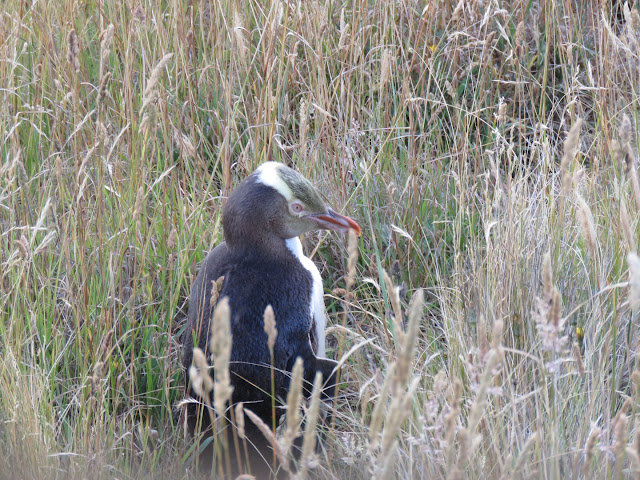

The penguins nest on the grass hillsides. The parents are in the sea all day finding food for the young and starting around two hours before dusk you can see them coming in to the beaches to land.


They climb across the beach and up the hillside, through the grass, to make their way up to the nests to feed the chicks. Here the two parents are flanking a very fat, very well-fed, chick.


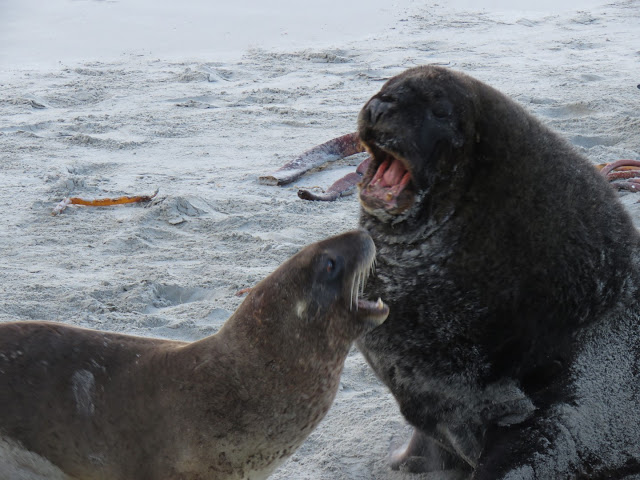
Hooker Sea lions are the rarest of the world's five species of sea lions and are endemic to New Zealand. They are making a comeback on the NZ mainland after being eliminated, by Maori hunting, centuries before the arrival of Europeans. There was no guarantee that we'd see any, but, there was a small group on the beach and we carefully made our way past them. They mostly took absolutely no notice of us. There is a risk that they could charge and their bite can be dangerous if you get in their way and block their escape route. The males can reach up to 3 metres in length, weigh up to 400 kg. and can live to 25 years. Females are smaller. On the beach tonight, there was a large male and a few juvenile males, no females in sight.


They are gregarious animals and enjoy each other's close company. They put on quite a show with lots of play aggression. It was fascinating to watch their sparring.

After viewing the sea lions, we went down to the next bay along the coast where we saw dozens of fur seal pups learning to swim in large tidal rock pools.


It was a wonderful evening and one of the best we've had on our entire trip so far.


 photo arrow.pngCONTINUE READING

Tuesday, 14 February 2017

When we visited Dunedin via cruise ship last November we discovered the existence of the Royal Albatross Centre http://albatross.org.nz/. It would have been expensive to visit as a cruise ship shore excursion. There wasn't going to be much bird activity in November anyway as incubation is just starting then. So, we decided to give it a miss and make a special trip back for a visit in January when it's usually possible to see some chicks. Unfortunately, when we visited, in mid-January, the chicks were still about a week away from hatching, so, we missed them. It was still a fascinating visit nonetheless to learn about and view these magnificent creatures. The first chick was hatched on January 28 and a webcam has been installed, so, you can have a look! www.doc.govt.nz/royalcam


The colony at Taiaro Head (Pukekura) is the only mainland breeding colony in the world of the Royal Albatross. They have been intensively managed, by a charitable organisation, since 1951 and there are now about sixty breeding pairs at Taiaro Head. In 2014, the 500th chick made a first return to the Head.

Access to the nest site is strictly controlled and your admission fee gets you entry into a soundproof building with large glass viewing windows very close to the birds. We went late in the day so the winds would be up and we could see the birds at their best. We were rewarded with wonderful views of about 15-20 albatrosses soaring, gliding, diving and landing right in front of us.

There were a few birds sitting on nests and there were many juveniles about, having a gam, in the long grass.


We stood transfixed for an hour, just watching this rare spectacle. The birds are generally solitary when you see them at sea, far offshore, but, here we were privileged to see a large group interacting with each other.


If you're not familiar with albatross, they have an amazing life cycle and physiology. Albatross are the largest of the world's seabirds with the Royal being the largest of all. It can measure 1.2 metres from the tip of its beak to the tip of its tail and up to 3.3 metres in wingspan!  In the pictures here, you'll note that the wings are very long and narrow and have a third joint in them to support this incredibly long reach.


They can fly at speeds of around 120kph (75mph). They have a special gland in their cheeks that allows them to drink salty sea water. This is a good thing as the only reason an albatross ever comes to land is to breed, the rest of their time is spent at sea.


Each breeding pair only has one egg to raise every two years as it takes a full year, from September to the following September, for the entire cycle to result in just one chick. Once the chicks fledge they are at sea for 4-6 years on average. Parents leave the colony to spend a year at sea before returning to breed again the following year. When they are not breeding, royal albatrosses undertake circumpolar flights in the southern oceans, and in particular like the Humboldt Current and the Patagonian Shelf.


 photo arrow.pngCONTINUE READING

Friday, 10 February 2017

You'll have noticed in the last post that we were very impressed with the small town of Oamaru NZ. It wasn't only the tremendous architecture in the 'Victorian Precinct' that intrigued us, but, also the introduction to another new (to us) subculture, known as 'Steampunk'. What is it? The term was first coined in 1987. Wiki describes it as:

Steampunk is a subgenre of science fiction or science fantasy that incorporates technology and  aesthetic designs inspired by 19th-century industrial steam-powered machinery. Although its literary origins are sometimes associated with the cyberpunk genre, steampunk works are often set in an alternative history of the 19th century's British Victorian era or American "Wild West", in a post-apocalyptic future during which steam power has maintained mainstream usage, or in a fantasy world that similarly employs steam power. Therefore, steampunk may be described as neo-Victorian.

How does this relate to Oamaru. Well, one of the amazing buildings I wrote about in the last post has been repurposed as SteamPunk HQ. http://steampunkoamaru.co.nz/


A sucker for anything steam-powered: old farm machinery, boats, trains, or, industrial machinery, we were intrigued and had to go in for a look. More operational steam would have made it great. As it was, it was very interesting and you have to admire the imagination and artistry that went into it. Unfortunately, the founder and driving force of Steampunk in Oamaru had a too early death, but, his legacy lives on in this gallery and cemented Oamaru's place in Steampunk culture.

 https://www.theguardian.com/world/2016/aug/30/new-zealand-town-oamaru-steampunk-capital-of-the-world


The Town has even picked up on the theme and the local playground has Steampunk elements in its construction as does this cafe by the waterfront.


 photo arrow.pngCONTINUE READING

Sunday, 5 February 2017

We headed south from Christchurch, hugging the east coast, on our way to Dunedin. To be honest, it was a very flat and boring drive. Then, there was Oamaru. Lonely Planet briefly mentioned a 'Victorian Precinct' in the town. It was a good location to stop for the night. We thought we'd have a look. The approach to the town was through the usual ugly strip malls and storefronts with plastic awnings defacing heritage buildings. We thought it was just another town, until we were absolutely blown away by the beauty and variety of the limestone architecture in the 'Precinct'. It is truly a national treasure. We've seen a lot of towns in NZ  by now and there's been absolutely nothing like it anywhere else. The town, to its credit, has realized the importance of its built heritage and formed the Oamaru Whitestone Civic Trust which now owns seventeen of the buildings http://www.victorianoamaru.co.nz/the-buildings.

Oamaru contains over 70 buildings registered as Category 1 or 2 Historic Places in the New Zealand Historic Places Trust register. Many of the buildings, originally grain and wool warehouses, have been repurposed and contain interesting second-hand bookshops, antique stores, artisan and sculpture studios, quality tourist shops, bakeries and cafes. There is still lots of scope for growth. Many of the buildings are still empty, just waiting for someone to bring all the storefronts and fittings/fixtures, still in original condition, back to their former glory. What an opportunity. The buildings, all adjacent to the waterfront and old port area of the town, combine to form an atmospheric area that transports you back in time.

To think, that a small provincial town in NZ, the population today is only 14,000, could have buildings like these, as good as you'd have seen in London at the time, seems an impossibility, but, here they are. Not just one, but, many, many fine examples all packed into just three streets, without a modern interloper to spoil the streetscape anywhere in their midst.


 photo arrow.pngCONTINUE READING

Thursday, 2 February 2017

We needed to get to Christchurch to pick up our 'new' van for the last three weeks of our NZ road trip. We'd been reading in the newspapers about how Christchurch has been 'rebuilding' and some of the many problems they are encountering with money, delays and politics. However, we weren't quite prepared for the shock of seeing the state of the town. Six years after the devastating 2010/11 earthquakes, in which 185 people died, the central business district still looks like a 'bombed-out' area with many buildings collapsed and seemingly left as they fell. Some have been demolished, leaving large, empty spaces, others are fenced off and braced with supports, others were in the process of being demolished. The worst sight of all, though, was Christchurch cathedral, located at the centre of town and its namesake. We read that the Church decided, in 2012, to demolish the building. A local group wanted the building rebuilt. It's now in the courts. Who knows how long it will take to come to a resolution and determine the fate of the building, what's left of it.


Worst afflicted were the stone and brick facades of the beautiful, heritage buildings.


Even new builds weren't immune.


Then, there was this. The botanical gardens have survived, in all their bucolic glory.


It was heartening to see signs of recovery, like this 'Re-Start' mall, built out of discarded shipping containers.


There are still examples of street sculpture.


After leaving Christchurch, we were glad to be back out in the countryside. We paid another visit to Akaroa, which we'd first visited on the cruise ship way back in November. It was great to get the land view this time and what a view it was!


 photo arrow.pngCONTINUE READING

Saturday, 28 January 2017

As mentioned in my last post, the coastal scenery on the West Coast of NZ, from Westport down to Punakaiki (Pancake Rocks), was absolutely spectacular. The Rocks themselves were also stunning and very unusual. It's a very popular tourist stop, just off the highway. From this picture you can see why they're called Pancake Rocks, they are composed of layered limestone reminiscent of thin pancakes.


In addition to the layered limestone, the area is heavily eroded and there are many caverns and blowholes, where, at high tide, the water explodes to the surface, like a geyser.


The Rocks were also home to nesting terns and there were many of them all along the topmost ledges.


 photo arrow.pngCONTINUE READING

Wednesday, 25 January 2017

After leaving the Nelson area, we headed over to the northwest tip of the South Island to explore the top end of the wild West Coast. From Karamea at the top, down to Greymouth. The Coast Road between Westport and Punakaiki (Pancake Rocks) has to be the most scenic coastline we've ever seen, anywhere and that's saying a lot. The road is very narrow and there aren't any places to pull over, so, not many pictures, but, it was spectacular: lush green forest, cliffs, jagged rocks and a wild sea. Along the way, we stopped at Cape Foulwind (love that name) to view the seal colony there. I know I've published a bunch of seal pictures recently, but, really, how could I resist sharing this one.


At the end of road, just north of Karamea, is the start of the Heaphy Track, a five day Great Walk that goes through Kahurangi National Park. We had no plans to do the Heaphy Track, but, there were a couple of short walks at its terminus that sounded interesting, especially the Nikau Palm Forest Walk.

A suspension bridge led into the forest.


A forest of palm trees is just as lush and green as you'd expect.


Occasionally, a glimpse through the forest showed pohutukawa trees blooming red on the hillsides.


The walk led to a scenic lookout over the first beach on the Heaphy Track.


The way back was just as pretty as the way in.


As usual, there was also lots of birdlife to enjoy. These are cormorants, known in NZ as 'shags'.


 photo arrow.pngCONTINUE READING