Here she is, our new (to us) boat!

We are very pleased to be able to announce that we have purchased another boat! After being without a boat for fourteen months (we sold old Gjoa in January 2016) we were beginning to despair of finding anything suitable ever again. Please welcome a new Gjoa (the boat formerly known as Momo-Sailing and most recently, Momo-Saruwa). Strangely, it is another German designed and built boat, just like old Gjoa.

We knew we wanted an aluminium hull, preferably unpainted and were not willing to compromise on that. We had toyed with the idea of buying a catamaran and even went so far as to put an offer on one. Aluminium catamarans are few and far between (or horrifically expensive) and we had some reservations about their handling and ocean-crossing capabilities, so, we started looking at monohulls again. As they say, sometimes the 'devil you know' is the best choice. We had our eye on a couple, but, frankly, they were old, needed work and were rather ordinary. We were heads down into our campervan conversion when something interesting came up and caught our attention. We read the listing avidly until we came to the part about its bilge keels (two small keels) and we were no longer interested. The only bilge-keeled boats we'd ever seen were in the UK, usually sitting forlornly askew in the middle of a tidal mud flat. They had a reputation as rather 'slow pigs' and we didn't want anything to do with one. We decided to keep looking.

A couple of weeks later, I was browsing again and had a closer look at the listing. As we studied it we realized that, other than two keels, this boat had just about everything else on our list of desired attributes. We decided to do a bit of research into twin keels, could they really be so bad? A couple of papers we read convinced us that maybe twin keels weren't so bad after all and actually were even possibly better than single keel boats in a number of ways. For the interested, here is a link to one convincing piece on the 'advantages of twin keels'.
http://www.brayyachtdesign.bc.ca/article_twinkeels.html
Higher sailing speeds were an attractive advantage and this seems to be borne out by a survey done on Momo-Saruwa which indicated sailing speeds of 7-8 knots in 18 knots of wind. We'll believe it when we see it, but, if true, it will be a nice plus. It's interesting that maybe we've ended up with something that's not a catamaran, but, not a traditional monohull either, something almost between the two. We should have higher sailing speeds, a shoal draft (only 1.55 m) and the ability to take the ground like a catamaran, but, with the solid construction, good tracking capability and righting ability of a monohull.

As mentioned in our last post, we had to travel to Langkawi, Malysia in order to view the boat and meet the Swiss owners who were leaving in a few days to return home. The boat lived up to its pictures. The forecabin was built just like on old Gjoa, with sleeping accommodation for two people and storage for an army.

The aft cabin (centre cockpit) was reached by a passage that had limited headroom, but, opened up nicely.

We paid top dollar for the boat, but, were able to rationalize this based on all the new equipment onboard. Hopefully, our maintenance bills should be fairly low for the first few years anyway. There is a brand-new engine and gearbox, Yanmar 75hp 4JH4G-TBE (only ten hours on it!), new 600ah house bank batteries, a new Panda Fischer 8kva generator installed in 2015, new electronics 2015, full insulation (so important, but, impossible to retrofit well in a boat), diesel heater and a full array of creature comforts which we've never had before. With added comforts, though, comes increased complexity and maintenance. Over time, we may try to simplify the boat, but, for right now, we're willing to put the work into learning and maintaining a boat with 12v, 24v and 240v electrical systems along with the aforementioned huge generator that powers an electric cooktop/oven/microwave, 70 lph watermaker, washing machine, hot water, pressurized water, a shower, freezer, fridge, twin autopilots, bow thruster and many other things. The learning curve will be very steep. There is solar and wind power, but, their input is minimal. Tankage is great, 1110 litres diesel. Some of the equipment choices are not what we would have chosen and we'll either get used to them or replace over time.

The boat is a 2001 Reinke 13m Special, designed by German naval architect Kurt Reinke and professionally-built at Rehberger yachts in Bremen, Germany with interior finishing done at Friendship, Switzerland. She is hull number 15, hopefully all the design kinks were worked out in numbers 1-14!

She was built in 2001, twelve years newer than our old Gjoa, and we will be the third owners. Both previous owners were Swiss and even though the first owners were thirteen year liveaboards, the boat is in absolutely immaculate condition, still mostly just like new. The Special designation is because she is slightly longer than the original 13m design (13.95m) and slightly wider (3.98m beam) to accommodate the very thick insulation. Different than any other Reinke we've ever seen, this one has a raised saloon table and nav station that provides seated 360 degree visibility, something we also hoped to get with a catamaran and have gotten it in a monohull instead.


The galley is also 'down', our preferred location and has lots of really bright headroom.

There is a 'proper' engine room with easy interior access. A hatch in the cockpit sole lifts up and provides standing headroom access to the engine and generator.

A very solid aluminum hard dodger, integral to the boat, with windshield (and wiper!) covers the helm position for inclement weather. A bimini for the tropics shades the comfortable cockpit and rounds out the design.

Her hull is 10mm, topsides 8mm, 5mm deck and she weighs 15,000 kg. The hull and decks are unpainted (hooray!) with a non-skid paint partially covering the decks. A fully-battened main, twin headsail rig, running backstays, dedicated trysail track, trysail and storm jib complete a large sail inventory. A sugarscoop and swim ladder provide great access to the dinghy and water. There are many ingenious examples of German design onboard, including interior locking mechanisms for the tank fills, interior sliding bars that lock the anchor locker, cockpit locker and hatches and a locking liferaft compartment on the sugarscoop. The deck on top of the aft cabin is a great place to stage a drogue deployment.
I'm sure that the non-sailors out there have their eyes glazed over about now and you're saying 'enough already'! I could go on and on, maybe the pictures will give you some idea. The pros outweighed the cons on this boat and we decided to go for it. I don't think we'll regret it.
Our plans for 2017 will now include less time on the campervan and a trip to get the boat from Malaysia to Australia. We're not sure yet what our timeframes will be. All will be revealed in due course.

We are very pleased to be able to announce that we have purchased another boat! After being without a boat for fourteen months (we sold old Gjoa in January 2016) we were beginning to despair of finding anything suitable ever again. Please welcome a new Gjoa (the boat formerly known as Momo-Sailing and most recently, Momo-Saruwa). Strangely, it is another German designed and built boat, just like old Gjoa.

We knew we wanted an aluminium hull, preferably unpainted and were not willing to compromise on that. We had toyed with the idea of buying a catamaran and even went so far as to put an offer on one. Aluminium catamarans are few and far between (or horrifically expensive) and we had some reservations about their handling and ocean-crossing capabilities, so, we started looking at monohulls again. As they say, sometimes the 'devil you know' is the best choice. We had our eye on a couple, but, frankly, they were old, needed work and were rather ordinary. We were heads down into our campervan conversion when something interesting came up and caught our attention. We read the listing avidly until we came to the part about its bilge keels (two small keels) and we were no longer interested. The only bilge-keeled boats we'd ever seen were in the UK, usually sitting forlornly askew in the middle of a tidal mud flat. They had a reputation as rather 'slow pigs' and we didn't want anything to do with one. We decided to keep looking.

A couple of weeks later, I was browsing again and had a closer look at the listing. As we studied it we realized that, other than two keels, this boat had just about everything else on our list of desired attributes. We decided to do a bit of research into twin keels, could they really be so bad? A couple of papers we read convinced us that maybe twin keels weren't so bad after all and actually were even possibly better than single keel boats in a number of ways. For the interested, here is a link to one convincing piece on the 'advantages of twin keels'.
http://www.brayyachtdesign.bc.ca/article_twinkeels.html
Higher sailing speeds were an attractive advantage and this seems to be borne out by a survey done on Momo-Saruwa which indicated sailing speeds of 7-8 knots in 18 knots of wind. We'll believe it when we see it, but, if true, it will be a nice plus. It's interesting that maybe we've ended up with something that's not a catamaran, but, not a traditional monohull either, something almost between the two. We should have higher sailing speeds, a shoal draft (only 1.55 m) and the ability to take the ground like a catamaran, but, with the solid construction, good tracking capability and righting ability of a monohull.

As mentioned in our last post, we had to travel to Langkawi, Malysia in order to view the boat and meet the Swiss owners who were leaving in a few days to return home. The boat lived up to its pictures. The forecabin was built just like on old Gjoa, with sleeping accommodation for two people and storage for an army.

The aft cabin (centre cockpit) was reached by a passage that had limited headroom, but, opened up nicely.

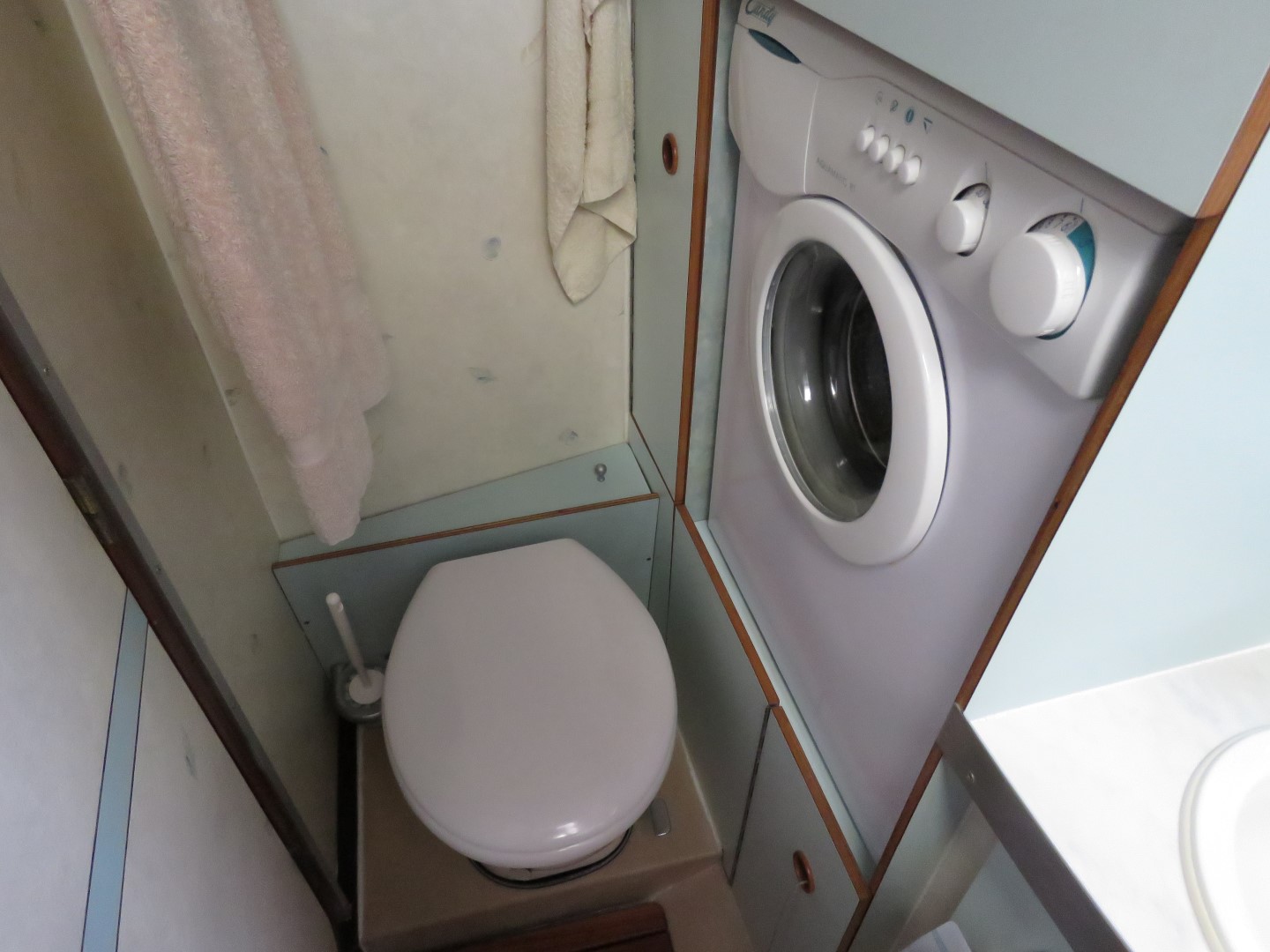
We paid top dollar for the boat, but, were able to rationalize this based on all the new equipment onboard. Hopefully, our maintenance bills should be fairly low for the first few years anyway. There is a brand-new engine and gearbox, Yanmar 75hp 4JH4G-TBE (only ten hours on it!), new 600ah house bank batteries, a new Panda Fischer 8kva generator installed in 2015, new electronics 2015, full insulation (so important, but, impossible to retrofit well in a boat), diesel heater and a full array of creature comforts which we've never had before. With added comforts, though, comes increased complexity and maintenance. Over time, we may try to simplify the boat, but, for right now, we're willing to put the work into learning and maintaining a boat with 12v, 24v and 240v electrical systems along with the aforementioned huge generator that powers an electric cooktop/oven/microwave, 70 lph watermaker, washing machine, hot water, pressurized water, a shower, freezer, fridge, twin autopilots, bow thruster and many other things. The learning curve will be very steep. There is solar and wind power, but, their input is minimal. Tankage is great, 1110 litres diesel. Some of the equipment choices are not what we would have chosen and we'll either get used to them or replace over time.
The boat is a 2001 Reinke 13m Special, designed by German naval architect Kurt Reinke and professionally-built at Rehberger yachts in Bremen, Germany with interior finishing done at Friendship, Switzerland. She is hull number 15, hopefully all the design kinks were worked out in numbers 1-14!

She was built in 2001, twelve years newer than our old Gjoa, and we will be the third owners. Both previous owners were Swiss and even though the first owners were thirteen year liveaboards, the boat is in absolutely immaculate condition, still mostly just like new. The Special designation is because she is slightly longer than the original 13m design (13.95m) and slightly wider (3.98m beam) to accommodate the very thick insulation. Different than any other Reinke we've ever seen, this one has a raised saloon table and nav station that provides seated 360 degree visibility, something we also hoped to get with a catamaran and have gotten it in a monohull instead.


The galley is also 'down', our preferred location and has lots of really bright headroom.

There is a 'proper' engine room with easy interior access. A hatch in the cockpit sole lifts up and provides standing headroom access to the engine and generator.

A very solid aluminum hard dodger, integral to the boat, with windshield (and wiper!) covers the helm position for inclement weather. A bimini for the tropics shades the comfortable cockpit and rounds out the design.

Her hull is 10mm, topsides 8mm, 5mm deck and she weighs 15,000 kg. The hull and decks are unpainted (hooray!) with a non-skid paint partially covering the decks. A fully-battened main, twin headsail rig, running backstays, dedicated trysail track, trysail and storm jib complete a large sail inventory. A sugarscoop and swim ladder provide great access to the dinghy and water. There are many ingenious examples of German design onboard, including interior locking mechanisms for the tank fills, interior sliding bars that lock the anchor locker, cockpit locker and hatches and a locking liferaft compartment on the sugarscoop. The deck on top of the aft cabin is a great place to stage a drogue deployment.
I'm sure that the non-sailors out there have their eyes glazed over about now and you're saying 'enough already'! I could go on and on, maybe the pictures will give you some idea. The pros outweighed the cons on this boat and we decided to go for it. I don't think we'll regret it.
Our plans for 2017 will now include less time on the campervan and a trip to get the boat from Malaysia to Australia. We're not sure yet what our timeframes will be. All will be revealed in due course.
 CONTINUE READING