Friday, 23 November 2018

In the past, we've visited quite a few areas of Wales: we've climbed Snowdon, sailed 'The Swellies' (got to love that name) in the Menai Strait, walked on spectacular beaches, visited enchanting Portmeirion and many other coastal villages. What we've seen so far has only whetted our appetite for more though. Wales is a fascinating country with plenty of history and natural beauty. Cardiff, the capital city of Wales, is only a one hour train journey from Bristol and we recently went for a visit, planning to walk the six mile circular footpath around Cardiff Bay.

Alighting at the main train station meant an additional walk of about one km, through some rather depressing housing estates, to the waterfront where things improved greatly. The waterfront area is still under development, but, the scale of the development is quite staggering. They've actually enclosed Cardiff Bay from the sea with a man-made Barrage and lock system. As a result, the Bay is now fresh water. You have to wonder about the environmental impact of this and there was significant controversy at the time (mostly about construction cost, not environmental impact), but, the Bay was probably always brackish anyway as two significant rivers, the Taff and Ely, drain into it. There is a fish ladder so the fish can still bypass the locks and get in and out. For humans, it has become a lovely place for sheltered sailing, walking and cycling.


First on the path was a mixed area of new bars, restaurants and entertainments alongside the old Pierhead Building, built in 1897.


...behind which was the new Wales Millenium Centre.


We then made our way along the barrage, with the sea on one side and the Bay on the other.


Along the way was a large display of picture boards noting that Cardiff was the departure point of Captain Scott's ill-fated expedition to be first to the South Pole which resulted in death for him and four of his crewmembers. His expedition ship left from this point on June 15, 1910.


At the end of the Barrage, past the locks, was part of the old harbour complex consisting of a rather nice Custom House, now converted into two restaurants and beside it, in an enviable location, a very beautiful  ruin, just waiting for someone to purchase it and hopefully make a go of it.


Heading back to town, we came across the Cardiff International White Water centre.


If you're not familiar with this type of complex, they consist of a man-made 'river' of white water to learn and practice moving water skills in a controlled environment. The level, force and path of the water can all be adjusted. We got there just at the right time to see groups coming down in all types of craft.

This open canoe came down backwards with a kayaker on guard.


Their second attempt was better.


This raft smashed into the barrier at the top, went vertical and then right over spilling the people into the water. When this picture was snapped, a couple of people were still underneath the raft, not a fun place to be.


This raft executed their transit perfectly which resulted in relaxed-looking big smiles all round!


 photo arrow.pngCONTINUE READING

Friday, 16 November 2018

On yet another glorious autumn day (how much longer can it last?!), we headed out to walk the southernmost ten miles of the Offa's Dyke Path, another of the fifteen National Trails in England and Wales. Starting out from Bristol, we took the bus to Chepstow, the southern terminus. Chepstow is also the start of the Wales Coast Path which incorporates another of the fifteen National Trails, the Pembrokeshire Coast Path. Chepstow, as detailed in the previous post, was a great destination in its own right, but, our day's walk beckoned and so we quickly headed out of town.


We hadn't given much thought to the rather unusual name of the path, but, it turns out that 'Offa' was actually a person, an Anglo-Saxon king of Mercia from 757 to 796. The 'dyke' part of the name refers to an earthen bank and ditch that he ordered built. It was about 150 miles long, 20m wide and 2.5m high and was dug by hand and completed in the eighth century. Nobody really knows why it was built and from the portion we viewed it didn't seem like it would have been very effective to repel Welsh invaders, if that was the intent. The National Trail, 177 miles long, mostly follows the route of the dyke and the current English/Welsh border.


Along the way, views of the River Wye were spectacular...


...as was this view of the ruins of Tintern Abbey, from the Devil's Pulpit lookout.


The trail was varied: from shady forest paths...


...through to imposing country estates.


We were only out for a day's walk, so left the path at the village of Brockweir where we could catch a bus back to Chepstow. Unexpectedly coming across this 14th century monk's house was a great end to another great day out. Later, looking it up online for more historical information, imagine my surprise that you can rent this property as a holiday let! From the website, it looks like they've done a fabulous job on the interior. Have a look, The website states that it is a:
"...truly historic building, which once belonged to the monks of Tintern Abbey, and which is believed to be the oldest house in the Wye Valley, this beautiful property bears witness to the passage of many centuries. Originally a 12th-century monks’ hall with an ‘undercroft’ below for animals, and extended in the 14th-century, Monks Hall has recently been carefully renovated and furnished to provide a romantic, atmospheric place to stay."

 photo arrow.pngCONTINUE READING

Friday, 9 November 2018

We were heading out for the day to walk the southernmost ten mile portion of the Offa's Dyke National Trail (more on that in the next post) and started with a bus from Bristol to Chepstow. As the bus wove its way over the Severn River Bridge we seemed to cross the England/Wales border multiple times and we realized we weren't sure which country Chepstow is in. Actually, it's in both. The main town is in Wales, on the western bank of the river Wye, while the adjoining villages on the eastern bank of the river are in England. The town turned out to be a delightful surprise, worthy of a visit in its own right, having been a medieval port with a walled town and the oldest surviving stone castle in Britain.

The dramatic castle ruin is perched on the limestone cliffs overlooking the River Wye.


Seen from the town side, the castle looks more intact.


The riverside area adjacent to the Castle had interesting sights as well. This elegant cast iron bridge was built in 1816.


Across the river we could see the Gloucester Hole, an enlarged natural hole in the limestone cliff opposite. Forming a natural warehouse, cargo used to be unloaded from ships anchored to the wall. It must have been a nightmare for ancient (and modern) boats trying to navigate this river. The tides are the fastest on earth and can rise 13 metres (43 ft.) in just four hours. The tides at Chepstow and the Severn Estuary are second in height only to the Bay of Fundy in Canada. The river 'reverses' and changes direction of flow four times a day.


The town itself was not to be outdone. The town gate and part of the wall is still intact.


The high street was busy with many small specialty shops. Civic pride was evident everywhere. Something we've not seen in any other town are the plaques set into the pavement giving the history of the use and occupancy of the shop it marked, so interesting and what a great idea....


Some of the art installations were also unique...


Many narrow, quaint streets were just waiting to be explored.


We didn't spend as long as we would have liked in Chepstow, our day's walk was beckoning, but, it was such an interesting place we may come back to have a better look!


 photo arrow.pngCONTINUE READING

Friday, 2 November 2018

I don't know about you, but, I'm a sucker for anything steam-powered: boats, cars, farm machinery, but, especially trains. So, when we learned of the close-by West Somerset Railway, well, we just had to visit the longest (twenty miles) steam heritage railway in England. The train runs between the village of Bishops Lydeard and Minehead. There are eight additional stations along the route, all renovated to the period.


It's mostly a volunteer-run organization and you could tell it's a labour of love by the effort put into keeping the various locomotives polished and painted until they gleamed.


Coal-fired (you can just see the fire's glow in front of the engineer below) we chugged away from the station in a cloud of smoke. We sat in the car directly behind the locomotive to be sure we got the full physical effects of the steam powered motion and sound. It was 'interesting' to feel the train lean significantly when the track curved, no modern leveling devices on these trains.


Our journey was a return trip to and from the seaside town of Minehead. The two hour stopover in the town was an added bonus. It was a cold day with a biting wind, but, it's never too cold to have a fish and chip feed on the seafront, although we skipped the traditional whipped ice cream cone crowned with a Cadbury Flake. We had to leave room for the cream tea included as part of our ticket for the return journey.


After the fish and chips, we wandered around the town and were interested to note that it's the start of the South West Coast Path, 700 miles from Minehead to Poole, maybe someday...


Today, we only completed the first 1/4 mile!


The lifeboat station was a fantastic building, but, a very long way from the water.


We wondered how this pub got its name...


...and enjoyed the old houses with October gardens still in bloom.


Back on the train for the return trip, the afternoon cream tea was very generous and tasty, but, unfortunately not very elegantly presented, no white linens and china cups/saucers on this trip. Tea in a paper cup just doesn't taste the same does it? It was still lovely though and made us remember when we used to travel weekly on the Art Deco 'Brighton Belle' Pullman train back in 1971, London to Brighton in one hour. It was a bit rough around the edges then, just a year before it was retired (built 1932, retired 1972), but, what an experience it was for two teenagers! It seemed the height of luxury with white tablecloths, a little lamp on the table and impeccable food service all enjoyed along with the passing scenery. Apparently, there is a project underway to restore the Brighton Belle, not a steam train, but, all-electric and fabulous, let's hope it happens. It will be a train journey not to be missed.


 photo arrow.pngCONTINUE READING

Friday, 26 October 2018

We'd heard good things about Malmesbury, Wiltshire and as it was close by, we decided to go and have a look at this medieval market town. It was a very pleasant day out. Malmesbury Abbey is one of the highlights. Founded in 675 it has had a continuous history since then. Æthelstan, the first King of England, was buried here in 939 (he was disinterred in the 11th century and reburied nearby).
Although it's now mostly in ruins with only about half of the building still standing, there is an intact section of the nave which is still in use as a church. Unusually, it also has a small cafe in the nave as well and it was very nice to be able to sit and enjoy a cuppa along with the ambience.


There were 'newer' delights as well, like this charming hotel and restaurant which looked very inviting. Adjacent to the Abbey, it was built in 1220 as the Abbey guest house. It's now The Old Bell hotel and claims to be the oldest hotel in England.


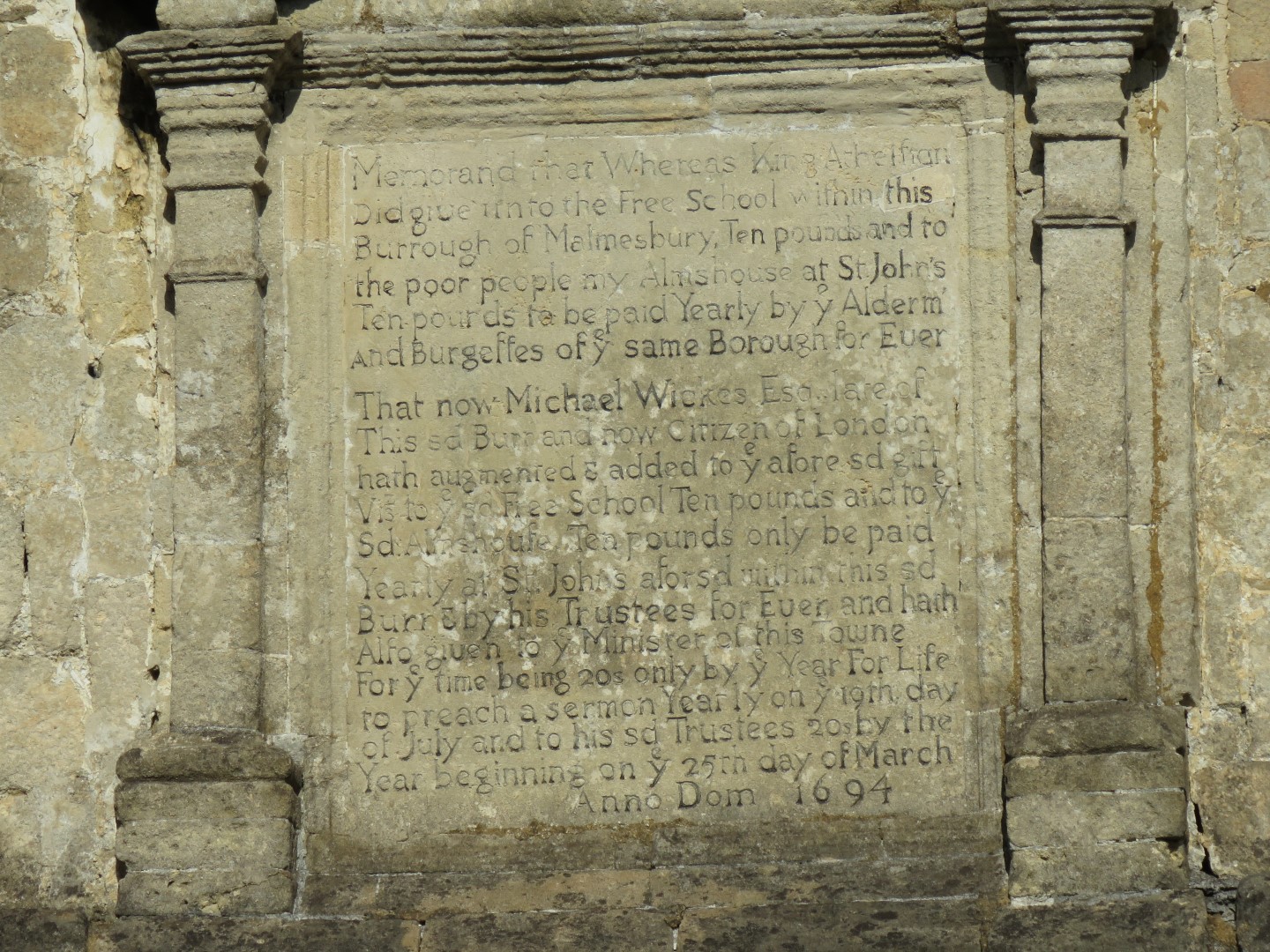
We walked the circular walk by the river and encountered many other intriguing sights, like this old archway, probably 12th century, on the site of a medieval hospital, chapel and Almshouse complex.


The plaque, above and to the left of the arch, dates from 1694.


The old Silk Mills complex, built 1793, has been turned into modern flats without compromising the architecture.


It also seems the residents have a sense of humour. Along a public footpath, attached to a rather ordinary suburban house, we came across this art installation. Look closely at the figure perched on the lintel.


 photo arrow.pngCONTINUE READING

Wednesday, 3 October 2018

The weather has turned decidedly autumnal now. Temperatures have cooled off, but, it's been surprisingly dry and the sun is still warm, perfect weather for walking. We've been taking advantage.


We're blessed in this part of the country with mostly easy walking and lots to see on the trail. There is a national trail nearby, the Cotswold Way, with easy access, by local bus from Bristol, to its southern end.

The trail runs from Chipping Campden in the north, to Bath in the south. So, far we've done all the day accessible bits of the trail, from Alderley to Bath, about thirty miles of the total 108 miles and hope to finish it all someday. The trail is well-marked, easy to follow and not crowded.


With the perfect weather it's been a pleasure to stroll along and pass through field, forest, manicured estate grounds, bucolic villages and many ancient sites and monuments. In just the third of the trail we've done so far, we've encountered a number of monuments and follies.


We've walked through many large estates, like Dodington Park, home of Sir James Dyson. We were unable to see the house, hidden from view by newly planted forest, but, the landscaped park we passed through, laid out by Capability Brown, was manicured beyond belief and so picturesque.


We wished we had had time to go inside Dyrham Park, built late 17th century, a National Trust property that was the setting for the film Remains of the Day, but, it was getting late, so, a walk by the gates was all we did.


There were also 'small' estates, like this lovely home...


We weren't short of interesting village sights either.


Did you ever wonder what would happen to all those iconic red telephone boxes that are now mostly obsolete?  In Old Sodbury, they've found an interesting solution, a combination defibrillator station and lending library!


Rural sights also abounded, from curious sheep...


to miles of dry stone walls, built without mortar. This example is new, but, there were many miles of original walls to see and marvel at the skill required to build them to last hundreds of years.


We approached Bath along a ridge which provided this spectacular view over the town.


We then descended into the town and right by the iconic Royal Crescent.


We're hoping the weather holds for a while longer to enable many more enticing days out on the trails.

 photo arrow.pngCONTINUE READING