Thursday, 31 March 2011

This winter we thought we’d have lots of time to rediscover the joys of skiing, both downhill and cross-country. What with one thing and another, events have conspired against us and we’ve hardly done any skiing at all. January was dark and most of February was spent in Canada. March seemed to be our last chance to get serious if we were going to do it. There certainly wasn’t a shortage of snow as it snowed almost every day all month.

I have previously mentioned the downhill ski trips to Snowman Resort (Målselv Fjellandsby) with Celia. We had bought a three-day lift ticket so were eager to get our third visit in. We set out in early March in a car Celia had borrowed from a friend. We were enjoying the drive to the resort in the clear morning and it promised a great day. We were almost there when all the dashboard lights lit up. Not sure what was happening we pulled over and tried a few things. The car started again and the lights had gone away, so, we continued on our journey rather nervously. I kept looking at how narrow the road was. There weren’t any shoulders due to the amount of snow that had been banked steeply on either side. After about 10km, I started to relax, we were almost there. Then, the car started to cough and splutter and we lost power. We were on a curve and there was just no way to get off the road. We rounded the corner and just coasted into the only bus stop lay-by for miles. Relief!

Luckily, Celia speaks Norwegian so we were able to call a tow truck. While waiting for the tow truck driver to call us back we both really needed to find a washroom. We were in the middle of nowhere. It was impossible to leave the road due to the deep snow. We thought if we opened the car door into the snowbank it would provide enough privacy and that’s what we did. As we’re both crouched down, each behind a door, the phone rings. I answer and hand it to Celia. As she’s multi-tasking talking to the driver while continuing to crouch, we notice over our shoulders that a car is pulling out of the driveway right beside us. So much for our privacy. The driver pulls up and now Celia has three tasks in process: talking to the driveway car driver to determine where we are, relaying our location to the tow truck driver, all while she is two inches off the ground with her knickers down. I start to laugh and all three of us (the car driver was a middle-aged lady luckily) end up in gales of laughter. The tow truck driver on the phone couldn’t figure out what was so funny. That was the last bit of fun for that day. We were towed into the nearest town where we had to leave the car for repairs. We got the bus back to Tromsø and although we were only a couple of miles from the resort, there was no skiing to be had that day.

 
Celia and our disabled car.
We haven’t done much cross-country skiing over the last few years, but, used to enjoy it although it can be really hard work. When we found out that there was a cross-country ski trail running the full length of Tromsøya (the island on which Tromsø is located) and also ski trails through the surrounding mountains we thought we’d like to take it up again. We had noticed used skis in the Salvation Army store earlier. We should have bought them while we had the chance. Now, in March, there just weren’t any to be had. G was able to borrow a set from a friend. I found a store that rented them. We decided to try the hut-to-hut network in the mountains above Tromsø. It was to be a three night outing, staying at a mountain hut each night.

The mountain huts belong to the Norwegian Trekking Association (www.turistforeningen.no/english). This is an amazing organization that has been in existence for 160 years. They manage a network of 20,000km! of marked hiking trails,  7,000km of cross-country ski trails and 460 cabins which criss-cross the entire country. They also have guided tours. The cabins range from fully staffed lodges that provide meals to very basic huts that provide emergency shelter only. The cabins above Tromsø are self-service. This means they are fully equipped with beds, kitchens/cookware, wood stoves and firewood. You only need to bring sleeping bags and food. Cabin prices are very reasonable, only about $40 if you are a member and not much more if you aren’t. With wonderful facilities such as this, it’s no wonder the Norwegians love the outdoor life so much.

So, with our borrowed and rented equipment, including a borrowed backpack and one pack of our own, we set off. The weather forecast indicated light snow and winds with grey skies and temperatures around 0 for the next nine days. We were hoping for a few clear patches in this dismal forecast. We left late as we’d been told the first hut was only a few hours of easy skiing away. We took the bus to the start point and set off. Our map reading and compass skills were rusty and we ended up skiing quite a bit out of our way, first up above the treeline and then down to the river. We had a GPS, but, of course this only indicates a straight line to the destination, it doesn’t show you the best way through. The hut is next to the river so we thought we could use it as a ‘handrail’ to guide us there, so, downhill we went. We ended up bushwhacking through dense brush and it wasn’t fun. We decided to retrace our steps back up the hill. By now it was getting on for 17:00 with only about an hour’s daylight left. Our pack had also started to disintegrate at the shoulder straps. We had nothing to repair it with and if it broke we’d be in big trouble. Things were getting a little serious as we didn’t want to be out there after dark.

About half-way back up the hill, over to the right, I saw a rather unnatural looking squared-off ridge where it looked like the snow had been cut off. We didn’t see this on the way down. Looking to the left, it became immediately obvious that there was a cut through the trees! So, we had a decision to make, left to the hut which must be just a mile or so through the cut, or, back to the road to try again another day. Due to the equipment problems, we decided for the known path back to the road and arrived just after dark. It was lucky we made this choice for we found out that the weather forecast had been changed at the last minute and we were now in for a big snowstorm and high winds the next day. We also found out that there is a groomer which drives from Tromsø once a week across the ski trail! All you have to do is follow its path. There was so much fresh snow and no tracks, so, we didn’t see the path and weren’t looking for it as we weren’t aware it existed. Anyway, we felt a bit like fools, but, better safe than sorry. We are planning to try again in April. People tell us that skiing in the mountains is possible even in May/June. We’ll probably be too busy with the boat then, but, we would like to see and experience the huts. Will keep you posted…

When we do get up to the huts it will probably look a lot like the following photos. These were taken from the cable car running up the side of the mountain which overlooks the boat. The forecast for this day was heavy snow. As you can see, it was a glorious day without a flake in sight and we took full advantage of it. Being able to just ‘seize the day’ is one of the joys of being retired and more in control of your own time.


On the sailing front, we have ordered our new mainsail from Mack Sails in Florida. It will be a fully-battened main, with a ‘Strong Track’ track slide system and a set of lazyjacks. We have measured up for our new toilet and will be ordering it this week. We’re just going with a basic, manual Jabsco as you can get these anywhere and will therefore be easy to replace/repair in future. Now all we need is some better weather to get started on our boat jobs. There is still tons of snow on the boat and it’s a little too cold to be working outside. We’ve been told that a hot summer’s day in Tromsø is about 15C, so, maybe the wait for warmer weather will be a too long one. We need to get started soon as we’d like to be underway sometime in June.

After much studying of various charts, books and pilots, we have refined our sailing plans and have decided that our goal for this year’s cruise is Barcelona, Spain. We’d like to be there by November and stay over for the winter. There could be a lot of reasons why we might not make it all the way, but, we need to have a goal to aim for. It will be about 4,000 miles of sailing. The Baltic cruise will be cut a little bit short as we’re now planning to traverse the French canals from Calais, through Paris and out into the Med near Marseilles with a final sprint across to Barcelona. The mast will need to come down for the canal trip. We also need to stick with the main canals. At 1.8 metres water draught and 3.2 metres air draught, Black Sheep II is at the maximum dimensions. We expect we might touch bottom in a few places, but, as long as there isn’t a drought this summer we should be able to squeeze through. It is surely a better choice than going around the outside and across the Bay of Biscay in October when the conditions can get really bad.


 photo arrow.pngCONTINUE READING

Monday, 28 February 2011

As I briefly mentioned at the end of January’s post, we had to make an unplanned trip back to Canada for three weeks to visit A’s mother who was ill in hospital. We made it just in time to say a very quick farewell as she passed away within twenty-four hours of our arrival, on January 31, 2011. The death was not unexpected as she was eighty-four and had been ill for many years. In a way, we felt relief that it was finally over for her as the last year had seen her lose her independence and mobility, a very difficult burden to live with for a fiercely independent person. We were also grateful that it happened at a time when we were not out sailing and were therefore able to quickly pick up and travel.

My mother left England in 1957 and lived for over fifty years in Canada where two of my brothers were born. Her ‘Englishness’, however, remained intact through all those years and England is where she chose to be for her final resting place. On the way back to Norway, we had a two day layover in England. This enabled us to take her ashes to Mortlake Cemetery, in London. The cemetery is adjacent to the Chiswick Bridge and fronts right onto the River Thames. It was a typically, grey, dank, cold English day, but, the crocus and daffodils were almost ready to bloom and it was green with the promise of spring. We met other family members there and put Mum to rest in the Rose Garden. She has now come full circle back to England.
 
Gates to Mortlake cemetery.
After the family meeting at the cemetery, we had lunch at an adjacent pub, the Ship Inn. Even though the weather was cold, there were rowers out on the river in front of the pub.
On the first of our two-day layover in England, waiting for our connecting flight from Gatwick to Tromsø, we went up to London in search of a chandlery. We were hoping to pick up some cruising guides to help in planning our 2011 sailing season. We were fighting to stay awake having been up all night, but, forced ourselves to walk around Westminster for three hours looking at old haunts. It had been many, many years since we’d been by Buckingham Palace and Big Ben etc. Although we didn’t get the guides we wanted, the walking tour was a lot of fun. Here are a few photos from our quick tour:
 
Big Ben, of course. Nice to see it all freshly restored and without scaffolding.
The Household Cavalry barracks adjacent to the Palace.
 
Westminster Cathedral]
 
 
Westminster Abbey
Although the primary purpose of our trip was sad, there was also a side benefit in that we found ourselves with some time, after the first week, for other pursuits.

Muskoka, in February, can be very pleasant when it’s cold, sunny and with those brittle, blue skies against white snow that you only see in the North. We found the brilliant sunshine blinding at first as we two moles hadn’t seen any direct sun for two months, but, soon got used to it and enjoyed the sun’s warmth. We were hoping to be able to get out cross-country skiing, but, ran out of time. We were able to get out for a skate on Lake Muskoka though and although out of practice and wobbly it was fun.
A skating on Lake Muskoka, I do have skates on my feet here although they’ve been chopped out of the picture.

G skating on Lake Muskoka
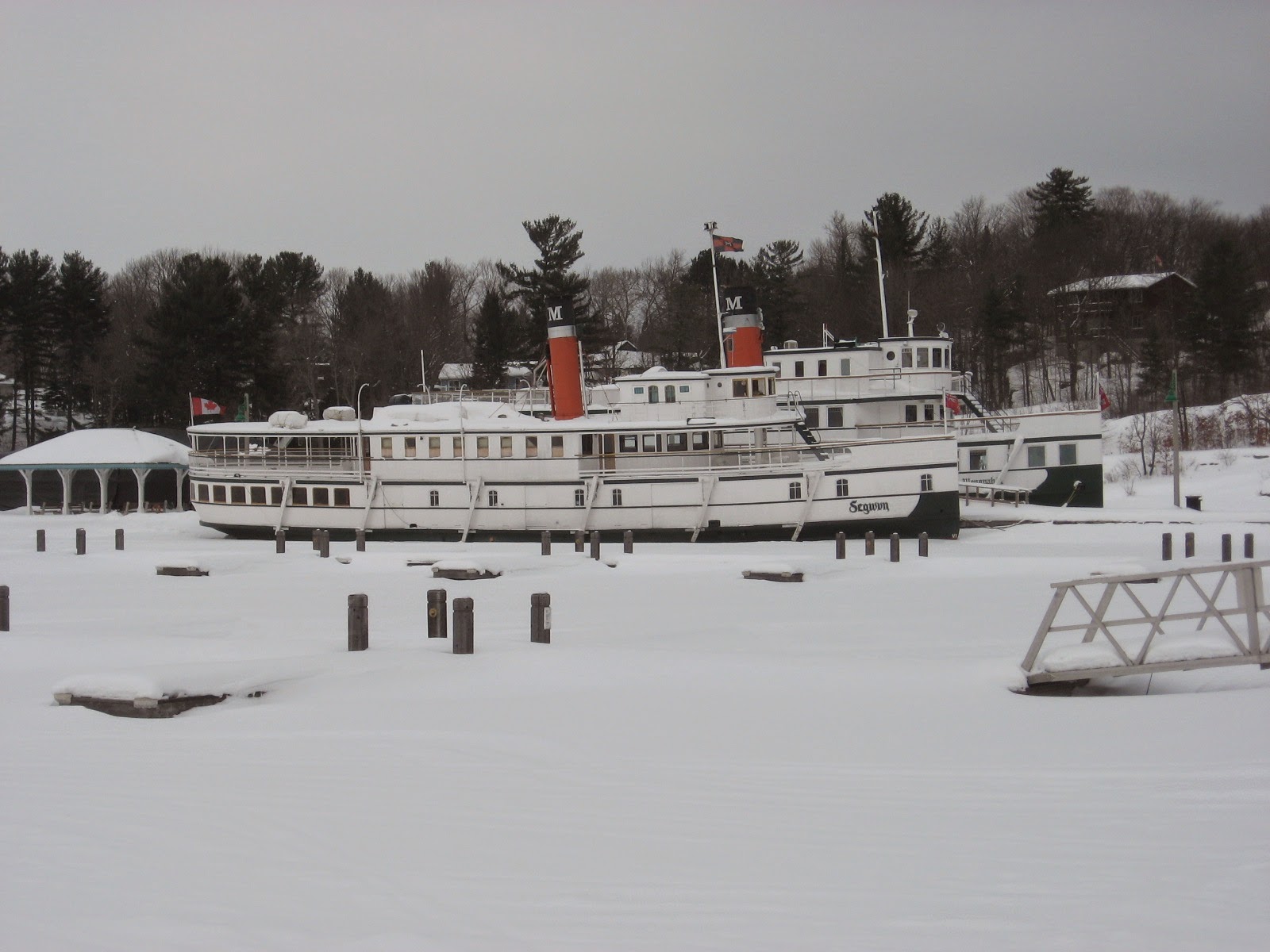
Gravenhurst, on Lake Muskoka, is home to a couple of steamships. One, the RMS (Royal Mail Ship) Segwun (frozen into the ice in the foreground in the picture below), is a true wooden antique and is coal-fired. It is truly amazing to see it in operation, with the coal fires being stoked below (a very hot job in the summer), black smoke belching out of the chimney above and all the brass workings of the ship polished to perfection and in operation.
 
The antique Segwun (foreground) and the replica Wenonah (background).

Historic plaque about steamboating in Muskoka.
We also really enjoyed being warm and able to have a hot shower every day in our apartment. We were able to visit friends and also get through all the usual personal maintenance items, like dental visits, haircuts, visits to accountants/lawyers and property managers etc. G was able to renew his driver’s license which had been a bit of a worry.

The extra time also allowed us to get started on the purchase of some of the boat maintenance items we need before starting our 2011 sailing season. A lot of the items we needed are only available in the U.S. At Christmas, we’d tried importing a couple of replacement manual galley foot pumps into Norway from the U.K. This proved to be so difficult and expensive that we just didn’t know how we were going to be able to obtain the other items. Being in Canada enabled us to quickly get onto West Marine and our other suppliers and order the following  items:

1)      AIS transceiver – I mentioned in a previous post how useful our AIS receiver had been and how we wished we had a transceiver (a unit that both transmits and receives boat info like course/speed, boat name, MMSI number and even calculates the CPA (closest point of approach) and TCPA (time to closest point of approach)).  With this new transceiver, our boat information should now show up on the big ships’ AIS screens. This, of course, assumes that someone is looking at the screen, it is turned on etc., but, we feel that anything that lessens the risk of getting run down is worth it. This year we will again be in areas with very heavy shipping. The transceivers had been quite expensive which is why we didn’t get one before, but, West Marine now has a unit available for only USD$500 which made it affordable. Unfortunately, you have to lay out another USD$200 for a VHF AIS Antenna Splitter so you can share the same coax cable that the VHF radio uses, but, even with the cost of both units, the price is still less than the name brand transceivers by themselves.

2)      Iridium external antenna – Our satellite phone has proved useful at times and is another essential safety item. However, we were very disappointed with its performance. Calls seemed to get continually dropped, even while at sea. Also, it can only be used outside with a clear view of the horizon. So, when it’s dark, the weather is freezing and the wind is howling through the rigging, it isn’t very conducive to going out on deck to make a phone call. In order to make calls from inside the boat we needed an external antenna. We also want to start using the phone to download data (weather grib files etc.), so, we needed an external antenna to do this as well. As usual, the price was out of sight, $600 for a piece of cone-shaped plastic and a bunch of cables. Added to the cost of the phone and the minutes it almost makes me wish we’d gotten an SSB instead, but, the convenience of the phone in an emergency still wins out in my view.

3)      Battery Monitor – we went with the Xantrex LinkLITE monitor this time, hopefully it’s more robust than the last monitor we had.

4)      Boat bits – replacement cabin fans, bilge pump float switches, watermaker filters, replacement Alpenglow light bulbs from Montana, Spurs zincs and bearings from Florida, sail repair items from SailRite in Indiana, diesel solenoid switch from Cape Cod, MA and many other bits and pieces. It’s amazing what’s required to try and keep this boat in good nick.

The only drawback with all this shopping was that we had to lug it all back with us. We just squeaked through on our luggage allowance. We now have just about everything on our list to start our maintenance and upgrade jobs when the weather turns a little nicer here. We’re still working on obtaining a new mainsail to replace our shredded one and also some kind of backup regulator in case our single regulator that controls both alternators (one on the engine and another on the generator) gives out. A new toilet to replace the one that’s been leaking since we left is also on the agenda. Not sure if we’ll have time this year, but, we’d like to replace the corroded bus bars in the panel and redo the throttle cables as well.

We arrived back at the boat on February 23, around 2:30 a.m. The boat was cold, but, fairly dry and warmed up quickly. We learned that there had been a lot of snow while we were gone and a few very cold nights. Our water system was frozen, but, has now thawed out with the warmer weather we are currently experiencing and there weren’t any leaks  (fingers crossed). We see we have some hull paint damage where ice had formed on the fenders and then scraped against the hull.

Daylight is back and it’s now light between 8 a.m. and 5 p.m., marvellous! We missed the National Reindeer Championship races on the main street of Tromsø while we were gone, something I was really looking forward to. Hopefully we’ll see reindeer elsewhere before we leave Norway. You’ll have noticed that leaving is now on our minds. We have started to plan our departure and 2011 sailing. So far, it looks like this:

a)      April/May – boat maintenance

b)      June - in the general Tromsø area enjoying the ‘white nights’ and ‘midnight sun’. We plan to visit the Lyngen Alps area and a few other fjords and anchorages.

c)      around July 1 depart for Svalbard. Svalbard is an Arctic island archipelago about 600 miles further north and only about 600 miles from the North Pole. This destination will be totally dependent on the weather and ice in the area and we may not be able to do it given the limitations of a fibreglass boat.

d)     Around the end of July make a long run offshore to the far south of Norway and through the Goteborg canal into Sweden and the Baltic.

e)      Tour the Baltic for August/September and then we’re not sure yet. We’d really like to end up somewhere warm for next winter, but, we may run out of time and weather, so, we’ll see….


 photo arrow.pngCONTINUE READING

Monday, 31 January 2011

January, the first month of a new year was also a month of firsts for us.

First time to see the Northern lights in Tromsø. Although they are visible a lot here, they can happen anytime during the dark hours and they don’t often last long. You have to be in the right place at the right time. As we aren’t out much at night, we were beginning to despair of ever glimpsing them. We set up a watch system with Tevakenui and Mark gave us a knock on the hull late one night and there they were! A long curtain of shimmering pale green that arced right over us, wonderful!

First time to see the returning sun. January 21 was the day the sun came back over the mountains in Tromsø. Although it was a cloudy, snowy day and we couldn’t actually see the sun, it was a town celebration anyway. It is a tradition to celebrate by drinking hot chocolate and a solbolle (‘sun bun’) which is a kind of donut (more like a hot cross bun) filled with custard. We enjoyed ours but will have to wait to actually see the sun. The days are noticeably lighter now and it can only get better from here.

My favourite Tromsø building - photo museum Perspektivet
First time to eat reindeer. Celia, our new friend, invited us to dinner at her student residence and we enjoyed a lovely meal of reindeer. It was very tasty. She had threatened to serve us mølje as it is the season for it. This is some kind of mixture of cod livers and cod roe. We politely declined. She also threatened to serve us rakfisk (rotten fish), which sounds just as good. I don’t have all the details, but, they actually bury fish underground for a while, then, dig it up and eat it. The uric acid involved in the decaying process serves to tenderize the fish. Writing this, I’m sure you think I’m pulling your leg, but, it’s really true. Rakfisk is different from lutefisk which is cod marinated in lye which sounds equally appetising!

At the reindeer dinner party at Celia’s, we met Karsten and Helge, from Germany. Karsten is an executive chef on the Hurtigruten (coastal steamer) and it was fascinating to learn behind the scenes stories of a cruise. Helge is a geophysicist/glaciologist doing research at the Polar Institute. I have never met so many PhD’s/scientists in one place as there are here in Tromsø. It’s an amazing place with the University, teaching hospital and Polar Institute drawing brilliant people from all over the world. This week there is a large contingent in town for a major Polar conference. Norway, of course, is a polar nation and Svalbard, with its true Arctic environment, is researched extensively. Norway also has a large research station on Antarctica. Many of the scientists from here relocate to the research station to do research during the Antarctic summer season (i.e. now).

First time skiing in Norway. Celia was able to borrow a car and A went off for a day’s downhill skiing to Målselv Fjellandsby (Snowman resort). This was about a two hour drive southeast of Tromsø. What a treat to get out in a car, the surrounding area has absolutely spectacular scenery with mountains all round. The pastel colours of the sunrise on the mountains and unfrozen fjords were superb. The skiing was excellent, a small, uncrowded resort with great snow. I had no trouble getting down the hills, although they were challenging. My problem occurred in getting back up them! As a spoiled North American used to chair lifts and gondolas, the basic bobble and t-bar lifts provided proved to be a big challenge. I felt like a beginner again as I either fell flat on my face trying to attach myself to the lift at the beginning, lost balance and fell over half-way up, or, in one memorable case, got dragged up the side of a hill hanging on for dear life. It was all very entertaining for Celia to watch. I, however, had to swallow my pride and nurse my aching shoulders and triceps for days afterwards. Some of the lifts were very long and unlike a chair lift where you get a nice respite between runs, the manual lifts required effort to hang on and it felt like you were skiing uphill as well as downhill. It proved to be quite tiring. We are hoping to get in some cross-country skiing as well, possibly even a hut-to-hut overnight trip. However, when we went to buy some used skis last week, there wasn’t anything left, so this will depend on ski availability.

First time at an international film festival. When we first heard that there was an international film festival here in January, we wondered why you’d ever pick dark, cold, January to hold it. On further reflection though, it became obvious. It’s a great diversion for the dark time. We had heard that many volunteers were needed and with visions of spending a few days working inside nice, warm, dry, comfortable theatres, maybe ticket-taking, along with a few free movies as well we decided to become volunteers. English-only didn’t seem to be a drawback, so, we submitted our applications and were accepted. To our horror, when we got our assignments, it was to work outside at the children’s Snow Screen venue! First of all, it was outside, second, it involved working two split shifts daily for three consecutive days and it involved hordes of five year olds, just our cup of tea. It seemed like a match made in hell.
 
Historic movie theatre - Verdensteatret
The reality was quite different and although cold, we thoroughly enjoyed our volunteering. Only the morning shift involved children and I must admit it was a bit daunting the first morning. We arrived on-time, only to find that most of the children were already there. If you can imagine around three hundred five-year olds milling around in thick snowsuits all wearing reflective yellow vests, flopping around on the bean-bag seating, running up and sliding down the two snow slides
A on the snow slide
G on the snow slide
over and over again, well, you can image the scene, utter pandemonium. Combine this with us two newbie volunteers and it gets even better. Our job was to set up the venue and distribute hot lemonade, cut up and distribute apple sections and festival souvenir bracelets to the kiddies. On the third day, the audience was a little older, maybe around 9-10 years old and therefore more demanding. We had fiskeburgers (fishburgers) to hand out as well as the apples for them and there were a lot more questions in Norwegian that we couldn’t answer. Anyway, we got through it, the weather cooperated and we got our free film reward.

As volunteers, we were able to view, for free, up to six films every day, what a great deal. We managed to get in around sixteen films in seven days, so, got our money’s worth. All the venues were packed and most films were sold out. We missed a couple due to the sell-outs and also a few were on so late at night we gave them a miss. For some of the films, the makers were present and gave an introduction prior to the film. This really added to the experience. There were four or five venues around town, all within walking distance and it was great to see all the crowds and feel the energy on the streets moving from place-to-place between films. The Snow Screen venue, which we worked, is actually a screen made from snow. They hand-carve and smooth it out of a large pile of snow and it works remarkably well.


The Snow Screen outdoor theatre.
Snow sculpture
We had always wanted to visit the Toronto film festival, but, never had the time. In Tromsø, we made up for it. We also loved the Northern slant as many of the films were from Scandinavia, Russia and other polar countries. Did you know that Murmansk also has a film festival. We saw films from Greenland (their first ever feature film and it was good), Russia, Thailand, U.S., Norway, Argentina, Romania and the U.K. Some of the highlights were:

Incendies (Canada) – a Canadian film which has now been nominated in Hollywood for best foreign language film. It was amazing: well-made, good acting and a brutal, but, gripping story. See it if you get a chance.

How I Ended this Summer (Russia) – two men, a remote Arctic weather station, a radio, majestic scenery and not much else. You wouldn’t think you could make an interesting two hour movie from that, but, this one really worked for us and held our attention throughout.

Exit through the Gift Shop (UK/USA) – you’ve probably heard of this documentary. It’s about ‘tagging’ (street art), something I didn’t think I’d be interested in as I absolutely hate graffiti, but, the film is good fun as it’s actually more about the people involved than their ‘art’.

Roald Amundsen 1925 (Norway) – this was a silent film, made in 1925, with Norwegian subtitles, of Roald Amundsen’s expedition to the North Pole in 1925 via what looked like two flying boats. The film has been digitially remastered and the quality was excellent. The Norwegian government has declared 2011 the ‘Year of Nansen and Amundsen’ to celebrate two major anniversaries. This year is 150 years since polar explorer Fridtjof Nansen was born and 100 years since polar hero Roald Amundsen and his four men were the first people in history to reach the South Pole. On the last Sunday of the film festival, there was an additional celebration at Polaria to kick this anniversary year off. They had free Amundsen/Nansen films, dog sled rides,
Dog sled rides at Polaria.
speeches, lots of free cake, solbolles, cookies and hot chocolate to celebrate. G picked up what he thought were some chocolate disks which turned out to be something ‘fishy’, we don’t know what!


POSTSCRIPT – I am actually posting this entry in Canada, where we arrived late last night. It is an unplanned three week trip to visit A’s mother who is gravely ill in hospital. So, we may be seeing some of you face-to-face over the next few weeks. The boat is safe under the watchful eye of Tevakenui and we plan to return to Norway on February 23rd.

Black Sheep II awaiting our return.

 photo arrow.pngCONTINUE READING

Friday, 31 December 2010

Another month has slipped by and as planned last month we spent it very quietly. The increasingly dark days weren’t that conducive to much activity anyway. One highly anticipated milestone was reaching December 21 as it’s the shortest day of the year. We were very curious as to how much daylight we’d actually have on that date. As you can see from the photo below, taken at noon on December 21, a very clear day, there is a kind of a grey/blue twilight for about two hours a day, 10-12. Before 10 and after 1 p.m. it’s pitch dark. You know the sun is there somewhere below the horizon, but, you can’t see it. It’s just enough daylight to mark the coming and going of each day.

December 21, noon

December 21, sunset

 Now that we’re past the winter solstice, we can expect each day’s light to become longer. On January 21 the sun will rise above the horizon again for the first time since November 21. We’ve been told the days lengthen very quickly and by Easter we should expect almost 24 hour daylight. Once the days start to lengthen, the ski season will also start in earnest. Some people are already taking advantage of the lit, cross-country ski trail that runs the length of the island, along its spine. We don’t have skis yet, but, hope to buy some used ones at the local recycle centre soon.

One negative to all this ‘darktime’ is that it has been playing havoc with our sleep patterns. There’ve been a few episodes of going to bed at 3 a.m. and not getting up until 10-11. We’re trying to maintain a ‘normal’ sleep pattern, but, it’s difficult. On the plus side, it’s been a welcome break in our usual hectic lives and has allowed us to get back into reading for recreation. Unfortunately, we have now gotten through every book we had on board and all those we traded with the neighbouring boat. There are some English language books on sale here, but, they’re expensive and not a great selection. So, I have ordered myself a Kindle from Amazon (electronic e-reader) and am eagerly awaiting its arrival in late January so I can download books anywhere and everywhere. In the meantime, what a treat it’s been to finally read a lot of books that have been on my list for years, like Mutiny on the Bounty (a really good yarn). In addition to quite a few sailing books, I have also ploughed through the Stieg Larsen ‘dragon tattoo’ trilogy, Rohinton Mistry’s A Fine Balance (very good), Jonathan Frantzen’s The Corrections (well-written, but didn’t like the characters or story much) and about a dozen other varied titles.

Three books that really resonated were all by the same author, David Howarth. I mentioned in an earlier blog that we met the author’s son-in-law on a neighbouring boat in Stornoway which is how the author first came to our attention. Usually, I have absolutely no interest whatsoever in war history, but, these three are just good all-round adventure stories as well as historical books. I think they’re still in print and if you’re interested in a good story, these are all a very fast, enjoyable read. For us, having visited the sites in both Scotland and Norway and right across the North Sea where the action took place made it all the more real and gripping. In the spring, we’re planning to visit the Toftfjord and the Lyngen Alps mentioned in the books. Would recommend reading The Shetland Bus first, followed by We Die Alone. The Sledge Patrol can be read independently and is set in Greenland. If you like these books, you may also like The Last Gentleman Adventurer: Coming of Age in the Arctic, by Edward Maurice which I found fascinating for its insights into the Hudson Bay Company and Canadian Inuit culture just prior to ‘modernization’.

December, of course, also brings the Christmas and New Year’s period. We were interested to see how Norwegians celebrate. This was also our first Christmas spent living aboard and we wanted to celebrate old traditions while perhaps also making some new ones.

For us, Christmas dinner is always turkey. For Norwegians, it’s usually lamb or something else, so, first we wondered whether we’d even be able to get a turkey (‘kalkun’). There were a few, in boxes, in the grocery store, so, we nabbed one when we first saw them. The next question was whether it would fit into our propane oven. With some rearrangement of the interior we were just able to fit it in. The next worry was would it cook properly as the oven heat is somewhat irregular and localized and we could run out of propane. We were having guests (Mark and his daughter Marissa from the boat Tevakenui and Celia, my new friend from New Zealand who has been here six years teaching English), so, were worried that not only might we ruin our own Christmas dinner but others’ as well. As it was, by rotating the turkey every hour, it was done to perfection and the dinner was a great success. We made an effort to have all the trimmings as well. We didn’t make stuffing, but, the requisite Brussels sprouts and other vegetables were easy to find. Not so easy was mincemeat. We searched every single grocery store in town and found a single, dusty jar of imported Robertson’s mincemeat which was only one month past its sell-by date. We grabbed it! Our guests brought homemade Christmas cake and shortbread which rounded out the traditional meal.

New Year’s Eve was highly anticipated. We knew there would be a fireworks display from the top of the chairlift that goes up the mountain adjacent to our marina. We anxiously watched the weather throughout the day as we first had some fog, then heavy snow, which obscured the mountain top. We thought the celebration might be cancelled. In the evening, the skies lifted and it looked like a go. Around 11 p.m. we made our way to the town square to find that there were only a very few drunken foreigners milling about, no Norwegians, no music and no scheduled events. Disappointed, at 11:45 we decided to make our way back to the marina to watch the fireworks from there. Halfway back, the mountaintop around the detonation site was first surrounded by red flares and then a ring of bright white, flaming, torches. Then, the fireworks started and we soon realized why no Norwegians were downtown. They were all at home setting off their own elaborate firework displays. The private displays were almost as good as the official display. We’ve seen better quality fireworks, but, the sheer volume of the displays, which must have numbered in the hundreds was truly amazing and went on for almost an hour. Both sides of the channel which separate the island of Tromsø from the mainland and up the mountain sides were ablaze and the air smelled of gunpowder. At the stroke of 12, the Hurtigruten (coastal steamer) sounded a few long, deep blasts of its horn and followed up with some red parachute flares of its own. Then, for additional atmosphere, a light snow started which complimented the warm (0C) and windless evening. A very memorable evening after all.


I wish I had a tripod so I could have taken better pictures, but, here a few which really don’t do the scene any justice at all….


 photo arrow.pngCONTINUE READING

Tuesday, 30 November 2010

People speak of short winter days and how winter evenings ‘close in’. Well, here in Tromsø, at 69 North, the evenings have ‘closed in’ permanently. The sun has disappeared below the horizon and we won’t see it again until late January. That doesn’t mean it’s totally dark all the time (yet!). Right now, it gets light about 9:30 a.m. and is pitch-black by 2:30 p.m. The ‘light’ period gets noticeably shorter every day. At first, it was very peculiar. It would be very dark out and we’d have this feeling like it should be after dinner already. It felt like you were always late for something, then, look at your watch and realize it was only 3:00 p.m. and could relax, still lots of ‘day’time left. We can still see the loom of the sun below the horizon, but, at 10:00 a.m. it looks like you’re viewing a sunset rather than a sunrise.
Sunrise/Sunset
Black Sheep II has pretty much settled in now for the winter at Polar Havn Marina. Life at the dock has taken on a bit of a routine. Between daily trips to the library (we don’t have internet access on the boat), the gym/pool and the daily chores, the days seem to fly by. Daily life is a bit more difficult and time-consuming than on land. We have to get all our water in jugs from a public supply, fairly close by and transport it to the boat to fill the water tanks. So far, the boat’s water system hasn’t frozen, but, it’s still a worry that it might. Likewise, both propane and diesel have to be bought across town and carried to the boat. We don’t have hot water, so, when required, it must be heated on the stove. Showers aren’t an issue though. I have joined a gym within easy walking distance and Glenn has a pool membership, so, we’re well served in that regard. As we’re close to downtown, we have a choice of grocery stores and Glenn enjoys getting an English newspaper once in a while. Laundry is a problem, we have to travel by local bus ($16 round-trip) to a campground that has the only public laundry we’ve been able to find in all of Tromsø. To wash/dry a single load is about $16, so, it’s not an inexpensive chore. They only have one machine too, so, to do just two loads is an all-day task costing about $54. Needless to say, we only go when we absolutely have to. Hand-washing is out of the question, we don’t have the space and humidity/condensation is already an issue on the boat.

In our slip at Polar Havn Marina
Mark (our New Zealand neighbour) drops by to visit quite often. A Norwegian friend of his had been out fishing and left a couple of freshly caught fish on the back of Mark’s boat. As it was dark he didn’t notice them there and woke up to a commotion in the night which turned out to be an otter stealing one of the fish. We were given ½ of the remaining fish, a very large cod and it was delicious. Other than that, we haven’t seen any wildlife here, it seems strange.

As I mentioned earlier, I have joined a gym and it’s been really good to get back to a fitness routine again. They have all the same types of classes that I’m used to. However, doing a yoga or step aerobics class when it’s all in Norwegian and you don’t understand a word can have interesting consequences! One nice perk is that I met a couple of ladies at yoga who are part of the English-speaking Tromsø ex-pat community of mostly Americans. We got invited to their annual American Thanksgiving pot-luck celebration. It was conveniently located in a building next to our marina and we really enjoyed the turkey with all the traditional trimmings including pumpkin pie. They were able to buy the only eight turkeys in town and people had saved up cans of pumpkin. Couldn’t find cranberries, but, local Norwegian lingonberries were a great substitute. We met some really nice people, most of them professors at the University.

We’re managing to keep fairly warm on the boat with our little electric heaters although we are using way more electricity than we’d like to. The boat isn’t insulated and condensation is a problem requiring continual wiping up. It was fairly cold this week, around -10C and the heaters were struggling a bit, so, we’re hoping it won’t get too much colder than that, or, we may have a problem.

There is a two-page list of boat jobs waiting to be started. However, we have decided to take a bit of a hiatus from boat work until the sun comes back. It’s just too dark and cold to be trying to do outside work. Some jobs had to be done though. We weren’t sure how cold it was going to get here, so, thought rather than worry about it, we’d winterize both the main engine and generator. Sourcing out the correct antifreeze took a while, but, we managed and got them both done as well as topping up the diesel etc.

The snow that arrived with us in late October is still here along with a bit more. The temperature seems to stay fairly constant with little fluctuation between the day and night temperature. They don’t use salt on the roads here, so, the snow stays white and is very dry, quite nice actually except for the ice on which I’ve slipped and fallen twice already. A lot of people are wearing crampons on their boots, guess I’ll have to get a pair.

People here seem to take the winter and darkness in stride and even revel in it. It still amazes me to see construction workers, up on a roof, building trusses in the pitch-dark, not even wearing head lamps. There are even many bicycles about on the snow-covered streets, using studded bicycle tires for traction. We haven’t seen any of the Norwegian kick-sleds in use yet, although we’ve seen them for sale in the stores.
Cathedral
Tromsø is really a lovely town with a great quality of life. No highways and driving to malls and big box stores to deal with. There are three very small indoor malls, so, the old-fashioned main street with all its wooden buildings is still the primary shopping area and it seems to be thriving.
Florist
Part of the street is a pedestrian mall. On Saturday, even when it’s really cold, the street is just crammed with throngs of people of all ages. Elderly ladies with canes decked out in fur garments from head to foot, young families with very small babies all bundled up, gypsies on street corners playing accordion and saxophone, street vendors selling shrimp and waffles, it’s all very charming. The street has been hung with Christmas lights now and the stores are being decorated. Many stores have candles lit up on the sidewalk outside to lead shoppers in. There are many coffee shops packed with patrons. One really nice innovation is that they pump seawater underneath the sidewalks, so that they remain ice and snow-free.


We don’t have much planned for the winter and expect it to be a quiet time, will be spending our energies just trying to stay fit and warm. We won’t be sailing again until probably May, so, it will be a long layoff. However, we’re looking forward to a bit of a rest as the last year has been so busy what with multiple intercontinental moves opening/closing apartments in three countries, refitting the boat, finishing up work and preparing ourselves for our first year’s cruising. It will be good to slow down a little. Probably won’t have too much to write about, but, will post monthly just to let you know how we’re doing. When the sun comes back in January we hope to become more active again.
 photo arrow.pngCONTINUE READING

Sunday, 31 October 2010

When we planned our first cruising season, Tromso, Norway was the ultimate goal. There were a few (many) times when we wondered whether we’d actually make it. We toyed with the idea of spending the winter in the U.K., southern Norway, or even heading somewhere else that’s warmer. However, we persevered and I’m pleased to say we arrived in Tromso on October 21.

Tromso Arrival - this building is Polaria, made to look like ice floes
We'd hoped to be here at the end of September and if we hadn't stopped for three weeks in Bodo, for repairs, we would have made it while the nice weather lasted. As it was, it was none too soon weather-wise. At the end of last month we were in Bodo (pronounced boo-duh), waiting for our new shaft seal to arrive. It arrived incredibly fast, in only 2-1/2 business days from West Marine in the U.S., using FedEx, very impressive. We were then duly hauled out and put on the hard. Closer examination revealed that a large part of the leak problem was because the engine was out of alignment. This led to the cutless bearing being worn irregularly. The shaft also had some irregularities but was still ok for the new seal which would be in a slightly different location on the shaft. So, as usual, the simple job morphed into an expensive repair, new seal, cutless bearing and an alignment. We decided we’d make do with the old shaft. The shop was able to locate a correctly-sized cutless bearing in south Norway. It took four days to arrive. The largest cost was the skilled labour. With the exchange rate and the 25% VAT the hourly mechanic rate was around $200 an hour, ridiculous, but we had no option but to pay it.

We were on the hard two weeks. The weather was still wonderful and we were even able to do some varnish repairs and repaint the bootstripe. After the seal work was done we were dropped back into the water in the middle of a gale.  We took shelter in Bodo harbour and waited it out for four days. There were fifty knot gusts at the dock. We were being blown off the dock and it certainly tested our lines. A couple chafed right through very quickly and our priority became getting chafe protection on the remaining lines. This gale was the turning point in the weather and it hasn’t been the same since.

While waiting out the gale, we were invited to join a young Swedish couple, Olu and Caroline on their boat for dinner. They had a beautiful boat that they’ve built themselves (Olu is a professional boatbuilder) and are dreaming of travel to Alaska with it. They prepared a lovely meal of halibut that they’d caught from the boat. We saw pictures of it prior to it being turned into halibut steaks and it was huge! They’d also invited their Norwegian neighbours to join us. After dinner we went to Helge and Ellen’s rorbu (rorbu, or, rorbua plural, are holiday homes styled on traditional Norwegian fisherman’s cottages) for cheese/crackers. We had a fun evening with an international flavour. Luckily, they all spoke good English, or, it would have been a lot more difficult to communicate.

We left Bodo Oct 13th on a crisp day with fresh snow on the peaks.
Leaving Bodo
We were wrestling with our passage plan to Tromso because we didn’t want to travel at night and the days were now getting so short we couldn’t get the daily distances to work between safe harbours. There was also one last open water, potentially dangerous, crossing we needed to do across the VestFjord which would take us to the scenic Lofoten peninsula.
Vestfjord and the 'Lofoten Wall'
We could make a much shorter crossing by hugging the mainland and stopping in marginal harbours, or, make a direct crossing of about 35 miles direct to Svolvaer. We chose the latter approach. It was a very lumpy crossing with headwinds and we were only able to motor around four knots. At least it wasn’t raining. We made it into harbour just as it was getting dark in the middle of a sleet squall. We docked easily and with great relief, but, soon realized we’d have to move as we didn’t have the necessary depth alongside. So, one last chore needed to get done before we were able to plug in and turn on our new electric heaters we’d picked up in Bodo.


October is the month when Orcas (killer whales) follow the herring into the Vestfjord and we were really hoping we’d see them, but, no such luck. In Svolvaer we did see a whaling boat with a huge harpoon gun on the bow platform. Norway is still a whaling nation.

Svolvaer was a great town with a brand-new waterfront and town square and we were considering it as a winter stop as we’d been offered a cheap berth there for the winter. However, we thought it was a little too small and the marina didn’t have any services so decided against it.

Svolvaer
Leaving Lofoten
One other reason for choosing the Svolvaer landfall was so that we were close to the Raftsundet passage through the ‘Lofoten Wall’ and the Trollfjord (a major tourist attraction).
Trollfjord
Trollfjord
It would take a day longer to get to Tromso this way, but, we didn’t want to rush so much that we were missing sights along the way. The Raftsundet is supposed to have some tricky tides, but, we must have timed it right because there was no impact at all. The Trollfjord was interesting. Apparently, the big cruise ships go in there and do a 360 turn between the walls to impress their guests.

Exiting the Raftsundet, the rain started and visibility was bad. We couldn’t locate the leading lights into the small mole (breakwater) harbour we’d chosen at Hennes. As it was a dangerous approach, through shallows, we decided not to risk it and pushed on to Stokmarknes. Again we arrived just as darkness was closing in.

Next day we found, to our delight, that we were getting a big push from the tide and were doing almost 7 knots for quite a while. Then, because we’d made such good progress, we got ambitious and decided to push on to Harstad, about 60 miles in total rather than spend the night in a marginal spot. With the benefit of the tide, we’d hoped to get in before dark and because the approach was very straightforward we thought we could manage in the dark if we absolutely had to. This decision broke one of our rules not to approach strange harbours at night, but, there wasn’t a lot of choice. The last hour of the approach was in darkness and although it was straightforward (with the chartplotter guiding us in), it didn’t feel that way and we were quite stressed when we finally got in. While tying up to the guest dock, we got a nasty surprise when one of the fast ferries pulled in beside us and did a complete turn, in the process sending up a small tsunami which practically threw us off the deck. This wash from the continual ferries plagued us for the two nights we spent there and we were glad to leave.

After crossing the Vestfjord, we’d thought we’d left all the open water behind us and would only be in sheltered water now all the way to Tromso. However, leaving Harstad required crossing another fjord quite open to the sea. The weather forecast had called for a F8 gale decreasing to F5. At 10 a.m., in harbour, it was very settled and the barometer was rising. It was only about 14 miles across and we thought, the worst must be over, how bad can it be? Stupid mistake, it was bad and got worse. Around 12:30 it went to a F9 and we were motoring to windward at about 0-1 knots. We decided to abandon our plans and go downwind to a small mole harbour. We surfed downwind, sometimes at 10 knots and got to Bolla in about 20 minutes flat. It was snowing heavily, it was cold and visibility was really bad. We were worried about approaching the entrance because we couldn’t see it until the last minute, but, it was fine. We approached upwind and at the last minute did a quick turn and got in behind the breakwater. The harbour was closed up tight and we were prisoners on the pontoon with a locked gate and there was no hydro available (i.e. no heat). At around 17:00, the wind shut off like somebody turned a switch and we spent a quiet, though cold, night.

Only two days left to go at this point and we were getting anxious to arrive. On the way to Finnsnes, on October 20, we again had very poor visibility and heavy snow. By the time we got to the marina, we had about six inches on the deck. We pulled in to find it was really full-up, although deserted. We rafted up against a fishing boat, plugged in and collapsed. We were just starting to get warm when we heard a commotion next door. We had rafted-up to the only boat going out that night, so, had to get the boots on again and move.

Finally, the last travel day, October 21, dawned. After clearing snow and dealing with the frozen lines, we cast off for a fairly uneventful day’s travel into Tromso arriving early Thursday afternoon. Pulled up to the guest harbour to sticker shock. This was the most expensive harbour to date, 225 NOK ($37.50) per night. There was no service building, or, water available for this exorbitant charge. It didn’t feel much like a warm welcome to our chosen winter hometown. The harbour was also being dredged and there were huge, loud pile-drivers at work. We started having serious misgivings about this place, but, we were here now and stuck with it. We were also disappointed to find no other occupied cruising boats.

Next day, our opinion changed quickly. Speaking with a Kiwi (New Zealander) at the tourist office, we learned there was another cruising family, also New Zealanders, who had arrived the week before and were now settled into a small, private marina that we’d noticed on the way in that was in a great location, very close to the downtown. We’d read that this marina wasn’t available and that our only other choices were a couple of small places way out of town. It wasn’t looking good, but, we went to check it out anyway. We managed to meet Mark and Jane, along with their 15 year old daughter Marissa. They had done all the legwork and contacted various berth owners in the marina and said they were sure that we’d be able to get a berth. They got their Norwegian friend, Harald, to call the owner and we got a yes right away. We immediately moved the boat and were settled in before lunchtime on Friday! The berth owner, Trond, came down after work and he gave us an incredibly generous offer for monthly rental of the berth which we immediately accepted. We are very grateful to Mark and Jane as they did all the legwork and saved us a lot of time and probably frustration. Jane has an interesting career as a fisheries observer and today has left for a two-month stint on the Indian Ocean, leaving Mark and Marissa here to brave the winter. Mark/Jane have lived aboard their home-built steel boat for 23 years and have travelled to some very unusual places. Marissa grew up on the boat and has never lived anywhere else.

We later went out to explore the town and were duly impressed, thankfully. There is an old-fashioned, thriving, main street with many shops, interesting museums, a great library, three small indoor shopping malls, swimming pool, gyms and a movie theatre. Also, a large number of cross-country ski trails (lit up at night) and a small Alpine ski hill. In short, everything you could possibly want, except maybe warmer weather.
Lots of interesting sites around town

Every corner has something interesting

Library with great internet access

View of Arctic cathedral and fisherman's monument
The record low temperature in Tromso is only -18C and the average January temperature is around -4C, so, it probably will be warmer than what we were used to in Muskoka where we’d sometimes see -40C. The days are drawing in quickly now and we are looking forward, with interest, to the arrival of the Polar Nights (24 hour darkness). In Tromso, this is expected to last between November 28 through January 15, so, it will be a dark Christmas and New Year. On clear nights, we’ll be looking for the Northern Lights as well. This is supposed to be one of the best areas for viewing them. We’ve seen them in Canada, but, only as a weak, translucent, green ‘curtain’. The display should be more impressive here. The Midnight Sun (24 hour light), in Tromso, is between May 18 through July 25.
 photo arrow.pngCONTINUE READING