Sunday, 29 May 2022

Next step in the build, after preparing the lot, is to place the concrete footings and foundation walls. In our case, we only need concrete foundation walls on two sides of the structure as the other two sides are fully exposed and will be built using standard wooden stud construction. In this picture you can see where the dirt stops and the gravel starts. The gravel area has been totally excavated down to the hardpan, refilled with crushed gravel, reinforced with layers of landscape fabric, tamped and all held back from going down the hill with a huge, ninety foot retaining wall.


Wooden forms are built and the concrete is poured.


Once the footings set up, the wall forms can be built.


...and then poured


Now, it's all cleaned-up and ready for the structure build to start. We can't wait!!


While we are waiting for the next phase to start, it's fun to visit with some of the new neighbours...


 photo arrow.pngCONTINUE READING

It's been over two months since I last wrote. Our house build progress has been slow, but, steady. First, the ground was poked and prodded by our geotechnical engineer to determine the location of the 'hardpan'. Unlike in Ontario, where the Canadian Shield predominates and solid granite is usually easy to find, in British Columbia, to locate a suitable place for house footings they look for the top of the glacial till layer where the ice-age glaciers scraped the soil clean leaving a hard, dense surface. There was good news and bad news. The good news was that the hardpan layer was close to the surface and easy to find on the north side of the lot. Where the lot started going downhill on the south side of the lot, the layer was deep. It wasn't just bad news, it was very bad news because it wasn't just a matter of excavating a trench through the soft layer and putting in a wall. All the loose soil underneath and adjacent to the house location had to be removed and replaced with a new gravel mix that could be compacted into a dense, stable, supporting layer. 


And, so it began. The dump truck came and went fifty-five times! It took away twenty-seven loads of beautiful, rich, topsoil and replaced it with twenty-seven loads of crushed gravel. Drains were laid at the bottom of the pit. Each load of gravel was spread out and compacted using a hand compactor. Between each layer landscape fabric was laid, which helps to stabilize and link together the whole construction. We needed six rolls of fabric, each was $1,500. The first load of blocks arrived and the wall started to take shape. 


Two B-train loads of blocks were required, 152 blocks in total. Each block is 40 inches x 20 inches, weighs 1,200 pounds and had to be placed with an excavator. 


We knew we might need a retaining wall, but, we didn't think it would need to be this huge. It ended up ninety feet long and in places is ten feet high, all backfilled with new ground material. Over half the wall is buried, so, it doesn't look that massive from the downhill side and from the uphill, house level side there will only be about a foot visible above-ground. We did gain some extra usable level ground with the wall build, one small blessing. Although it took over 10% of the entire house budget to build, there was very little satisfaction once it was done, it was just a necessary evil before we could get on to the actual building of the house. 


 photo arrow.pngCONTINUE READING

Sunday, 13 March 2022

We've mentioned in this blog, multiple times now, that we're building a house in Port Alberni, Vancouver Island, British Columbia. The Alberni Valley is a beautiful place and we'll be right in the centre of it, surrounded by mountains and linked by a 25 mile fjord to the Pacific Ocean.

It's been over a year now since we purchased our building lot here, in November 2020. Since then, we've been trying, valiantly, to get this build going. It's been a struggle. The last time we built a house (1987, in Ontario) it took us only eight months, from a back of the napkin design at Easter to move-in at Christmas. That house was a custom-built post and beam home, around 2400 sq ft. Now, we're trying to build a home less than half that size and it's going to take three times as long. The reasons are many. Covid played a role as did labour shortages due to housing demand, huge cost spikes and supply chain issues. Location played a big part. Building in BC, in both a high seismic zone and a tsunami zone, meant there were many additional obstacles to overcome. We needed structural engineering review to deal with the seismic issues. We'd never heard of 'geotechnical' engineering before, but, soon learned that was a requirement as well, due to risk of landslide on our fairly steep lot and close proximity of a neighbour's rather large retaining wall. We also needed a new survey, usually around $800. The 'current' one was done in 1910 and unfortunately it ended up costing $12,000 because we had to survey, not just our lot, but the entire City block. The biggest reason for the delay though seemed to be that the company we had hired for design and material supply just didn't seem all that motivated to get it done. The design has changed very little from the first sketch, yet, it often took a couple of months to implement one revision. Then, we'd find it hadn't changed the way we'd asked and would have to keep repeating ourselves. We're not patient people and the wait has been excruciating. 

However, I'm now thrilled to report that, at last, we have started! The excavator has been working for three days. Our 'geotech' engineer has had a look at the dig and decided that we will also be needing a large retaining wall to ensure we don't migrate down the hill. We thought that might be the case, but, it still means a very heavy expense that's not usually required. We could have bought an easy, flat, boring lot but we think the attributes of this lot are worth the extra expense. We have a fabulous 180 degree view of the Alberni Inlet, a triple-sized City lot with services, unopened road allowances on two sides, laneway access at the rear and a cul-de-sac at the front. We can easily walk to shops/restaurants yet still feel we are living in a private, rural location.

So, everything's in place now and fingers crossed, it will be a reasonably trouble-free, fast build.


 photo arrow.pngCONTINUE READING

Sunday, 27 February 2022

This second winter on a boat in BC hasn't been quite as easy as our first winter. Last year, in Victoria, we had just one dump of wet snow in February that was completely gone in about three days. This year, in Port Alberni, there was a nasty, almost record-setting weeks-long cold spell over the Christmas period with lots of ice and snow. Temperatures hit -16C, the record December low for Port Alberni is -17.4C, set in 1950 (average low is +0.4C), so, very close to the all-time record. The boat is not insulated, so, we could definitely feel a chill right through the thin fibreglass hull, although it wasn't that bad with our diesel stove, an electric top-up space heater and our quality down duvets. A skin of ice formed around the boat. It was thin so there was no risk to the boat and it was fun to watch the ducks slipping and sliding trying to figure it out. It was when the pipes froze in the marina buildings that we started to wonder how bad it would get. We had no water for over two weeks as they had to wait for a thaw before they could fix things. The weather slowly improved through January and we made a quick trip to Vancouver (only four hours by road/ferry) to combine a few nights hotel stay with shopping for the upcoming house build. It was a nice break that came with an unlikely Vancouver snow storm, bad weather seemed to be following us! At least the water stayed on in the hotel.

February arrived, nothing was happening with the house build, weather was warmer, but, damp, foggy days were the norm and we needed a break. A warm-weather destination appealed, but, with covid restrictions still in place, we didn't want to leave the country. We decided, after a six year absence, to go downhill skiing!

We chose Big White resort in Kelowna BC. We booked just a couple of days ahead and were surprised to see there was still some availability and reasonable accommodation prices (at the budget end anyway). Of course, accommodation is only a small part of a ski vacation cost. Equipment rentals and lift tickets tripled the accommodation cost. 

We had doubts that we'd have the stamina to get our money's worth from the lift tickets, but, it was a great trip. Our aging legs and knees held up ok and it felt amazing to be outdoors in a beautiful mountain environment. The weather was perfect: warm, brilliantly sunny with lots of blinding-white snow. The base was 167 cm which the locals said was less than half what it is normally. There seemed plenty to us, enough to make a good cushion after we took a few tumbles due to our rusty technique. By the third day we were improving, but, unfortunately it was time to leave. We enjoyed it so much we have plans to return next year. 

We liked Big White a lot. Our room in the centre of the village had a sunny aspect, a great mountain view and a lift about 30m from the front door. 

It was also a short stroll to some very nice restaurants.

The village is not too big, mostly traffic-free and is all ski-in/ski-out. There were no long lift lines. The terrain has something for all skiers. After our long absence from skiing, we felt like beginners again, but, there were plenty of green (easy) runs to keep us occupied. Unlike other resorts where the easy runs are only at lower elevations, at Big White, you can get all the way to the summit on multiple long, easy runs. 

An added bonus to our time away was that on our return to the Island it seemed like spring had sprung in our brief absence. When we left, Mt. Arrowsmith was still snow-covered. On our return there was absolutely no snow anywhere at street level. Things looked very green with nascent buds on the trees. Port Alberni greeted us with spring-like temperatures, +11C and clear sunshine. Not bad for mid-February in Canada!


 photo arrow.pngCONTINUE READING

Tuesday, 8 February 2022

So, how did two non-fishers end up choosing Port Alberni, BC, "Canada's ultimate fishing town", as their new home base?


Well, it had a lot to do with geography. As seen on the map, it looks very far inland. However, it is directly linked to the Pacific Ocean, via the very beautiful 25 mile/40 km. Alberni Inlet (fjord). It's a deep water port, accessible by large, ocean-going cargo ships. For pleasure boats like ours, it provides direct access to the incredible cruising ground of the wild, west coast of Vancouver Island. The city is located almost in the centre of Vancouver Island, central to everything: approx. one hour west to Tofino/Ucluelet (incredible surf beaches and Pacific Rim National Park), one hour north to Mt. Washington ski area and Strathcona Provincial Park, one hour south to Nanaimo (all the shops you could want and the ferry to Vancouver) and 2-1/2 hours to Victoria, the provincial capital with all city amenities in a beautiful location. Officially a City, Port Alberni is part of the Alberni-Clayoquot Region. There are only about 18,000 residents. It's not a large place, but, definitely poised for growth.


The geography was great, the City itself not so much. In the 1960's Port Alberni actually had the highest per capita income in Canada. It was two towns originally, Alberni and Port Alberni, amalgamated into one. This bifurcation is still very apparent and works against the town. The older, 'uptown' half in which we will be building a house used to be the commercial hub. Banks, restaurants, shops and government offices thrived here. Now, a lot of the shops are deserted. Stop work orders are plastered on doorfronts of decaying buildings. Commerce has mostly moved to the other half of town where the new strip malls, fast food restaurants and big box stores are located. The two halves are divided by an industrial centre, three large paper mill sites with hulking buildings that block access to and views of the waterfront. Walking between the two halves is only possible via a very busy, unattractive road. A lot of the existing housing is very old and poorly built. Sounds horrible, doesn't it, especially when compared with the multiple retirement and tourist havens that dot the entire east coast of Vancouver Island (Parksville, Qualicum Beach, Ladysmith etc.) 

We wouldn't be settling in Port Alberni if it didn't at least have potential and lots of it. The signs are everywhere. Now, after living here a while we are confident we have made a good choice. There's a small regional hospital, extensive recreation facilities and other hidden gems that have become apparent only after being here a while. Like, a few good restaurants and bakeries, with more opening soon. There's also an incredible network of easily accessible, extensive walking trails that thread through the entire city. 


The immediate surrounding area has lots to offer as well, the Alberni Inlet (which we wrote about during a brief visit in 2016, Barkley Sound) is amazing for both boating and hiking. A little further out is McLean Mill (a national historic site) and Stamp River (a major spawning salmon stream) Provincial Park. Nearby are two large freshwater lakes: Sproat Lake and Great Central Lake offering freshwater swimming beaches and boating opportunities.

The three (there is a fourth smaller, plywood mill on the southern boundary) dominant mill sites are also changing. The San Group has installed a large, landscaped berm with trees which improves the view along their stretch of road between the city's two halves. The Catalyst mill looks like it's thriving and in good, working order. The third mill site, the 43 acre former Somass Sawmill is the jewel in the crown. It's abandoned, derelict and looks it, but, the good news is that the City has just purchased this prime, waterfront site and it will be redeveloped. If done well, it will be a gamechanger. It may take too long for our remaining timeframe, but, having an extended waterfront walking path would be something we'd really enjoy. At the very least, we'll watch the changes happening with interest. Following photo reprinted from city-port-alberni-redevelopment-plans-somass-lands.


The City and much of the surrounding area is dominated by Mt. Arrowsmith. Often shrouded in cloud, we didn't realize it even existed until all-of-a-sudden, one day, there it was in all its glory. We now enjoy seeing it in all its moods.

Taken from the boat, here's a view at sunrise:


and this one is with the first snow cover, seen in October.


We're looking forward to continuing our exploration of this amazing location over the next few years. Now, as to that "ultimate fishing town" label, we can't vouch for that as we don't fish, but, the winner of the 2021 salmon derby was a whopping 31 lb. (14 kg.) salmon. The strange thing is, there isn't a fish market anywhere in the town (that we've found) to buy any of the catch....

 photo arrow.pngCONTINUE READING

Monday, 24 January 2022

We recently spent a year at Wharf Street Marina, in Victoria (Sept. 2020 - Sept. 2021) living on our sailboat Gjoa. On arriving in British Columbia, we soon learned that being a 'liveaboard' has very negative connotations here due to a derelict boat problem along with the often derelict people that live aboard them. The boats never leave the dock, or, anchor and they tend to just rot in place leaving unpaid bills and a disposal headache for marinas and municipalities. Unfortunately, international cruising sailors are also lumped in with this group. Most marinas have just put their head in the sand and made intractable "no liveaboard" policies rather than deal with the issue. So, it was a breath of fresh air when cruising friends told us about the progressive policies of the GVHA (Greater Victoria Harbour Authority). They have no trouble filling their marinas in the summer season, but, when winter comes, the berths often sit empty. A winter liveaboard program is offered to cruising boats. There's usually a wait list and both marina and personal references are required to even get onto the list. We were accepted at the last minute and heaved a sigh of relief that we had somewhere to go. Rates were reasonable and the usual toilet/shower/laundry facilities were provided and very nice they were too. The rates also included a weekly visit from the sewage pumpout boat. I'm sure at this point most non-sailors are thinking this is "too much information", but, this small thing makes a huge difference in life aboard. Victoria is the only place we've been that offers this welcome service.

The location was also superb and has to be one of the premier city centre marina locations in North America. We thoroughly enjoyed our year there and fell in love with Victoria in the process. There were always things happening in the inner harbour: demonstrations in front of the Legislature (Victoria is the provincial capital of BC), street entertainers, patio dining, float planes that seemed to come and go endlessly and many interesting boats, including the unique water taxis. They have regular stops around the harbour and one day, when I went to check out music being played over a loudspeaker, I came across them doing a unique, synchronized "boat ballet" to classical music! Fun to watch and requires a great deal of skill.


We also enjoyed the wildlife in the harbour. There were often seals and mink around the boat. In the spring a family of sea otters with five young entertained us with their antics. The otters were a mixed blessing. They were often up on and sometimes in the boats, particularly those with swim platforms. They would bring their crab catches up on deck to eat and leave a mess of bones and other deposits behind. This grimacing otter has a crab between its paws and is crunching a mouthful!


There was only one dump of snow all winter and it only lasted a few days. Then, we were back to the usual balmy temperatures in this area.


We enjoyed walking the many neighbourhoods, especially the heritage areas. This is the Emily Carr museum in the very appealing James Bay area.


Oak Bay is another lovely neighbourhood. Deer are considered garden pests here, but, it was fantastic to see them nonetheless.

There were many superb in-town walks: along the Dallas Road seafront, out along the breakwater seawall and through expensive, oceanfront neighbourhoods with fabulous water and mountain views.


Going further afield we must have walked the whole waterfront from Sidney to Sooke. We often took the bus out of town and walked back in. 


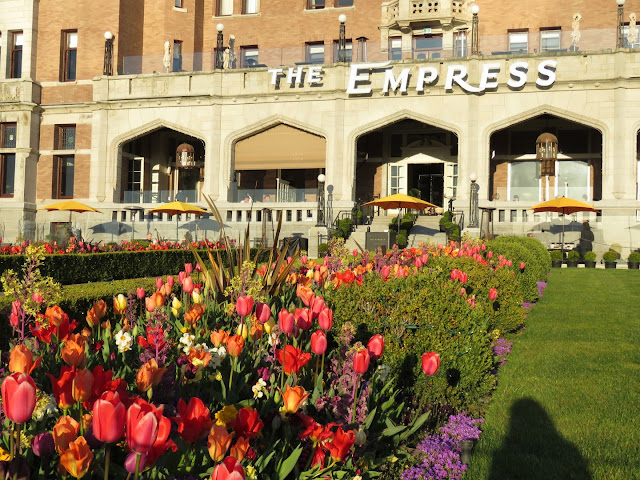
We did consider setting up our intended home base in Victoria, but, as much we loved it there, it was still too urban for us and we decided that being further afield would suit us better. However, we intend to visit often in future. Maybe we'll stay at the Empress, lovely any time of the year.


 photo arrow.pngCONTINUE READING

Sunday, 9 January 2022

After not posting for over a year, some of you may have missed the brief comment about a change of boat in my return to posting. So, in case you missed it, we have now sold (August 2021) boat #5, our 14m Reinke aluminium cruising sailboat and are now aboard boat #6, an 8m Nordic Tug 26, purchased June 2021.

Here she is: boat #6: a 1984 Nordic Tug 26, hull #59 of 184 built. Her name is also GJØA, our third.


I suppose that's enough news in itself, but, wait, it's not just boat #6, it's also our first motor boat, no sails! We've gone to "the dark side". Having said that, this new boat is a good boat, we hope, to enable us to do the type of cruising we want to do next. We probably won't be crossing oceans any more where sails are the only way to travel such long distances, but, we definitely want to coastal cruise, preferably in wild, remote places and perhaps along some more urban coasts as well. Cruising among intricate coastal channels doesn't provide much good sailing wind. We didn't raise our sails once when coming down the coast from Alaska. It seemed pointless to maintain sails and their critical, expensive supporting rig when they're used so rarely in our new type of cruising. Now that we're based on the "we[s]t" coast a motorboat also provides a warm, protected steering station at all times and the means to manage our speed at a consistent 6-7 knots.

General specs for the Nordic Tug 26 are:

LOA: 26 feet, 4 inches 
BEAM: 9 feet, 6 inches 
DRAFT: 2 feet, 9 inches 
WEIGHT: 7,500 pounds 
HULL TYPE: semi-displacement 
PROPULSION: single diesel 
BUILDER: Nordic Tugs, Burlington, Washington, nordictugs.com

Our particular model has a few nice, custom features such as a dry-stack exhaust (as seen on many fishing boats) which should require less maintenance than a typical wet exhaust. The engine is a Perkins 4-154, 62HP with 6475 hours (more than we would have liked). We expect to burn an economical 3-4 litres an hour at 6 knots providing an excellent range with our 100 (maybe 150? t.b.d.) gallon main tank.

The transition from a 14m (47 ft.) to 8m (26 ft.) boat to live on wasn't as difficult an adjustment as it might seem. No longer needing storage space for sails, world charts/cruising guides, four-season clothing, offshore equipment and extensive spares/food supplies, the smaller boat works well as a temporary home for two people and will more than suffice for an annual season spent out cruising.

There's no denying the boat is old and the maintenance had been let go, but, it had good bones. The initial viewing, survey and photos all looked good, but, as usual, after a closer look, we've noticed that there are a lot of things that really need to be addressed before we can have full confidence in the boat. The surveyor had noted that an urgent replacement of the shaft cooling through-hull needed to be done. So, first thing after taking possession we headed up to Sidney to get hauled out and do the repair. After we hauled out a leaking crack was also noticed in the bottom of the keel. It also had to be fixed immediately. This wasn't going well. Hopefully, not an indicator of things to come.

On the way back to Victoria we stopped at the always lovely Sidney Spit anchorage and enjoyed seeing our first purple martins. It helped to take our mind off the big bill we'd just paid for the keel and through-hull fix.


Unfortunately, as it turned out, there was more to come. Trying to leave the Spit anchorage we couldn't get the engine started and had to call C-Tow who also couldn't get us started. We were towed in to nearby Van Isle Marina. Now, it *really* wasn't going well, not what you want to happen on the first day out on a "new" boat. We had minimal tools aboard and had scant knowledge of the boat at this point, so, we called Ben at Gartside Marine Engines who went above and beyond to help. He came down to the boat well after his regular workday and quickly determined the starter had seized up. He took it out, sent it for a rebuild and had it back in the next day! We resumed our trip to Victoria wondering what we had got ourselves into with this boat.

Once we finally got to Victoria we kept our two boats side-by-side until we could make the changeover transition happen.


It was heart-wrenching to see our home of the last four+ years leave us standing on the dock on August 26 when she left for the USA on delivery to her new owners. We'd invested so much financially and emotionally it was very hard to see her go even though we knew it was the right decision.

A few days later, near Labour Day weekend, we headed off to our new chosen home base, Port Alberni. It would be our first real cruise in our new-to-us boat. We were a bit nervous heading out on an 8m (26 ft.) boat through the notorious Juan de Fuca Strait and up the exposed west coast of Vancouver Island where the ocean is wide-open all the way to Japan, the very definition of a lee shore. We weren't sure how this tiny boat (compared to our very capable ocean cruiser) would react in the inevitable ocean swell. But, we'd chosen our weather window well and we had perfect conditions. The boat performed admirably. We stopped the first night at Port Renfrew and made the push up to Bamfield on the second day. We didn't want to arrive in Port Alberni during their massive annual Labour Day weekend salmon fishing derby, so, enjoyed a couple of nights at anchor in delightful Bamfield watching a black bear foraging on the beach. We stopped another night at the Port Alberni Yacht Club outstation in the Broken Islands Group (a spectacular spot we plan to return to) before heading up the Alberni Inlet (a 40 km/25 mile long fjord) to Port Alberni. The fjord was very busy with many little sportfishing boats zipping up and down, but, they didn't detract from the beauty of the place. We arrived at Port Alberni in early afternoon. We had done it, changed boats, locations and life direction all in a few short months. It had been a busy summer!


 photo arrow.pngCONTINUE READING

Tuesday, 21 December 2021

If you're like me, when you've been following somebody's blog story for a while, maybe many years and posting just stops, permanently, it leaves you feeling a little bereft. They may be only 'friends in the cloud', but, somehow a connection is created and I miss them when they're not there. I would enjoy checking in every now and again to catch up. When there were no updates it made me wonder: Whatever happened to them? Where are they now? Are they ok? I often wish people would at least wrap up their story at a certain point and say goodbye instead of just doing a hard stop at a random place without a further word. I'm as guilty as the next person, it's actually been more than a year since I last posted here. Even worse, I suggested I would start writing again last spring and didn't. I don't really know how many people read this blog, there aren't many, but, I know there are a few and if you're one of those who was wondering 'whatever happened to them', well, we're still here and I'm planning at least a few more posts to bring our story up-to-date.

I always assumed I'd start posting again and I did think about posting a few times throughout the year, but, somehow there just never seemed to be anything interesting to say. It's not that there hasn't been a lot happening. There obviously hasn't been much on the travel front due to Covid, but, we've made a few major changes of direction (more on those later). 

I did toy with the idea of not continuing to write and actually questioned why I even write in the first place. This travel blog started in June 2010 when we became live-aboard cruisers on a sailboat. At the time it just seemed easier to post one update online that friends/family could choose to peruse at their leisure rather than repeat the same thing to multiple people in newsletters/email that maybe wouldn't always be welcome. It has stopped and started a few times, but, there are now about 280 posts. I'm finding they are often handy as an aide-mémoire and it's fun to dip into and relive past events, the details of which have long been forgotten. It also spurs the quest for better photographs as I have a place to publish them. There doesn't seem much point to photos unless you're going to share them. So, continuing to write seems worthwhile for a number of reasons and I hope you'll continue to follow along.

Now, on to a continuation of the story. Here's an overview of what happened this past year, details to follow.

Autumn - We arrived in Victoria BC a year ago September. Getting there had been our focus for the previous few years and we hadn't thought much beyond getting there. We'd been out cruising for a decade and wanted to take some time to re-evaluate our lifestyle. We quickly concluded that we'd been just about everywhere we wanted to go and Covid had stopped cruising sailors in their tracks anyway. Having a land base in BC seemed to be a good step for the future.


Winter - The decision to create a home base in BC having been made we plunged into trying to make it happen. We reviewed all the options and decided the best thing would be to build a new house. We applied a logical approach to finding the location and the lot. We chose Port Alberni as the location and we were lucky to find a lot for a reasonable price that met all our criteria. This photo was taken in March. This is what Vancouver Island looks like in winter!

Spring  - The next big decision was, what are we going to do about the boat? Having a world-class cruising boat isn't for the faint-hearted. It costs a lot of money and a lot of time and effort to keep it in fine fettle, safe and comfortable to travel the world's oceans. Sitting at a dock, or, just cruising locally in BC really was a waste of a good boat. We decided to sell it and spent many weeks preparing it for sale. Before we knew it, spring had arrived.

Summer - After we listed the boat for sale we started to get worried about becoming homeless. What if the boat sold quickly (it did) and the house wasn't ready (it wasn't).  We also knew we weren't giving up cruising, just probably not crossing oceans anymore, so, we decided to downsize to a smaller boat that was suitable for coastal cruising and that was comfortable enough to live on until the house was finished. We narrowed the choices down and then, through serendipity, a good boat popped up right in front of us and we bought it. We were now two boat owners, but, not for long. Gjoa departed for the USA to her new owners on August 27. A few days later, we (and our new-to-us boat) departed for Port Alberni. Here we are passing Race Rocks, just outside Victoria, at the entrance to Juan de Fuca Strait.

To be continued (I promise!).... 


 photo arrow.pngCONTINUE READING